A Vision of Eternal Grace
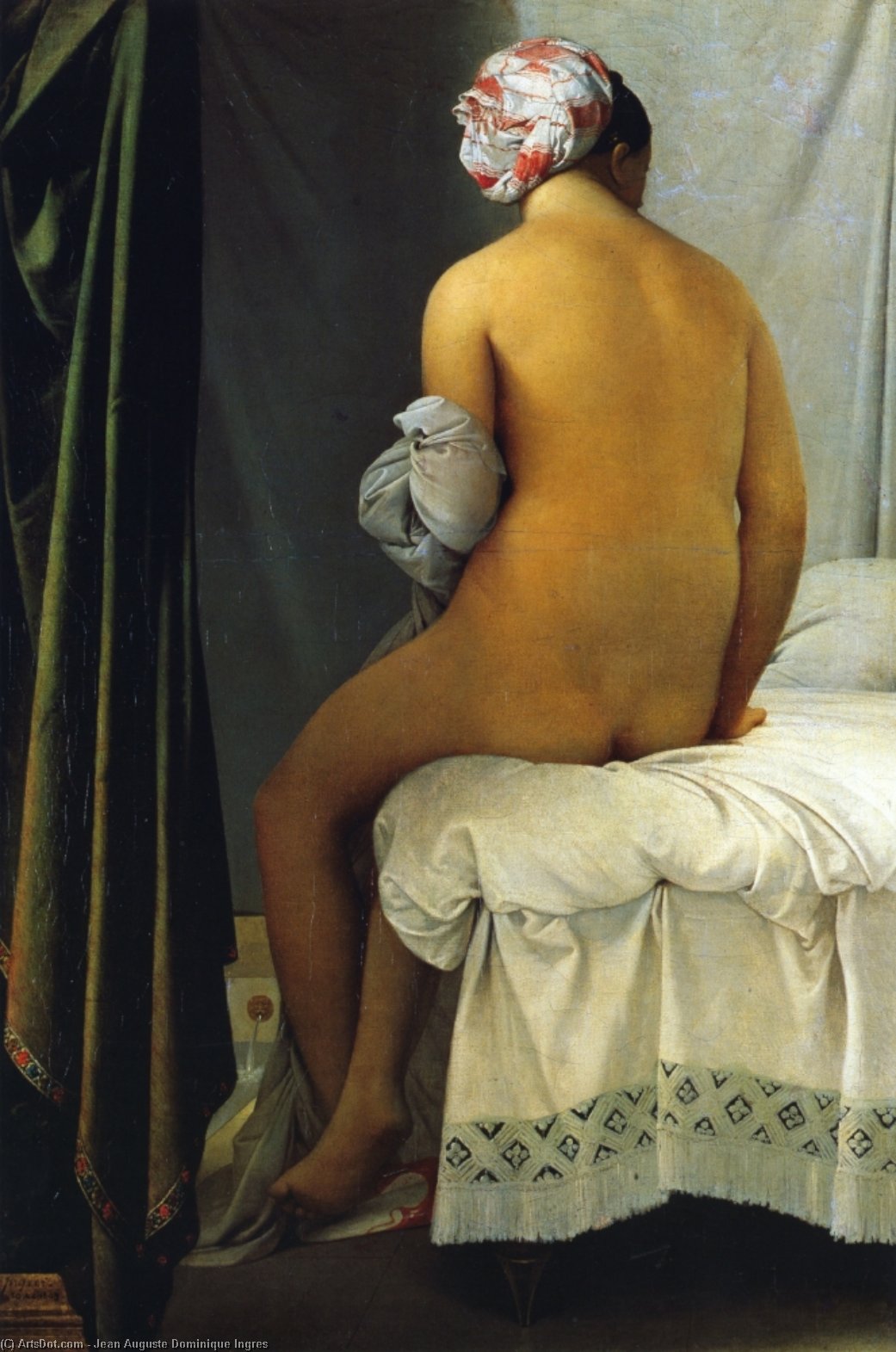
In the hallowed corridors of the Musée du Louvre, there exists a painting that captures not just a moment, but an entire philosophy of beauty. Jean-Auguste-Dominique Ingres’s 1808 masterpiece, La Grande Baigneuse—often celebrated as The Valpinçon Bather—stands as a monumental achievement of the Neoclassical era. At first glance, the viewer is met with the sight of a woman seated with her back turned, her form bathed in a soft, ethereal light that seems to emanous from within the canvas itself. This is not merely a depiction of a private moment of toilette; it is a profound meditation on stillness, purity, and the idealized human form. The subject, presented with an almost sculptural precision, invites the observer into a world where time slows down, allowing for a deep, contemplative engagement with the essence of feminine grace.
The composition is a masterclass in controlled elegance. By choosing to present the figure from behind, Ingres avoids the overt voyeurism often found in much of the era's genre painting, instead creating a sense of mystery and monumental dignity. The subtle twist of her torso and the smooth, uninterrupted lines of her back guide the eye across the canvas, emphasizing a rhythmic harmony that feels both ancient and timeless. This deliberate choice of perspective transforms the subject from an individual into an icon, a vessel for the classical ideals of beauty that Ingres so fervently championed throughout his illustrious career.
The Mastery of Line and Light
To behold this work is to witness the pinnacle of Neoclassical technique. Ingres was a titan of line, believing that the contour was the very soul of a painting. In La Grande Baigneuse, every edge is defined with an almost unnerving clarity, yet these boundaries are softened by his masterful use of sfumato. Through the painstaking blending of colors and subtle gradations of tone, he achieves a luminous quality that makes the skin appear to glow with a pearlescent sheen. This technical brilliance creates a tactile illusion; one can almost sense the warmth of the light hitting the smooth surface of the subject's skin.
The artist’s ability to manipulate light and shadow serves a purpose far beyond mere realism. It is used to sculpt the figure, giving her a three-dimensional presence that rivals the great marble statues of antiquity. The interplay between the bright, highlighted areas of the back and the gentle shadows pooling in the curves of the body creates a sense of depth and volume that is breathtaking. For the collector or the interior designer, this level of detail offers an unparalleled visual richness, making a high-quality reproduction a captivating focal point that brings a sense of sophisticated serenity to any curated space.
A Legacy for the Modern Collector
Beyond its technical prowess, La Grande Baigneuse carries a historical weight that resonates through the centuries. Painted while Ingres was studying in Rome, the work reflects his deep dialogue with the masters of the Renaissance and the classical traditions of Greece and Rome. It represents a period when art sought to capture a permanent, unchanging truth amidst a changing world. The painting’s emotional impact lies in this very stability—it offers a sanctuary of calm and perfection that remains deeply moving even in our modern, fast-paced era.
For those looking to elevate their surroundings with art that inspires awe and reflection, this piece serves as an exquisite choice. Whether placed in a grand salon or a quiet study, a reproduction of this masterpiece brings with it the prestige of the Louvre and the enduring spirit of Neoclassicism. It is more than decoration; it is an invitation to appreciate the sublime, a testament to the power of art to capture the elusive nature of beauty and hold it forever in a state of perfect, silent grace.