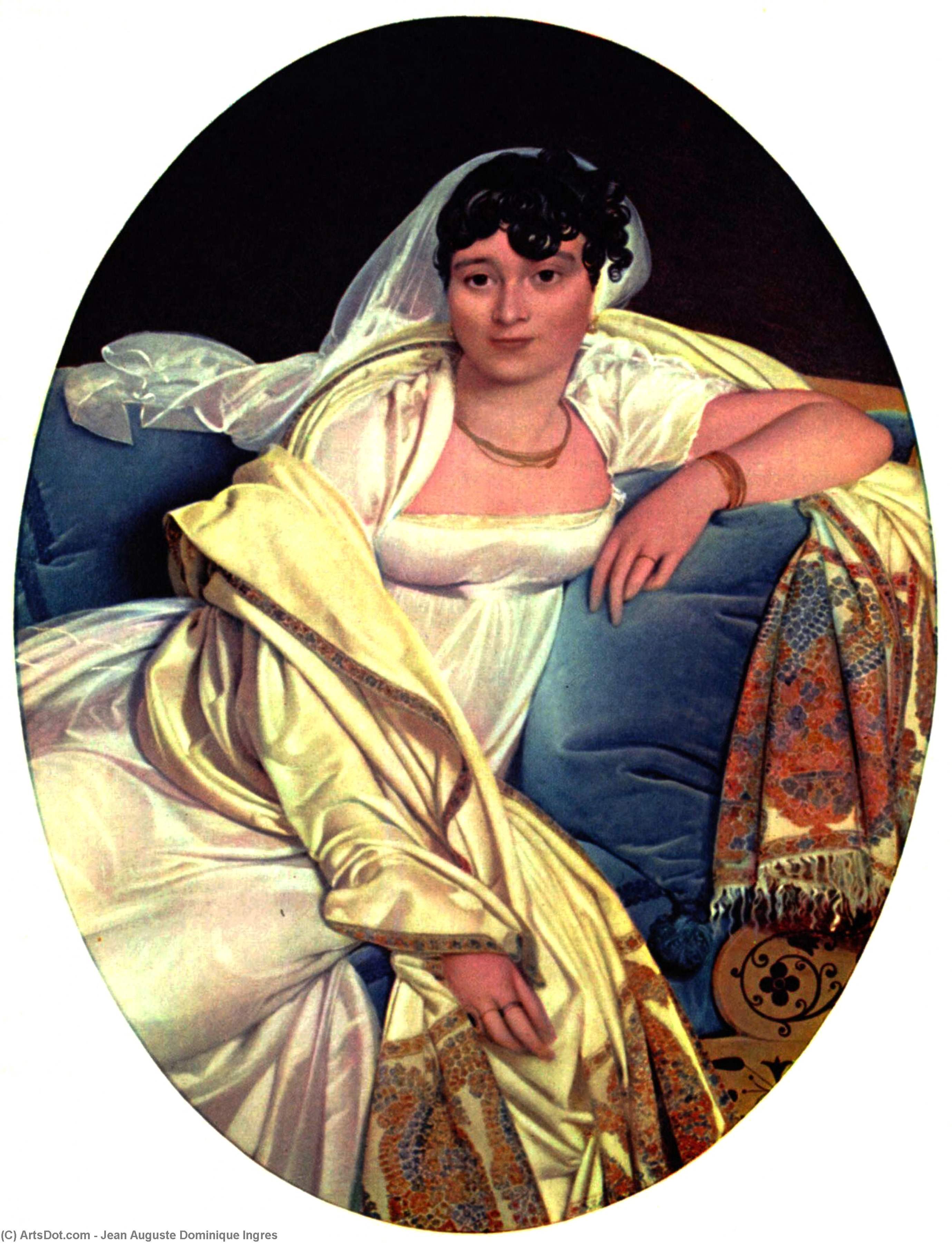
Marie-Francoise Rivière: A Neoclassical Portrait of Refined Elegance
- Artist: Jean-Auguste-Dominique Ingres
- Date: 1806
- Medium: Oil on Canvas
- Dimensions: 116 x 90 cm
- Location: Musée du Louvre, Paris, France
Artistic Context and Style
Jean-Auguste-Dominique Ingres (1780-1867) was a leading figure in the Neoclassical movement, which sought to revive the artistic ideals of ancient Greece and Rome. This style emphasized clarity, order, symmetry, and precision – qualities vividly displayed in "Marie-Francoise Rivière." Ingres’s work stands apart from the burgeoning Romanticism of his time, prioritizing meticulous draftsmanship and a focus on idealized forms over emotional intensity or dramatic narrative. His portraits, like this one, are celebrated for their technical mastery and ability to capture both physical likeness and an essence of character.
Composition and Technique
"Marie-Francoise Rivière" depicts the wife of a wealthy merchant seated gracefully on a couch. The composition is carefully balanced; Marie-Francoise’s pose exudes quiet confidence, her gaze directed slightly off-canvas, suggesting introspection. She wears a simple yet elegant white dress with a delicate blue veil, highlighting her refined beauty. The background features a soft blue hue that creates depth and tranquility. A gold necklace adds a touch of opulence, signifying her social standing. Ingres’s technique is characterized by smooth brushstrokes and precise detailing. He employed thin layers of oil paint (glazes) to achieve luminous effects and subtle gradations of color. The rendering of the fabrics – the sheen of the dress, the texture of the couch upholstery – demonstrates his exceptional skill in capturing surface qualities.
Symbolism and Emotional Impact
Beyond its aesthetic beauty, "Marie-Francoise Rivière" carries symbolic weight. The clock visible on the wall behind her subtly alludes to the passage of time and the fleeting nature of life. The carefully chosen attire – the white dress symbolizing purity and virtue, the gold necklace representing wealth and status – reflects the societal values of early 19th-century France. While seemingly serene, there's a hint of melancholy in Marie-Francoise’s expression, suggesting an underlying complexity beneath her composed exterior. The painting evokes a sense of timeless elegance and quiet dignity, inviting viewers to contemplate the subject's inner world.
Legacy and Influence
Ingres’s dedication to Neoclassical principles often drew criticism from those favoring Romanticism. However, his portraits remain highly regarded as masterpieces of their genre. His influence extended to later generations of artists, including Henri Matisse and Pablo Picasso, who admired his expressive distortions of form and space. "Marie-Francoise Rivière" stands as a testament to Ingres’s skill in capturing the essence of his subjects with precision and grace, solidifying his place as one of the most important figures in 19th-century art.