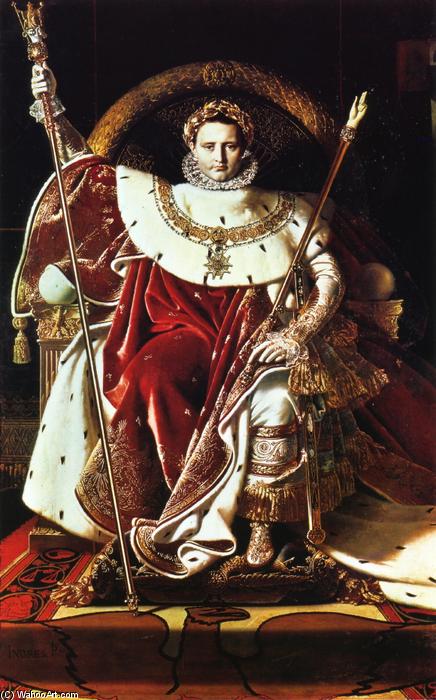
A Titan Ascendant: Ingres’ Napoleon as Jupiter Enthroned
The painting Napoleon as Jupiter Enthroned by Jean Auguste Dominique Ingres isn't merely an image; it’s a carefully constructed declaration of imperial grandeur, a distillation of Neoclassical ideals into a single breathtaking tableau. Completed in 1806 during the zenith of Napoleonic rule, this monumental canvas—measuring 259 x 162 cm and currently residing at the Musée de l'Armée in Paris—commands attention not just for its sheer scale but also for the profound artistic choices that underpin its enduring power. Ingres’ vision wasn’t simply to depict Napoleon; he sought to elevate him, transforming him into Jupiter, the Roman god of kingship, a deliberate gesture aimed at asserting France’s dominance on the European stage and solidifying Bonaparte's legacy as divine protector.
- Style & Technique: Ingres’ signature style—characterized by meticulous line work, smooth surfaces, and an almost sculptural quality—is evident throughout. He eschewed loose brushstrokes favored by Romantic painters, opting instead for a rigorously controlled technique that prioritized precision and idealized form. The painting utilizes oil on canvas with painstaking layering of glazes to achieve luminous tonal gradations and imbue the figures with an ethereal glow.
- Historical Context: Napoleon’s coronation in 1804 served as the catalyst for this ambitious project, reflecting the fervor surrounding the emperor's ascension to power and his ambition to emulate Roman imperial splendor. Ingres meticulously researched classical iconography and mythology, drawing inspiration from depictions of Jupiter enthroned—a motif that resonated deeply with notions of authority and divine legitimacy.
Symbolism & Composition: The painting’s composition is deliberately hierarchical, emphasizing Napoleon's central position on the throne. Above him floats a radiant aureole—a halo symbolizing divinity—further reinforcing his elevated status. The bird perched in the upper right corner represents wisdom and vigilance, guarding the emperor’s dominion. Ingres skillfully employs color to convey emotion; the dominant hues of gold and red evoke warmth, majesty, and regal splendor, creating an immersive experience for the viewer.
- Detailed Observation: Notice the exquisite rendering of Napoleon's robe—a testament to Ingres’ mastery of drapery—which cascades downwards in folds that appear to defy gravity. The meticulous attention to detail extends to every element of the scene, from the ornate throne to the subtle nuances of expression on Napoleon’s face.
- Emotional Resonance: Beyond its formal brilliance, Napoleon as Jupiter Enthroned possesses a palpable emotional resonance. It captures not only Napoleon's physical presence but also his inner conviction—his unwavering belief in his own righteousness and his determination to uphold the glory of Rome.
The painting continues to inspire awe and admiration centuries after its creation, serving as a cornerstone of Neoclassical art and a symbol of imperial ambition. Its enduring appeal lies in Ingres’ ability to transform historical grandeur into timeless beauty—a feat achieved through unwavering dedication to classical principles and an unparalleled command of artistic technique. A reproduction of Napoleon as Jupiter Enthroned would undoubtedly bring sophistication and elegance to any interior space, transporting viewers back to the opulent splendor of Napoleonic France.