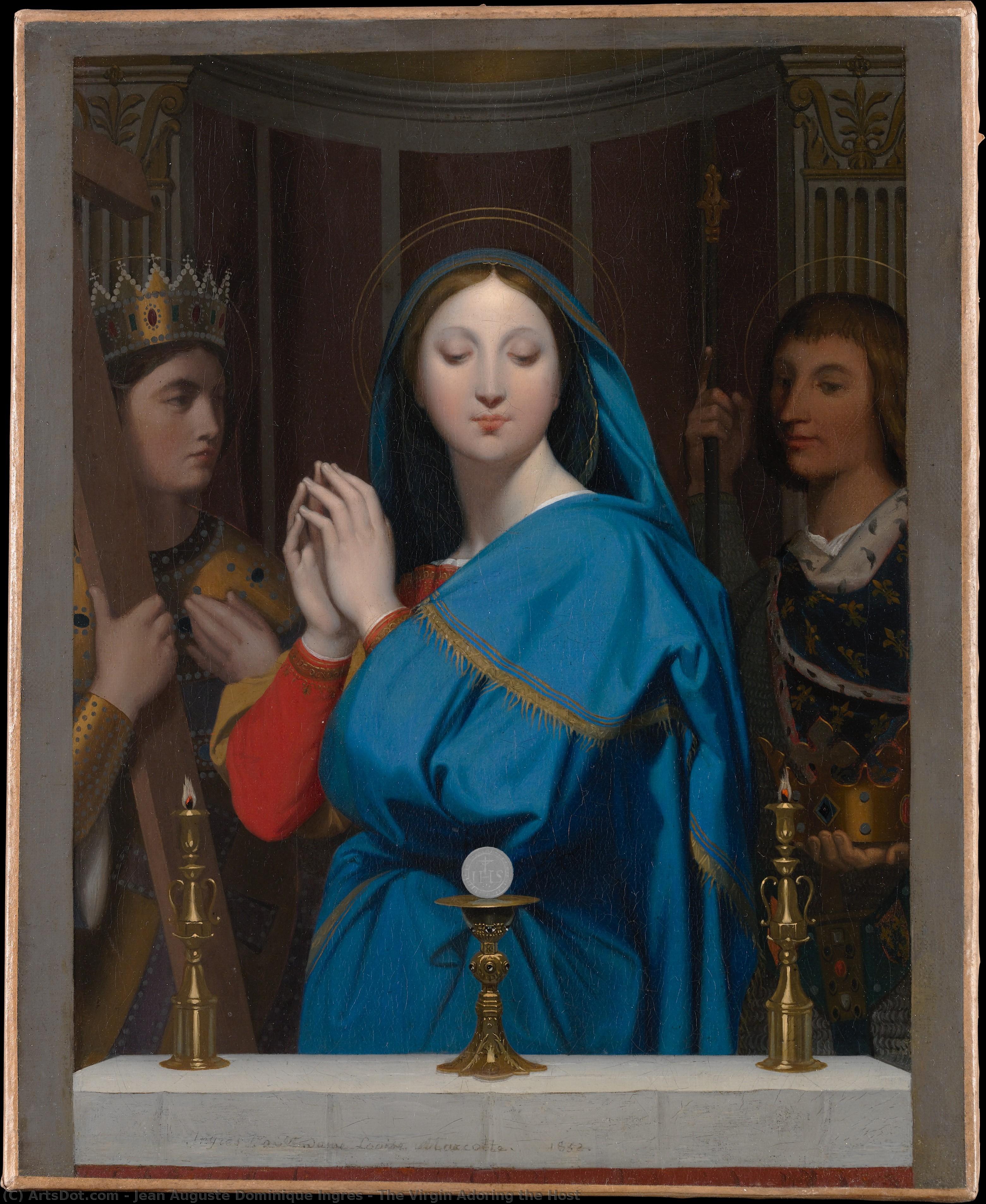
Ingres’s exquisite Virgin Adoring the Host captures the serene beauty of Neoclassical devotion, mirroring Raphael's iconic style and celebrating a timeless hymn to faith with meticulous line and form – explore this masterpiece.
Explore the neoclassical world of Jean-Auguste-Dominique Ingres (1780-1867). Discover his iconic portraits, historical paintings & lasting influence on art history at ArtsDot!
Explore The Metropolitan Museum of Art: 5,000 years of art from around the world! Discover masterpieces, ancient artifacts & immersive exhibitions – a global art destination awaits.
A Testament to Faith and Classical Elegance: Jean Auguste Dominique Ingres’s “The Virgin Adoring the Host”
Ingres's "The Virgin Adoring the Host," painted in 1852, stands as a poignant emblem of Romantic piety interwoven with the unwavering discipline of Neoclassicism. Presented as a gift to Louise Marcotte—a woman who would become his wife and muse—this diminutive devotional painting transcends mere representation; it embodies Ingres’s profound engagement with artistic tradition while simultaneously injecting a subtle personal touch. The artwork's intimate scale mirrors the spiritual fervor of its time, harking back to Raphael’s monumental frescoes in Rome, demonstrating Ingres’s deliberate homage to the stylistic grandeur of the Renaissance masters.
Style and Technique: Sculptural Precision Meets Delicate Detail
Ingres’s signature style is characterized by meticulous line work and a sculptural approach to form—a hallmark that distinguishes him from many of his contemporaries. He eschewed loose brushstrokes favored by Impressionists, opting instead for precise contours and carefully modeled surfaces that convey an astonishing sense of solidity and presence. The painting utilizes tempera on canvas, a technique known for its luminosity and durability, allowing Ingres to achieve remarkable tonal gradations and subtle nuances of color. Observe how the drapery folds are rendered with painstaking accuracy—each crease and ripple meticulously captured to create an illusion of three-dimensionality that is truly breathtaking.
Historical Context: Raphael’s Influence and Romantic Sentiment
The painting's genesis lies within a period marked by significant artistic upheaval, yet Ingres steadfastly adhered to classical principles. Raphael’s frescoes in the Vatican—particularly “The School of Athens”—served as an undeniable inspiration, influencing Ingres’s compositional choices and his unwavering commitment to idealized beauty. Simultaneously, however, the painting reflects the burgeoning Romantic sensibility of its era, expressed through a palpable reverence for religious iconography and a yearning for spiritual contemplation. The scene depicts Mary holding aloft the Eucharist—a central symbol of Christian faith—underscoring the importance of piety and devotion within French society during Ingres’s lifetime.
Symbolism: Reverence and Spiritual Reflection
Beyond its formal elegance, “The Virgin Adoring the Host” is laden with symbolic significance. The altar table symbolizes divine grace and holiness, while the saints flanking Mary represent spiritual guardianship and intercession. Their gaze directs towards the Eucharist—the consecrated bread—representing Christ’s sacrifice and offering salvation to humanity. Ingres's masterful depiction captures not only the visual splendor of the scene but also its profound emotional resonance, inviting viewers to contemplate themes of faith, humility, and divine love.
Emotional Impact: A Moment Frozen in Time
The painting’s subdued palette—dominated by blues and golds—contributes to its contemplative atmosphere. The soft lighting enhances the ethereal quality of the drapery and illuminates Mary's serene countenance, conveying a sense of tranquility and spiritual devotion. “The Virgin Adoring the Host” remains an enduring testament to Ingres’s artistic genius—a captivating artwork that continues to inspire admiration for its technical brilliance and its profound exploration of human emotion.