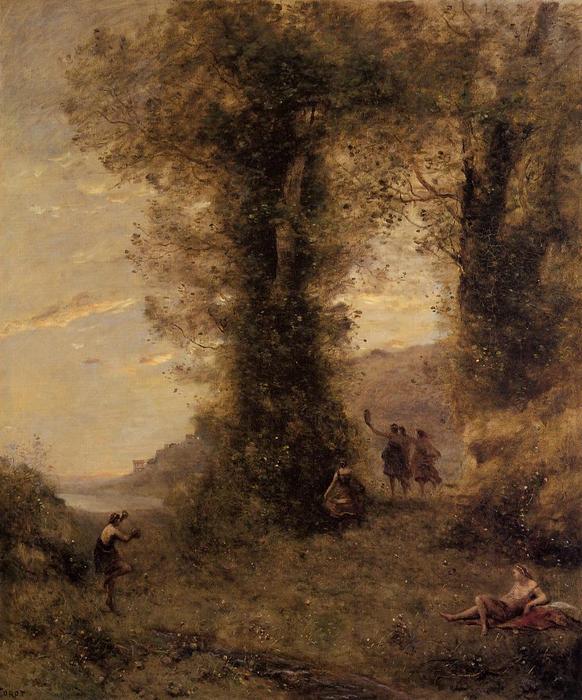
Explore Jean-Baptiste Corot’s ‘Pastorale,’ a Romantic oil painting of serene figures in a lush landscape. Discover its muted colors, expressive brushstrokes & timeless beauty.
Jean-Baptiste Camille Corot’s Pastoral Reverie
Jean-Baptiste Camille Corot (1796–1875), a luminary of Romantic landscape painting, stands as a testament to the enduring power of observation and emotion. Born into Parisian bourgeois comfort, his formative years spent immersed in rural tranquility—a stark contrast to urban life—fueled an artistic vision singularly focused on capturing the ethereal beauty of light and atmosphere. This early connection with nature would become the cornerstone of Corot’s oeuvre, shaping his distinctive style and cementing his place as one of France's most beloved artists.
- Subject Matter: The artwork depicts a serene pastoral scene—a meadow dotted with figures engaged in leisurely activities like dancing and resting. It’s not merely a depiction of scenery; it’s an invitation to contemplate the sublime harmony between humanity and the natural world.
- Style & Technique: Corot's approach aligns perfectly with Romantic ideals, prioritizing emotional resonance over precise realism. Employing loose brushstrokes—a hallmark of Impressionism—he achieves a palpable sense of movement and immediacy. The artist’s layering technique builds up texture and color, creating visible brushwork that conveys the roughness of the landscape and the materiality of pigment.
- Color Palette: Dominated by earthy hues – browns, greens, ochres – Corot's palette eschews vibrant colors for muted tones that evoke twilight or dawn. This deliberate restraint enhances the painting’s melancholic beauty and contributes to its dreamlike quality.
Romantic Vision & Artistic Innovation
Corot’s work represents a pivotal moment in artistic history, bridging the gap between Neoclassicism's formal rigor and the burgeoning Impressionist movement. Unlike his predecessors who sought to represent idealized forms with meticulous detail, Corot prioritized capturing fleeting impressions of light and color—a technique championed by artists like Claude Monet and Pierre-Auguste Renoir.
- Historical Context: Painted in 1873, ‘Pastorale’ reflects the Romantic sensibility prevalent during its time – a reaction against Enlightenment rationalism and an embrace of imagination and emotion. It aligns with the Barbizon School's emphasis on direct observation of nature as inspiration for artistic expression.
- Symbolism: The figures within the meadow can be interpreted as symbols of human joy and contemplation amidst the grandeur of the natural world. Corot’s deliberate use of perspective—flattened yet suggestive—further enhances this sense of timelessness, inviting viewers to lose themselves in the painting's tranquil atmosphere.
A Legacy of Atmospheric Beauty
Jean-Baptiste Camille Corot’s ‘Pastorale’ transcends mere visual representation; it communicates a profound emotional experience—a yearning for simplicity and connection with the natural world. His masterful technique, combined with his unwavering commitment to capturing light and atmosphere, continues to inspire artists and collectors alike. A reproduction of this iconic artwork offers an opportunity to bring Corot's poetic realism into your home, preserving its enduring beauty for generations to come.