The Genesis of Sorrow: Jean-Baptiste Greuze and "Boy with a Broken Egg"
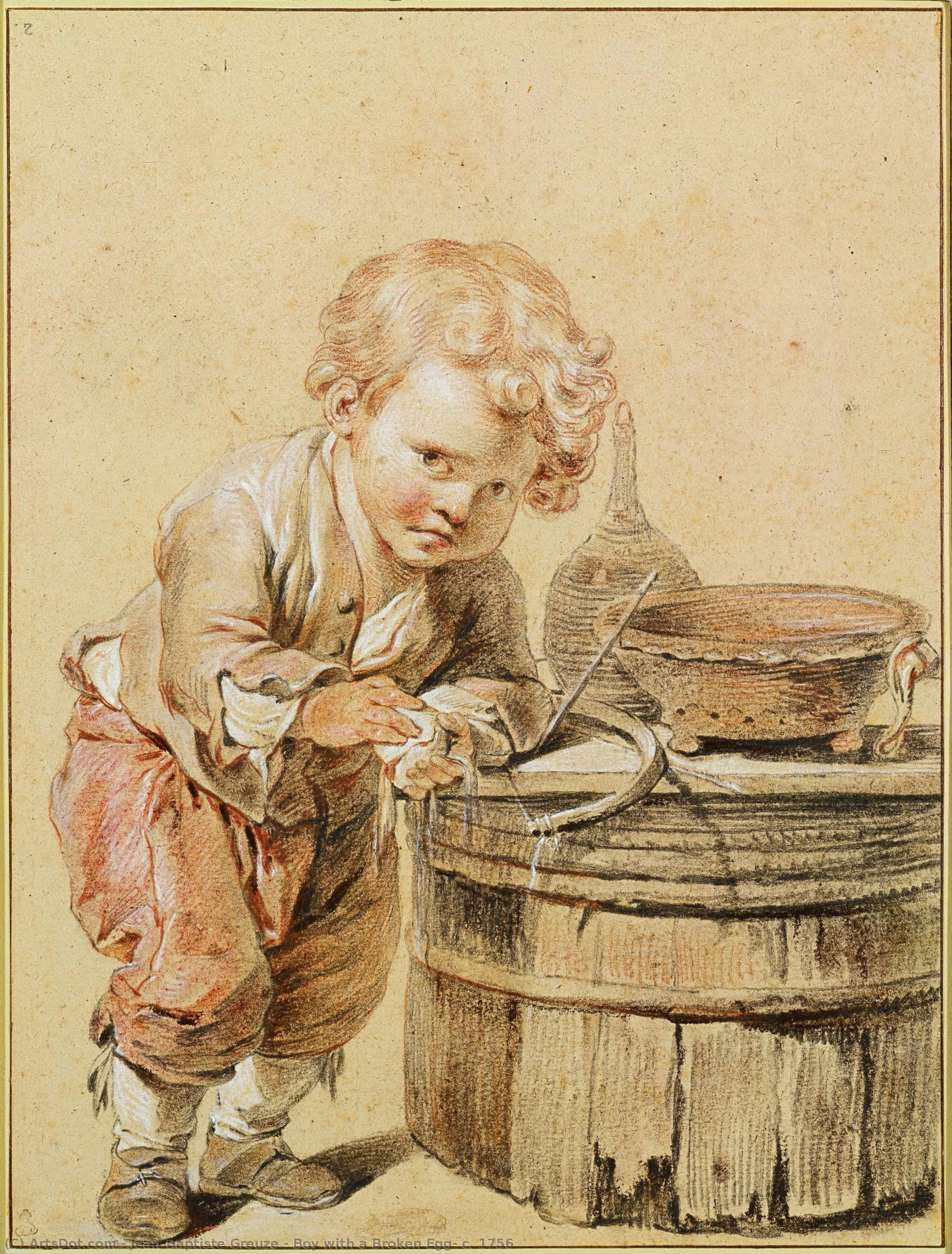
Jean-Baptiste Greuze's 1756 painting, “Boy with a Broken Egg,” isn’t merely a depiction of childhood mishap; it’s a meticulously crafted distillation of the burgeoning sentimentalism that defined late 18th-century French art. Born in Tournus, Burgundy, in 1725, Greuze rose from humble beginnings to become a master of capturing raw emotion – a skill he honed not through grand historical narratives or mythological allegories, but by focusing on the intimate dramas of everyday life. This particular work, housed within the Metropolitan Museum of Art in New York, exemplifies his signature style: a poignant blend of realism and heightened feeling, rendered with an almost unnerving directness.
The scene unfolds with quiet intensity. A young boy, perhaps no older than seven, stands beside a simple wooden barrel, his hand cradling a shattered egg – a single, heartbreaking symbol of loss. His gaze is fixed on the viewer, not with innocence or curiosity, but with a palpable sadness that seems to penetrate the canvas itself. Beside him, a young servant girl, her face etched with distress, attempts to salvage what remains of the broken shell, while a stern-faced woman – presumably his mother – watches with a mixture of disapproval and concern. The composition is deliberately uncluttered, drawing our attention solely to this small tableau of domestic sorrow.
A Palette of Emotion: Technique and Style
Greuze’s technique is characterized by its remarkable immediacy. He employed a rapid, almost sketch-like approach with black chalk and red chalk – a method that allowed him to capture fleeting expressions and intense emotions with astonishing speed. The lines are loose and expressive, conveying the urgency of the moment without resorting to elaborate detail. The color palette is muted, dominated by earthy tones—browns, grays, and ochres—which contribute to the painting’s somber mood. However, Greuze masterfully uses subtle shifts in value and texture to create a sense of depth and realism, particularly in the rendering of the boy's face – his eyes brimming with an almost unbearable sadness.
- Black Chalk: Used for outlining forms and creating sharp contrasts.
- Red Chalk: Employed for shading and adding warmth to certain areas, notably the boy’s skin.
- Loose Brushwork: Reflecting Greuze's desire to capture spontaneous emotion rather than meticulously rendered details.
Symbolism and Context: The Rise of Sentimentality
“Boy with a Broken Egg” is deeply rooted in the philosophical currents of its time. The 1750s witnessed a growing emphasis on sentiment – an appreciation for genuine emotion, particularly grief, compassion, and vulnerability. This shift away from the formal restraint of Neoclassicism was largely driven by the popularity of novels and plays that explored human psychology with unprecedented honesty. Greuze’s work perfectly embodies this trend, using simple scenes to evoke profound emotional responses in his audience.
The broken egg itself is a potent symbol – representing not just a lost object but also the loss of innocence, the fragility of childhood, and perhaps even the disruption of familial harmony. The boy’s direct gaze invites us into his sorrow, forcing us to confront our own capacity for empathy. Furthermore, the painting's creation coincided with significant historical events—the Seven Years' War—which fostered a climate of anxiety and uncertainty, contributing to the widespread interest in exploring human emotions.
A Legacy of Feeling: Greuze’s Enduring Impact
Jean-Baptiste Greuze’s influence on subsequent generations of artists is undeniable. He paved the way for the development of genre painting as a legitimate art form, demonstrating that profound emotional expression could be found in scenes from everyday life. “Boy with a Broken Egg” remains one of his most celebrated works, a testament to his extraordinary ability to capture the complexities of human feeling and his enduring contribution to the history of art. Reproductions of this poignant image continue to resonate with viewers today, reminding us of the universal power of sorrow and the importance of acknowledging our shared humanity.