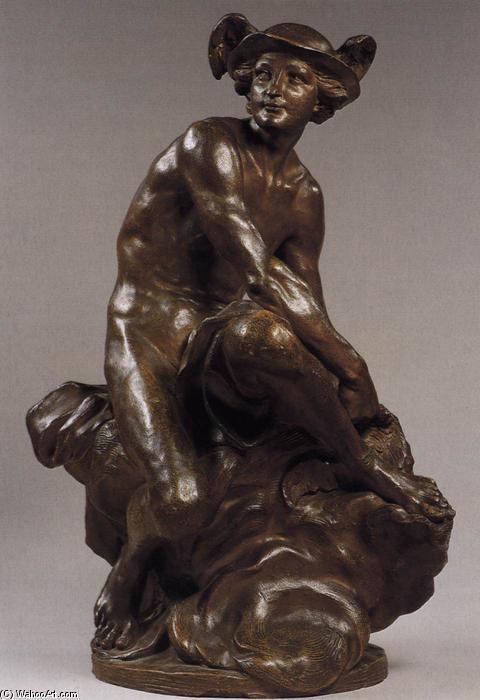
A Testament to Roman Mythology and Neoclassical Refinement: Jean Baptiste Pigalle’s Mercury
Jean-Baptiste Pigalle's sculpture, “Mercury Attaching his Winged Sandals,” stands as a cornerstone of French neoclassical art—a captivating embodiment of Roman mythology skillfully rendered in marble. Created in 1744, this masterpiece captures the essence of Hermes, the Greek god synonymous with swiftness and divine messenger, reflecting the artistic sensibilities of its time. The sculpture’s provenance traces back to the Royal Academy, where Pigalle honed his craft alongside luminaries like Nicolas Beauvais and Jean-François Vermeulen, establishing himself as a prominent figure within Parisian artistic circles.
- Subject Matter: The sculpture depicts Mercury in a dynamic pose—a deliberate choice mirroring depictions of Roman gods—as he meticulously secures his winged sandals to his feet. This gesture symbolizes Hermes’s role as a herald of divine will and the embodiment of speed, crucial attributes for conveying messages from Olympus to Earth.
- Style: Pigalle's work firmly anchors itself within the neoclassical movement, rejecting the exuberant ornamentation characteristic of Baroque sculpture in favor of restrained elegance and idealized form. The sculptor prioritized clarity of line and anatomical accuracy, adhering to principles championed by artists like Antonio Canova—a conscious effort to revive classical ideals after centuries of artistic experimentation.
- Technique: Crafted from Carrara marble – renowned for its purity and translucency – Pigalle employed meticulous carving techniques to achieve remarkable detail. The sculptor skillfully utilized chisels and hammers, combined with abrasives like sandpaper, to sculpt the marble into a form that captures both muscular definition and flowing drapery. This painstaking process resulted in a surface texture that subtly reflects light, enhancing the sculpture’s visual impact.
- Historical Context: Produced during Louis XV's reign, “Mercury Attaching his Winged Sandals” emerged from a period marked by intellectual revival and an obsession with reviving classical antiquity. The sculpture served as a symbol of royal patronage and reflected the broader cultural fascination with Roman history and mythology—a trend that profoundly influenced artistic production across Europe.
- Symbolism: Beyond its depiction of Hermes, the sculpture carries deeper symbolic significance. The winged sandals represent Hermes’s divine speed and ability to traverse vast distances instantaneously – a metaphor for communication and spiritual enlightenment. Furthermore, Mercury's posture conveys confidence and authority, reflecting the idealized virtues valued by neoclassicism—reason, order, and moral fortitude.
Discover this stunning artwork at ArtsDot.