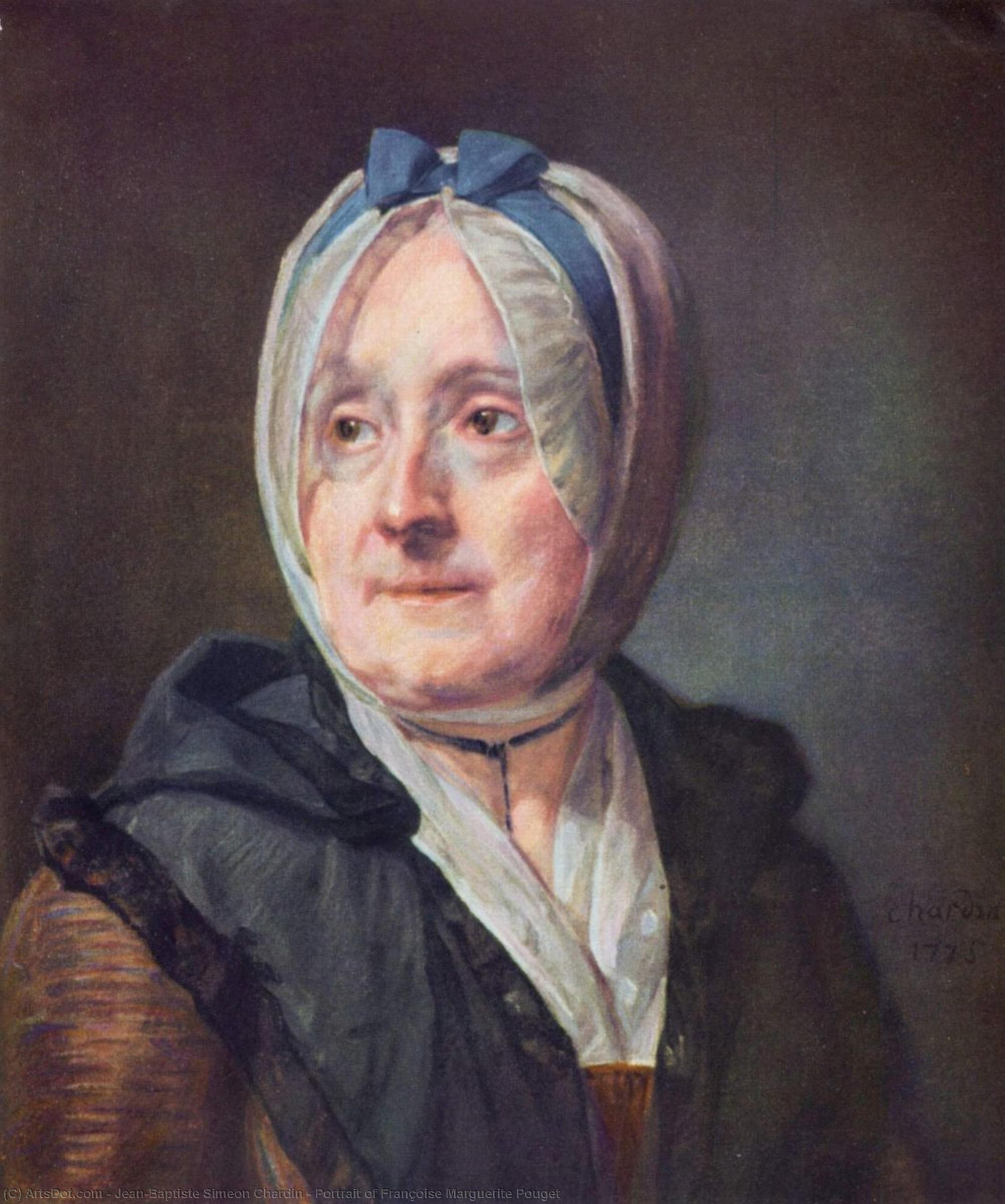
A Study in Dignity: The Quiet Presence of Françoise Marguerite Pouget
In the realm of 18th-century French portraiture, few masters could capture the profound essence of a human soul with as much restraint and tenderness as Jean-Baptiste-Siméon Chardin. His Portrait of Françoise Marguerite Pouget, painted in 1775, stands as a breathtaking testament to this ability. Rather than relying on the grandiosity or theatricality common in the Rococo era, Chardin invites us into an intimate encounter with an elderly woman whose very presence commands a quiet, contemplative respect. The composition is masterfully executed, positioning the subject slightly off-center to create a sense of natural movement within a static frame, drawing the viewer’s eye immediately to the weathered landscape of her face.
The technique employed in this work is nothing short of extraordinary, showcasing Chardin's unparalleled command over oil on canvas. Through meticulous brushwork and a sophisticated layering of pigments, he achieves a tactile reality that transcends the flat surface of the painting. One can almost feel the heavy weight of the wool, the delicate fragility of the lace, and the soft, papery texture of aging skin. The lighting is soft and diffused, acting as a gentle sculptor that carimently highlights the deep-set wrinkles and the wisdom etched into her features, while allowing the background to recede into a mysterious, velvety shadow. This interplay of light and dark creates a three-dimensional depth that breathes life into the subject.
The Beauty of the Mundane and the Eternal
Chardin’s palette is a masterclass in subtlety, eschewing vibrant, distracting hues in favor of a sophisticated arrangement of muted earth tones. Ochre, beige, grey, and deep browns dominate the canvas, creating an atmosphere of timelessness and stability. This choice of color does more than just ground the portrait in reality; it reinforces the symbolic weight of the subject. In this work, age is not depicted as a period of decline, but as a pinnacle of dignity and accumulated wisdom. The organic shapes of her bonnet and the soft folds of her garments harmonize with the natural contours of her face, suggesting a life lived in balance with the world around her.
For the discerning collector or interior designer, this portrait offers much more than mere decoration; it provides an emotional anchor for a space. Its understated elegance makes it a versatile masterpiece, capable of bringing a sense of historical depth and soulful tranquility to a modern study, a classic library, or a sophisticated living area. To possess a reproduction of such a piece is to invite the spirit of Chardin’s quiet observation into one's home—a reminder to find beauty in the subtle, the aged, and the everyday. It is an investment in an atmosphere of grace, inviting all who gaze upon it to pause, reflect, and appreciate the profound dignity found in the simplest of human truths.