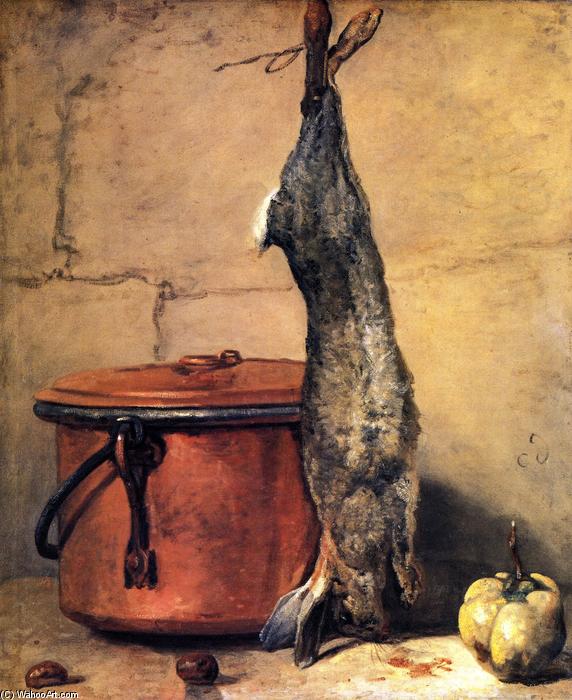
Jean-Baptiste Simeon Chardin’s “Rabbit with Copper Cauldron”: A Study in Quiet Observation
A single glance at Jean-Baptiste Simeon Chardin's "Rabbit with Copper Cauldron and Quince," completed in 1735, transports the viewer to a realm of understated beauty—a testament to the artist’s profound understanding of human experience and his revolutionary approach to still life painting. More than just an arrangement of objects on canvas; this artwork embodies a philosophy of seeing, capturing the essence of everyday life with remarkable sensitivity and precision.
Composition and Elements: A Deliberate Harmony
The painting's composition is remarkably simple yet powerfully effective. At its core lies a hare suspended from a hook, positioned above a copper cauldron containing a pot of water. Scattered around are two apples—one resting on the lower right corner, offering a splash of color against the muted tones of the wall—and a bowl filled with a spoon. This carefully considered arrangement isn’t merely decorative; it speaks to Chardin's belief that beauty resides in the ordinary. The artist meticulously crafted each element to contribute to the overall visual balance and narrative depth. Notice how the vertical line of the hook contrasts with the horizontal expanse of the wall, creating a dynamic interplay of shapes and lines.
Artistic Significance: Beyond Mere Representation
Chardin’s genius lay not in grand theatrical displays but in his ability to distill complex emotions into deceptively serene images. He championed a style characterized by meticulous realism—a technique that demanded an unwavering attention to detail and a masterful command of light and shadow. Unlike many artists of his time who sought to impress with opulent grandeur, Chardin prioritized capturing the subtle nuances of texture and color, mirroring the natural world with astonishing accuracy. His influence extended far beyond the confines of French painting; Pablo Picasso himself acknowledged Chardin’s profound impact on his own artistic vision, particularly in his exploration of still life as a vehicle for conveying psychological depth.
Historical Context: Reflecting Enlightenment Values
“Rabbit with Copper Cauldron” emerged during the Enlightenment—a period marked by intellectual curiosity and a burgeoning interest in scientific observation. However, Chardin’s art transcends mere historical context; it speaks to universal themes of mortality, contemplation, and the beauty inherent in the natural world. The painting reflects the prevailing aesthetic sensibilities of its time, favoring restraint and clarity over flamboyant ornamentation. It stands alongside other masterpieces from the era—such as Rembrandt's “The Night Watch”—demonstrating a shared commitment to portraying human experience with honesty and compassion.
Symbolism: Hints of Mortality and Tranquility
Beyond its visual appeal, "Rabbit with Copper Cauldron" carries symbolic weight. The hare, often associated with death and resurrection, serves as a poignant reminder of the cyclical nature of life—a theme subtly conveyed through Chardin’s masterful use of color and light. Similarly, the copper cauldron symbolizes purity and transformation, mirroring the artist's desire to elevate commonplace objects into symbols of profound contemplation. Ultimately, this artwork invites viewers to pause, observe, and appreciate the quiet beauty of existence—a legacy that continues to inspire artists and collectors alike.
- Artist: Jean-Baptiste Simeon Chardin
- Year Created: 1735
- Medium: Oil on Canvas
- Location: Nationalmuseum, Stockholm, Sweden
For a stunning high-quality reproduction of “Rabbit with Copper Cauldron,” visit ArtsDot.