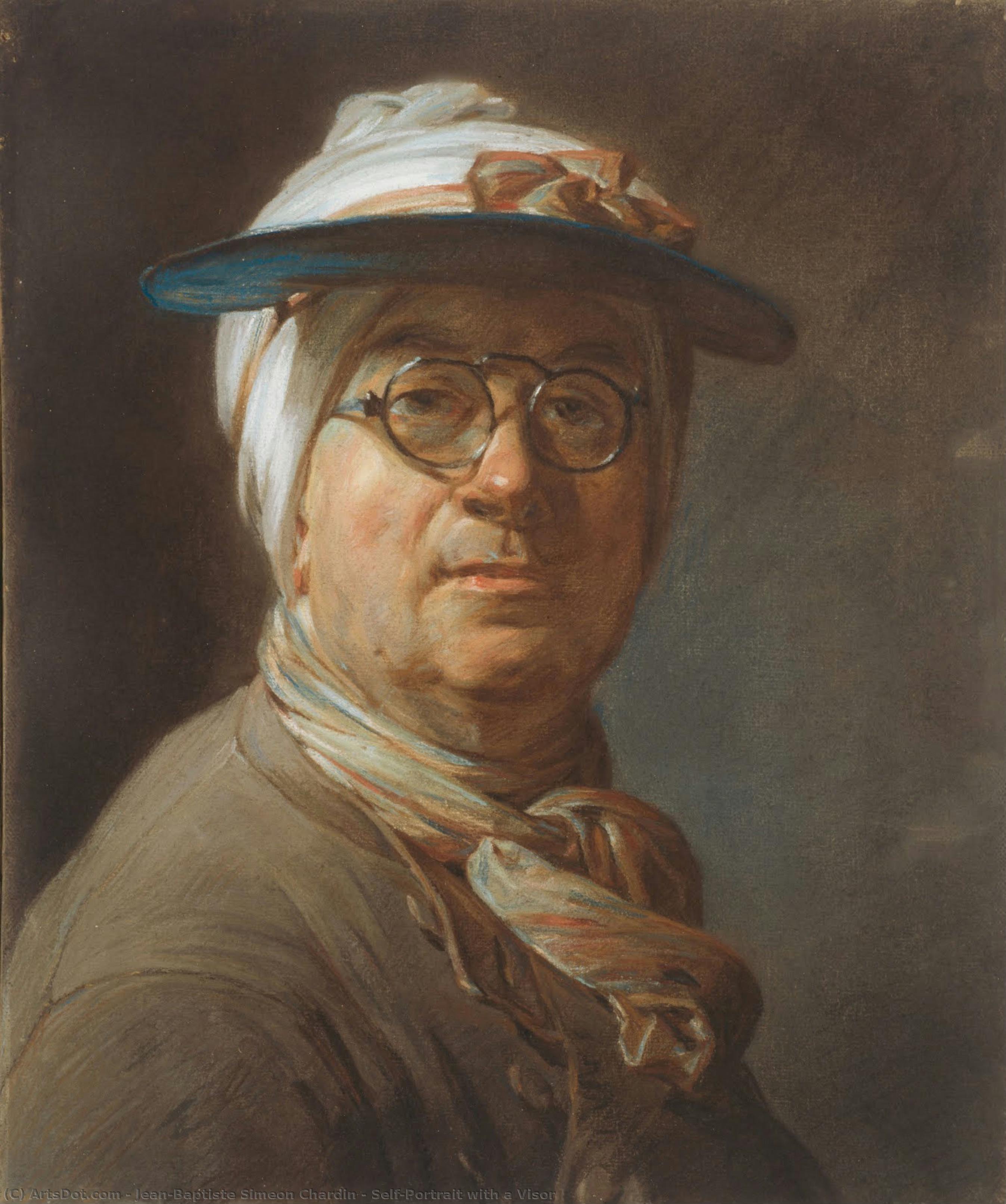
A captivating pastel self-portrait by Jean-Siméon Chardin, painted in 1776, showcases the aging artist's astute observation and joyful brushwork amidst a serene studio setting. Discover this timeless masterpiece and bring art home.
A Portrait of Reflection: Jean-Siméon Chardin’s ‘Self-Portrait with a Visor’
Jean-Baptiste-Siméon Chardin's “Self-Portrait with a Visor,” painted in 1776, stands as a poignant testament to the artist’s late career and a remarkable exploration of selfhood. Created during a period of profound artistic shift – a move from his celebrated still lifes to the intimate medium of pastel portraits – this work offers a rare glimpse into the mind of a master who dared to confront his own aging reflection. More than just a likeness, it's an embodiment of quiet contemplation and a subtle defiance of convention, reflecting Chardin’s unique approach to observing and representing the world around him.
- Subject & Composition: The painting depicts Chardin himself, a man nearing seventy, seated in his studio. His attire – a simple, casually dressed ensemble – speaks volumes about his rejection of aristocratic grandeur, aligning perfectly with his artistic philosophy rooted in everyday life. The composition is meticulously balanced, drawing the viewer’s eye to the artist's face and conveying a sense of dignified seriousness.
- Technique & Materials: Executed in pastel on paper, Chardin demonstrates a virtuoso command of this challenging medium. His brushstrokes are free and joyous, revealing a remarkable palette and an almost playful approach to color. The use of pastel allowed for subtle gradations and delicate modeling, enhancing the three-dimensionality of his figure.
A Window into a Changing Vision
The creation of this self-portrait coincided with a pivotal moment in Chardin’s career. His eyesight was deteriorating due to lead poisoning from his oil paints – a common occupational hazard at the time – forcing him to abandon his favored subject matter and experiment with new techniques. This shift is powerfully evident here; the rigorous construction of the figure, combined with the artist's intense gaze, suggests a deliberate effort to solidify his presence on canvas despite physical limitations. The portrait’s creation mirrors that of a similar work depicting his wife, highlighting a period of experimentation and replication for the artist.
- Historical Context: Painted during the Enlightenment, Chardin's art reflects a growing interest in individual experience and observation. His focus on domestic scenes and portraits offered a counterpoint to the grand narratives favored by court painters, emphasizing human emotion and connection over historical or mythological themes.
- The Louvre Connection: The portrait’s eventual reunion with its counterpart at the Musée du Louvre underscores its significance within Chardin's oeuvre and the art world’s history of dispersal and rediscovery.
Symbolism & Emotional Resonance
Beyond a simple self-portrait, “Self-Portrait with a Visor” is laden with symbolic meaning. The visor itself – a detail that adds to the painting's enigmatic quality – can be interpreted as a shield against the world, a barrier protecting the artist’s inner thoughts and observations. Chardin’s serious expression invites introspection, prompting viewers to consider themes of aging, self-awareness, and the quiet dignity of artistic endeavor. The inclusion of the handkerchief and glasses further emphasizes his vulnerability and the physical toll of his craft.
- Color Palette: The muted tones of pastel – predominantly browns, grays, and ochres – contribute to the painting’s somber yet harmonious mood, reflecting Chardin's mature style.
- Emotional Impact: The portrait evokes a sense of quiet contemplation and profound empathy, inviting viewers to connect with the artist’s personal journey and artistic vision.
Dimensions & Details
This meticulously hand-painted reproduction captures every nuance of Chardin's original masterpiece. The dimensions are 45 x 37 cm, making it ideal for a variety of interior spaces. This artwork is more than just a decoration; it’s an investment in art history and a celebration of one of France’s most beloved artists.