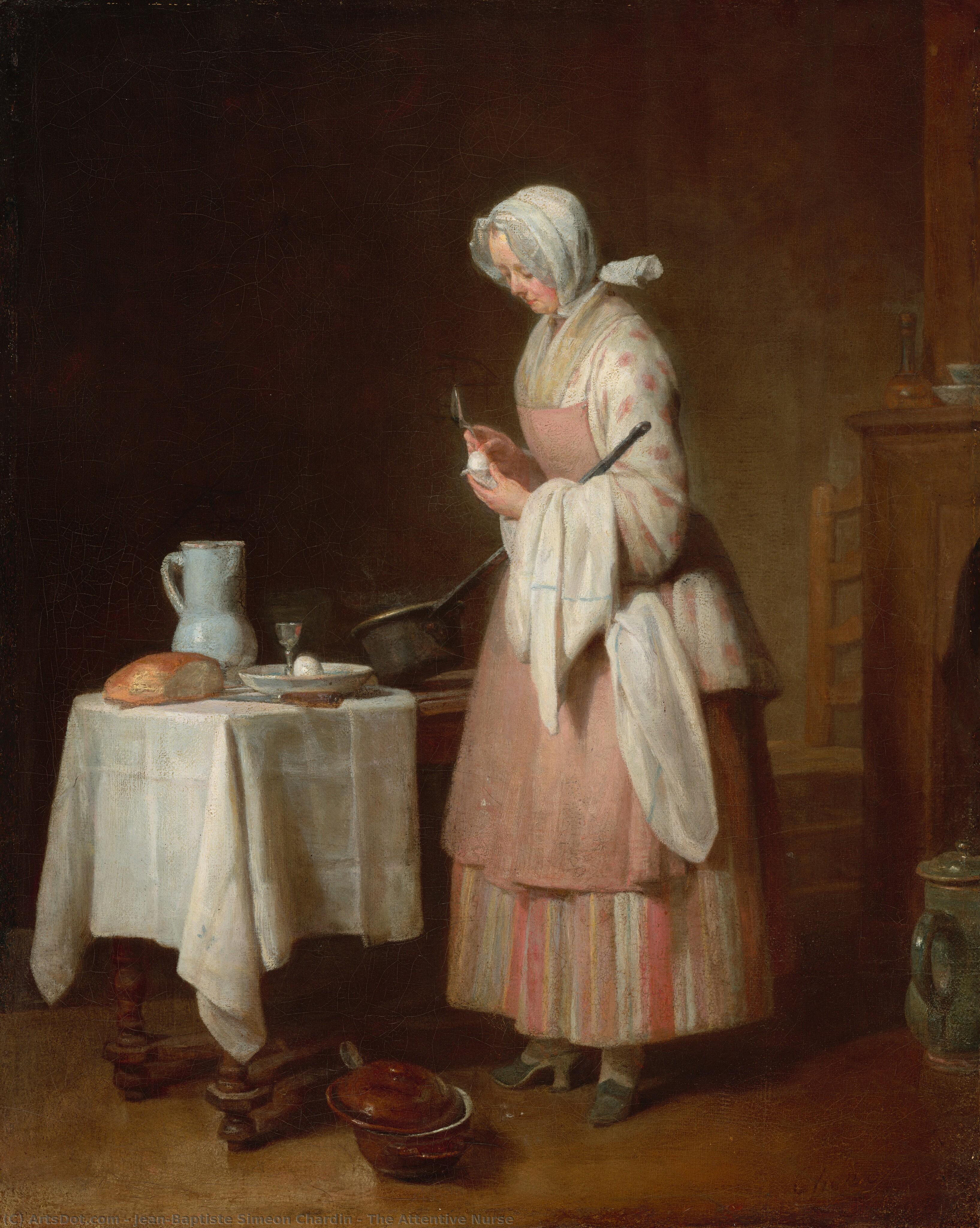
A Moment Frozen in Domestic Tranquility: Jean Baptiste Siméon Chardin’s “The Attentive Nurse”
Jean-Baptiste Siméon Chardin's "The Attentive Nurse," painted in 1747, transcends mere portraiture; it embodies a profound distillation of Enlightenment ideals—a celebration of simplicity, compassion, and the quiet dignity of everyday life. Executed in oil on canvas measuring 62 x 54 cm, this unassuming scene captures a woman preparing food within her home kitchen, offering an unparalleled glimpse into the domestic sphere during a period marked by intellectual ferment and artistic innovation. Chardin’s masterful technique—characterized by meticulous detail and subtle tonal gradations—allows him to convey not just what is seen but also what is felt. He eschews dramatic poses or opulent ornamentation, opting instead for a carefully constructed composition that prioritizes observation and psychological realism.
- Style & Technique: Chardin’s style aligns perfectly with Rococo sensibilities, yet distinguishes itself from the flamboyant excesses of its contemporaries. Unlike many artists of his time who sought to impress through grandeur, Chardin focused on capturing fleeting moments of human emotion—specifically tenderness and care—with remarkable accuracy. His brushstrokes are soft and blended, creating an illusion of luminous depth that imbues the canvas with a palpable warmth. The artist’s meticulous attention to texture is evident in the depiction of fabrics – the crisp linen of the nurse's apron contrasts beautifully with the velvety surface of the bread loaf and the smooth sheen of the pewter egg cup.
- Historical Context: Painted during Louis XV’s reign, “The Attentive Nurse” reflects the burgeoning interest in portraying ordinary subjects—particularly women—with dignity and respect. The Enlightenment championed reason and empirical observation, influencing artists like Chardin to move away from idealized representations of nobility and towards a more honest depiction of human experience. This painting speaks to the broader societal shift toward valuing domestic virtues and nurturing familial bonds.
- Symbolism & Composition: The carefully arranged objects within the kitchen—the loaf of bread, the pitcher, the eggs—are not merely decorative elements; they carry symbolic weight. They represent sustenance, fertility, and maternal care – concepts central to Enlightenment thought. The woman’s posture exudes calm composure as she attends to her tasks, embodying the virtues of patience and diligence. Her gaze is directed slightly off-center, inviting contemplation and fostering a connection with the viewer.
- Emotional Impact: Perhaps most powerfully, “The Attentive Nurse” evokes feelings of warmth, serenity, and empathy. Chardin’s ability to convey subtle psychological nuances—the tenderness in her eyes, the gentle curve of her hand cradling the pot—resonates deeply with viewers. It's a portrait not just of a woman but of an ideal – one devoted to nurturing and caring for those around her.
This artwork’s understated elegance continues to inspire interior designers seeking to create spaces that prioritize comfort, authenticity, and human connection. Its luminous palette—dominated by muted browns, creams, and pastel hues—harmoniously blends with natural light, fostering a sense of tranquility and inviting contemplation. A reproduction of “The Attentive Nurse” serves as a reminder that beauty can be found in the simplest of gestures and expressions – a timeless testament to Chardin’s genius and his enduring fascination with the human spirit.