A Moment Suspended in Time: The Quiet Dignity of Domestic Life
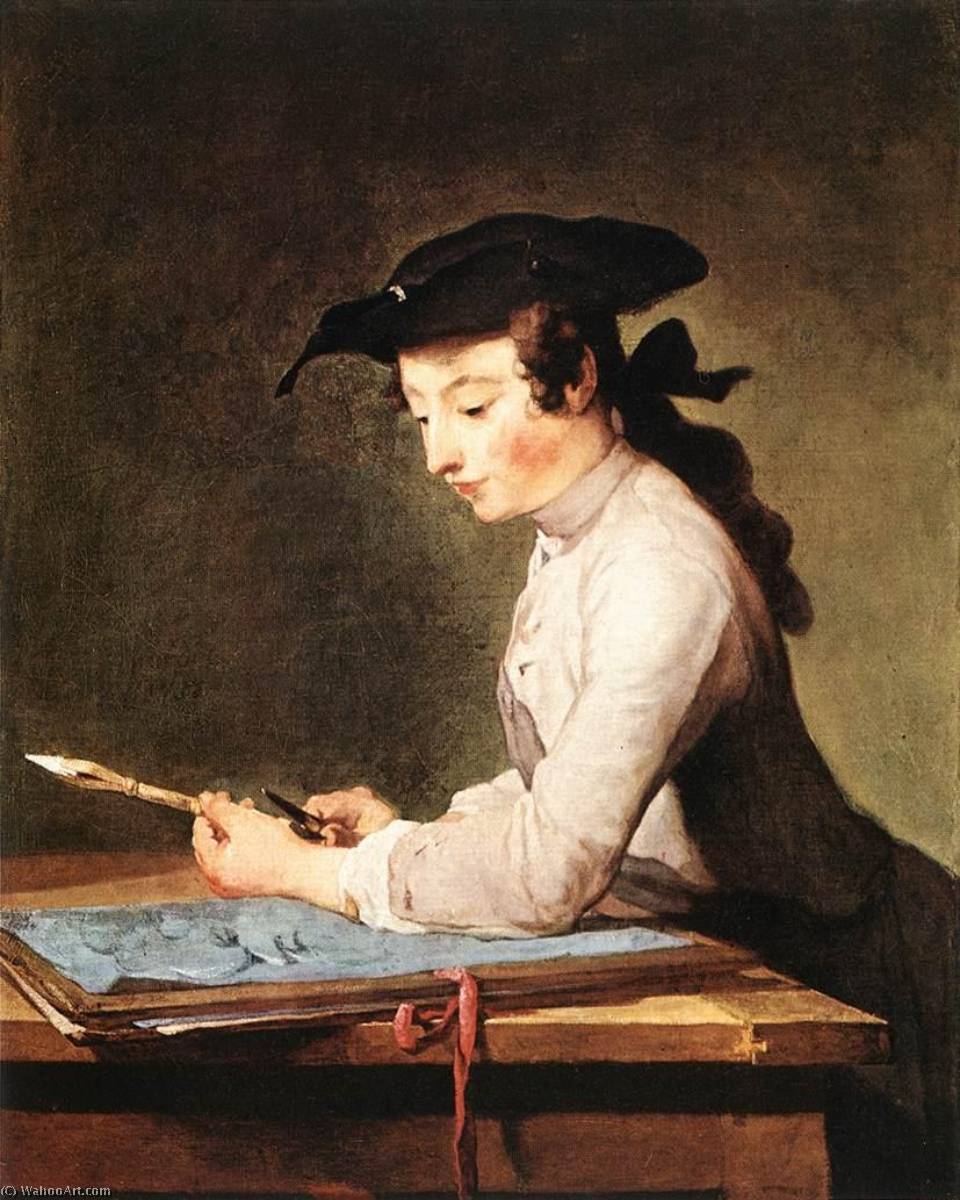
To gaze upon Jean-Baptiste-Siméon Chardin's The Draughtsman is to be invited into an intimate, hushed chamber where the passage of time seems to slow to a deliberate, contemplative rhythm. This portrait captures more than just a woman seated at a table; it arrests a moment of profound concentration. The subject, elegantly attired and poised with a piece of paper before her, embodies a quiet industry. Her focus is palpable—a delicate dance between the quill (or perhaps just the contemplation of the page) and the task at hand. Chardin, ever the master observer of the quotidian, elevates this simple act of writing or reading into an object of profound aesthetic consideration. The composition itself guides the eye across the carefully arranged props: the substantial books resting near the corner, the utilitarian gleam of the scissors nearby—each item seems imbued with a narrative weight, suggesting lives lived richly within the confines of domestic routine.
Mastery in Subtlety: Technique and Composition
Chardin’s technical brilliance here lies not in dramatic flourish, but in an almost breathtaking economy of means. His handling of light is masterful; it seems to emanate softly from an unseen source, gently illuminating the texture of her white shirt and casting subtle shadows that give depth to the tabletop. One can almost feel the velvety nap of the fabric or the smooth grain of the wood beneath her elbows. The palette itself speaks of restraint—earth tones, creamy whites, and muted accents—a characteristic signature that defines his genius. This restrained technique forces the viewer to look closer, rewarding sustained attention with revelations about texture, shadow, and the subtle interplay between light and material.
The Echoes of Rococo Intimacy
Dating from 1737, this work sits within the rich tapestry of the Rococo period, yet it subtly diverges from the era's typical excesses. While the Rococo often favored playful frivolity, Chardin anchors his vision in something far more enduring: human dignity. His approach strips away artifice to reveal the inherent beauty in the everyday objects and the focused spirit of the sitter. It is a genre scene elevated to high art—a testament to the profound poetry found within the domestic sphere. For those who appreciate art that speaks with quiet authority rather than booming pronouncements, this piece offers an unparalleled resonance.
Symbolism of Focus and Intellect
The symbolism woven into The Draughtsman is subtle but potent. The paper, the books, and the implements of writing are not mere props; they are symbols of intellect, learning, and communication. They suggest a life engaged in thought, in recording, and in understanding. The woman herself becomes an emblem of quiet competence—a portrait celebrating the power inherent in focused attention. Owning a reproduction of this piece is to invite that same atmosphere into your own space: one of calm contemplation, intellectual pursuit, and enduring grace.
Bringing the Salon Home
For collectors and interior designers alike, The Draughtsman offers an unparalleled opportunity to introduce sophisticated, historical depth without overwhelming a room. Its muted yet rich tonality allows it to harmonize beautifully with various décor schemes, whether classical or modern. It serves as a thoughtful anchor piece, drawing the eye into its quiet narrative. Reproducing this work allows you to possess a tangible connection to Chardin’s genius—a reminder that true beauty often resides in the most unassuming moments of our daily existence.