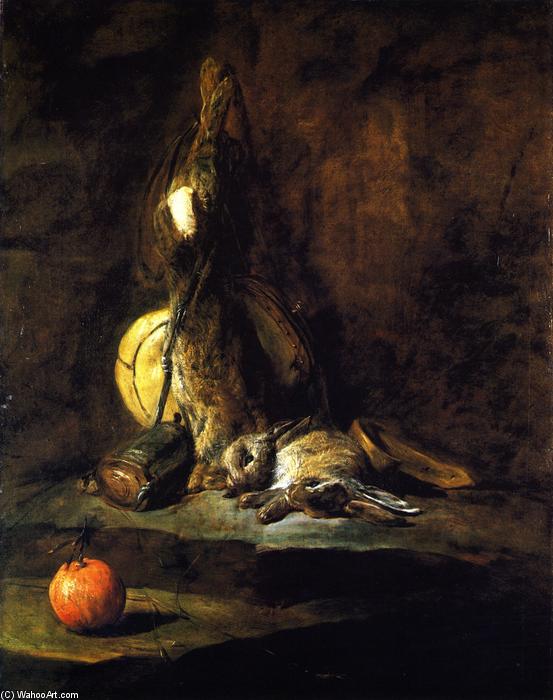
Discover Jean-Baptiste Chardin’s ‘Two Rabbits,’ a stunning Rococo still life masterpiece! Explore its symbolism, dramatic chiaroscuro & intricate details of this 1728 oil painting.
Discover Jean-Baptiste-Siméon Chardin’s serene still lifes & genre scenes capturing everyday life with quiet elegance and masterful detail. Explore his timeless art.
Experience the profound legacy of German masters like Dürer and Grünewald at Staatliche Kunsthalle Karlsruhe, where a stunning neoclassical building houses seven centuries of art history waiting for you to explore.
A Moment Frozen in Time: Exploring Chardin’s “Two Rabbits with Game Bag”
The painting "Two Rabbits with Game Bag," executed by Jean-Baptiste Simeon Chardin in 1728, transcends mere representation; it embodies the spirit of Rococo artistry and offers a poignant meditation on mortality rendered with breathtaking precision. Located at the Staatliche Kunsthalle in Karlsruhe, Germany, this oil on canvas masterpiece isn’t concerned with grand narratives or opulent displays—rather, it captures a single, arresting tableau: two rabbits nestled beside a game bag, powder flask, and a solitary orange pumpkin. This deceptively simple composition speaks volumes about Chardin's artistic vision and the broader cultural currents of his era.
The Rococo Aesthetic: Elegance Rooted in Restraint
Chardin’s style aligns seamlessly with the Rococo movement, which flourished in France during Louis XV’s reign. Unlike its predecessor, Baroque grandeur, Rococo prioritized delicacy, asymmetry, and a subtle interplay of light and shadow—qualities that Chardin masterfully achieved. The artist eschewed theatrical gestures and flamboyant ornamentation, favoring instead an understated elegance that sought to evoke emotion through nuanced observation. This restrained approach is evident in the muted palette dominated by earthy browns and yellows, punctuated by the vibrant orange of the pumpkin – a deliberate choice designed to draw attention without overwhelming the viewer’s senses.
Technical Mastery: Capturing Texture and Light
Chardin's technique exemplifies the meticulous craftsmanship characteristic of Dutch Golden Age painters who preceded him. He employed thick impasto—heavy brushstrokes laden with pigment—to sculpt the surfaces of the rabbits and their surroundings, creating a palpable sense of texture that invites tactile engagement. Crucially, Chardin harnessed the principles of chiaroscuro to illuminate the scene, casting deep shadows that accentuate form and enhancing the dramatic impact of the composition. The directional lighting emphasizes the contours of the animals’ bodies and highlights the subtle variations in color—a testament to Chardin's unparalleled ability to render naturalistic detail with remarkable sensitivity.
Symbolism Beyond Appearance: Death and Remembrance
The seemingly mundane objects adorning the canvas – the game bag, powder flask, and orange – carry profound symbolic weight. The game bag represents the pursuit of hunting, a pastime enjoyed by the aristocracy but also fraught with ethical considerations. The powder flask symbolizes preparation for action, mirroring the readiness to confront mortality. And the orange pumpkin, traditionally associated with abundance and prosperity, serves as a poignant counterpoint to the overarching theme of decay—a reminder that beauty can coexist alongside sorrow. Collectively, these elements invite contemplation on the cyclical nature of life and death and underscore Chardin’s humanist sensibility.
A Legacy of Quiet Beauty
“Two Rabbits with Game Bag” stands as an enduring emblem of Rococo artistry and a testament to Chardin's profound artistic legacy. Its understated elegance, coupled with its masterful execution and evocative symbolism, continues to inspire artists and collectors alike. High-quality reproductions are available at ArtsDot.com, allowing admirers worldwide to experience the captivating beauty and contemplative spirit of this iconic artwork—a timeless masterpiece that captures a fleeting moment frozen in time.