Jean-Édouard Vuillard’s “Interior with a Screen”: A Study in Quietude and Color
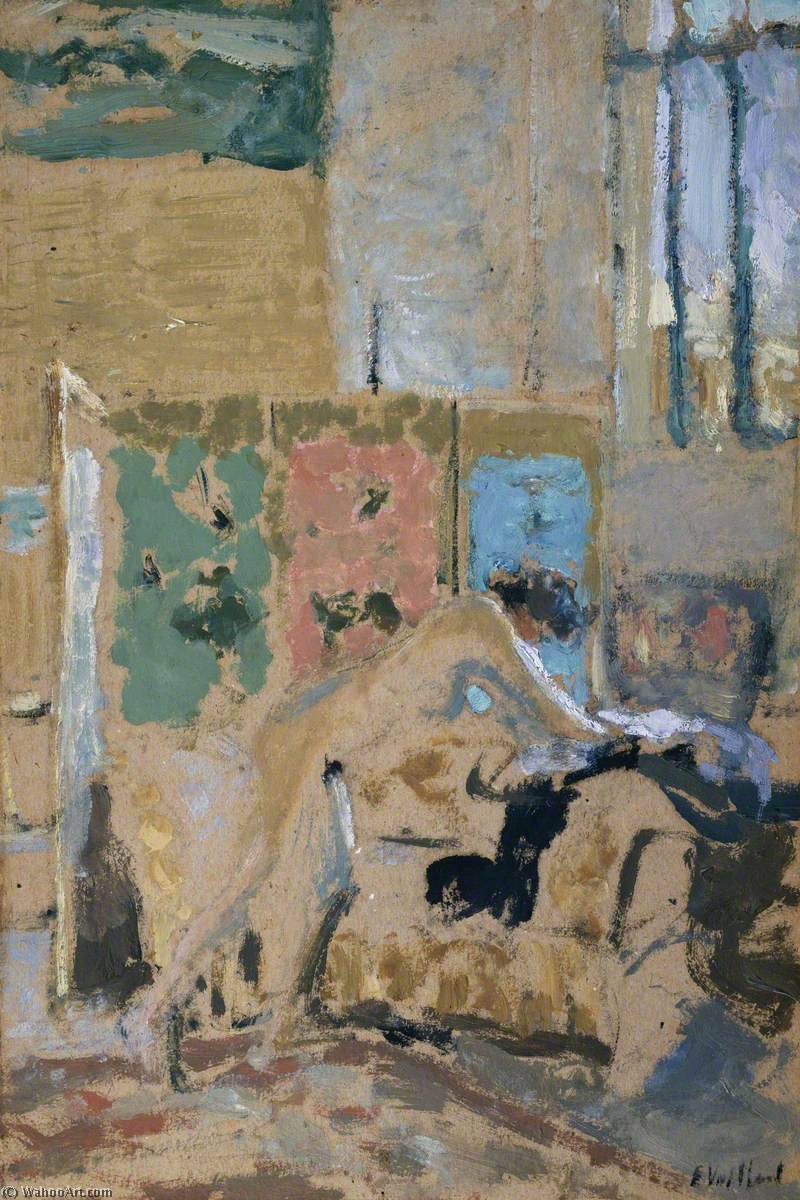
Jean-Édouard Vuillard's "Interior with a Screen," painted in 1909-1910, isn’t merely a depiction of a room; it’s an immersion into a carefully constructed world of muted tones, subtle shifts in light, and the quiet contemplation of domestic life. Belonging to the influential Nabis group—a collective that sought to liberate color from academic constraints—Vuillard masterfully employs flattened planes of pigment and a deliberate lack of sharp detail to evoke a profound sense of stillness and intimacy. The painting’s power lies not in dramatic narrative, but in its ability to capture a fleeting moment of serene observation within the confines of a private space.
The scene unfolds within a modestly furnished room, dominated by a dark screen that serves as both a visual barrier and a focal point. A woman sits on a sofa, her posture relaxed yet attentive, seemingly lost in thought. A man stands near the left side of the room, while another figure is partially visible further back on the right – suggesting a shared moment, perhaps a conversation or simply an awareness of each other’s presence. The furniture—a table, chairs, and a small lamp—is rendered with a gentle softness, their forms dissolving into the surrounding color field. Vuillard's technique eschews precise rendering; instead, he utilizes loose brushstrokes and overlapping washes of color to create an atmospheric effect, prioritizing the *feeling* of space over strict topographical accuracy.
The Nabis Aesthetic: Color as a Language
Understanding Vuillard’s work requires acknowledging his membership within the Nabis movement. Emerging in the late 1880s, the Nabis—meaning “prophets” – sought to revolutionize painting by rejecting traditional academic styles and embracing a more subjective approach to color. Inspired by Japanese prints, particularly their use of bold colors applied flatly to the surface, Vuillard and his fellow Nabis explored the expressive potential of pure color as a primary language. They deliberately avoided creating illusions of depth or perspective, opting instead for a flattened picture plane that emphasized the visual experience itself. “Interior with a Screen” exemplifies this approach perfectly; the colors—ranging from deep blues and greens to pale yellows and pinks—are not meant to represent reality but rather to convey mood and atmosphere.
Vuillard’s palette is remarkably restrained, dominated by cool tones that contribute to the painting's overall sense of tranquility. The use of complementary colors – such as blue and orange – creates subtle visual tension, adding a layer of complexity beneath the surface serenity. Notice how the light, filtered through the window, casts soft shadows across the room, further enhancing the feeling of intimacy and quiet contemplation. The artist’s masterful control over color allows him to create a remarkably luminous effect, despite the predominantly subdued palette.
Symbolism and Emotional Resonance
While seemingly simple in its composition, “Interior with a Screen” is rich in symbolic meaning. The screen itself can be interpreted as a barrier—both physical and psychological—that separates the figures from the outside world. It suggests a desire for privacy, introspection, and perhaps even a retreat from the complexities of modern life. The woman’s posture – relaxed yet attentive – hints at a state of quiet contemplation, while the presence of two figures suggests a shared experience or connection.
Beyond its specific details, the painting evokes a profound sense of melancholy and nostalgia. Vuillard's work often captures fleeting moments of beauty and tranquility—moments that are both deeply personal and universally relatable. “Interior with a Screen” invites us to pause, reflect, and appreciate the simple pleasures of domestic life. It’s a testament to Vuillard’s ability to transform ordinary scenes into works of art that resonate emotionally long after we've turned away from them.
Historical Context & Reproduction
Painted in 1910, “Interior with a Screen” reflects the changing artistic landscape of early 20th-century France. The painting’s emphasis on color and form foreshadowed the developments of Cubism and other modern movements. The Courtauld Gallery Collection Online provides valuable insight into this piece, detailing its provenance and highlighting Vuillard's place within the broader context of Nabis art (https://gallerycollections.courtauld.ac.uk/object-p-1948-sc-481). Reproductions, such as those offered by King & McGaw (https://www.kingandmcgaw.com/prints/edouard-vuillard/interior-with-a-screen-1909-1910-471674), allow viewers to experience the painting’s subtle nuances and delicate color harmonies in their own homes, bringing a touch of Vuillard's quiet beauty into any space.