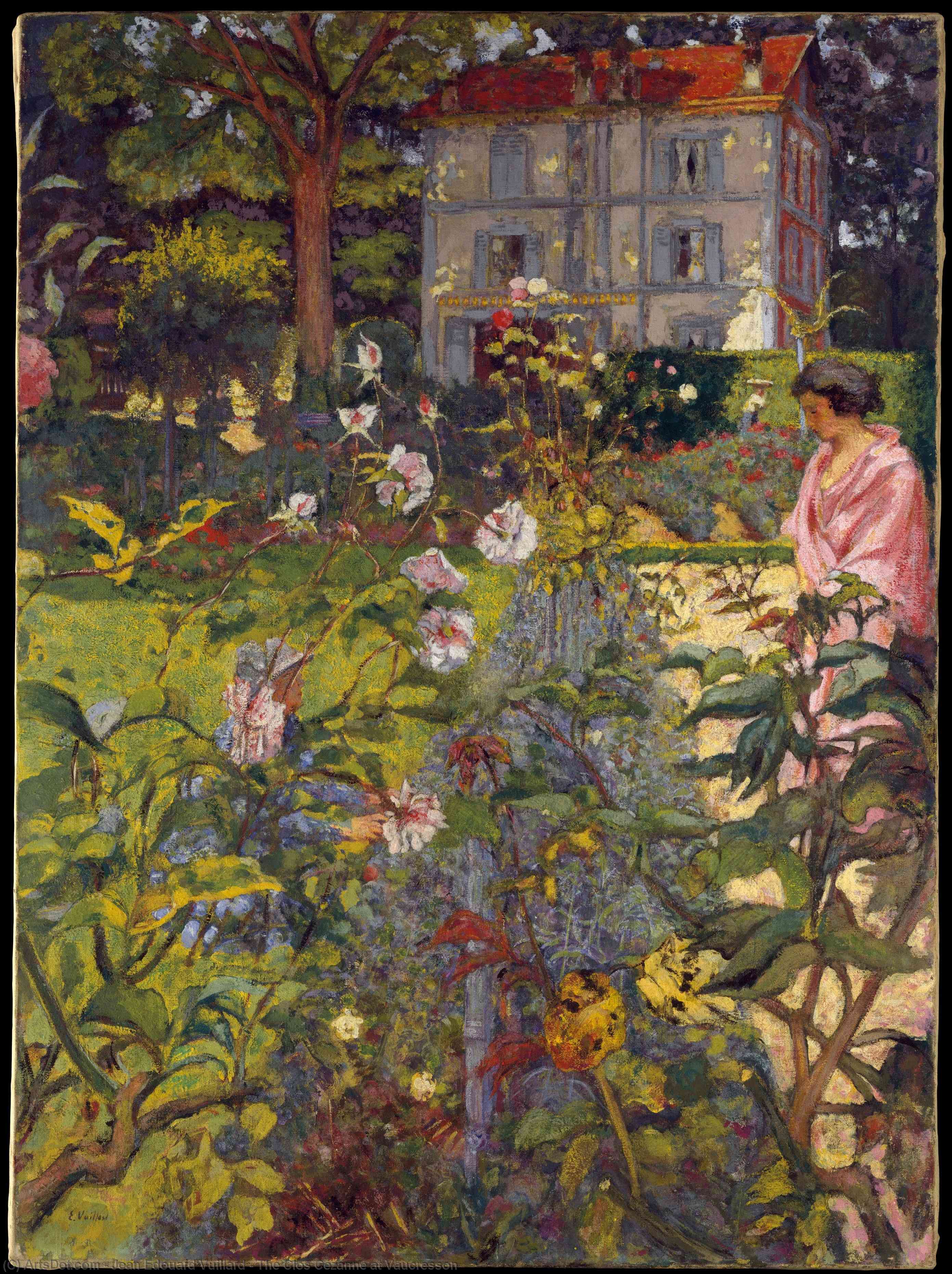
A Moment of Quiet Reverie: Jean Edouard Vuillard's *The Clos Cézanne at Vaucresson*
Jean Edouard Vuillard’s The Clos Cézanne at Vaucresson, painted in 1920, is more than just a depiction of a garden; it’s an immersion into a carefully constructed world of muted color and serene contemplation. This exquisite work, characteristic of Vuillard's mature style, offers a glimpse into the heart of the Nabis movement – a group of French artists who sought to elevate painting to a spiritual experience through the manipulation of color and form. The scene unfolds with a quiet grace: a woman stands poised before a charming house nestled within a riotous garden, seemingly lost in the beauty of the surrounding flora. It’s a tableau that speaks volumes about the pursuit of harmony between humanity and nature, a theme central to Vuillard's artistic vision.
- Subject Matter: The painting centers on a domestic interior – a woman within a garden setting – a frequent motif in Vuillard’s oeuvre. This focus on intimate scenes, particularly those of leisure and quiet observation, distinguishes him from the grand historical or mythological subjects favored by many of his contemporaries.
- Style & Movement: As an exemplary work of Post-Impressionism and firmly rooted within the Nabis movement, *The Clos Cézanne at Vaucresson* exemplifies Vuillard’s unique approach to color and form. He moved beyond Impressionistic attempts to capture fleeting moments of light, instead prioritizing a deliberate, almost architectural arrangement of color that aimed to evoke emotion and atmosphere.
Technique & Materials: A Masterclass in Atmospheric Painting
Vuillard’s meticulous technique is immediately apparent upon close inspection. Executed in fresco – a method involving the application of pigments to wet plaster – this painting demonstrates remarkable durability and richness of color. The loose, almost blurred brushstrokes create an incredibly soft and atmospheric effect, blurring the lines between reality and dream. The artist skillfully layered colors, building up depth and texture through subtle variations in tone and hue. Notice how the foliage isn’t rendered with photographic precision but rather as a symphony of greens, yellows, and browns, each shade carefully blended to create an illusion of shimmering light and shadow. The use of oil paints on canvas contributes significantly to the painting's luminous quality, allowing for a delicate handling of color that is both vibrant and restrained.
Historical Context & Influences
*The Clos Cézanne at Vaucresson* was created during a period when Vuillard was increasingly focused on realism, responding to influences from artists like Paul Gauguin. His work reflects the Nabis’ fascination with Japanese prints – particularly their flattened planes of color and simplified forms – which profoundly impacted his approach to spatial representation. The influence of Japanese art is evident in the painting's composition, where elements are arranged to create a sense of depth and perspective through carefully controlled color relationships rather than traditional linear techniques. Furthermore, Vuillard’s decorative work—including theater sets and interior panels—demonstrates his versatility as an artist and his ability to translate aesthetic principles into tangible objects.
Symbolism & Emotional Impact
Beyond its formal qualities, *The Clos Cézanne at Vaucresson* is imbued with a quiet sense of symbolism. The woman’s activity – tending to the flowers – represents care, nurturing, and an appreciation for beauty. The house itself, with its distinctive red roof, provides a grounding element, suggesting stability and domestic tranquility. The overall effect is one of profound serenity and contemplation. Vuillard invites us to share in this moment of quiet observation, encouraging us to find solace and inspiration in the simple pleasures of nature. This painting resonates with a timeless quality, offering a refuge from the complexities of modern life.