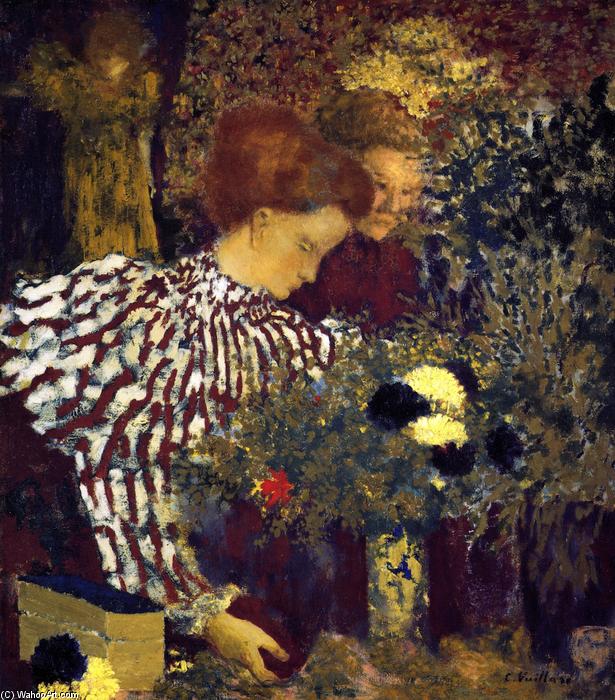
The Striped Blouse: A Window into Vuillard’s Intimate Vision
Jean Edouard Vuillard's “The Striped Blouse,” painted in 1895, stands as a quintessential example of Post-Impressionism and embodies the spirit of Les Nabis—a movement that fundamentally challenged artistic conventions. More than just a depiction of two women contemplating flowers, this artwork delves into the subtleties of perception and emotion, reflecting Vuillard’s profound fascination with capturing fleeting moments of domestic life.
- Subject Matter: The painting portrays two figures—presumably women—positioned before a vase brimming with blossoms. Their postures convey quiet contemplation, hinting at unspoken conversations and shared observations.
- Composition & Spatial Arrangement: Vuillard’s masterful use of flattened planes of color creates an illusionistic space that prioritizes atmosphere over precise realism. The placement of vases – one in front of the women and another behind—further enhances this sense of depth without resorting to traditional perspective techniques.
Stylistic Influences & Technique
Vuillard’s artistic approach was deeply rooted in the Nabis movement, which championed a bold simplification of form and color inspired by Japanese prints. He eschewed academic realism, favoring instead a technique characterized by smooth brushstrokes and muted hues—primarily pastel shades—that lend an ethereal quality to his canvases. This deliberate stylistic choice aligns with Henri Matisse’s pioneering exploration of expressive color, demonstrating Vuillard's contribution to the burgeoning avant-garde.
- Color Palette: Vuillard employed a restrained yet luminous palette dominated by delicate pinks, blues, and greens—colors that harmonize seamlessly to evoke tranquility and beauty.
- Brushwork & Texture: The artist’s brushstrokes are soft and blended, creating an almost velvety surface texture that contributes to the painting's overall impression of softness and intimacy.
Historical Context & Symbolism
"The Striped Blouse" emerged during a period of significant artistic experimentation in France—the late 1890s—marking a decisive break from Impressionism’s focus on capturing transient visual sensations. Vuillard's work reflects the broader cultural preoccupation with exploring inner states and emotions, mirroring the Symbolist movement’s interest in conveying psychological truths through evocative imagery.
- Nabis Movement: Vuillard’s affiliation with Les Nabis signifies a rejection of academic conventions and an embrace of subjective experience.
- Japanese Influence: The incorporation of Japanese print motifs underscores the movement's fascination with Eastern aesthetics—particularly its emphasis on flattened planes of color and decorative patterns.
Emotional Resonance & Artistic Legacy
Ultimately, “The Striped Blouse” transcends mere visual representation; it communicates a palpable sense of serenity and understated beauty. Vuillard’s ability to distill complex emotions into simple forms—a hallmark of his artistic style—continues to inspire artists today. Its availability on ArtsDot.com allows collectors and enthusiasts alike to experience the profound impact of this masterpiece firsthand, securing its place as an enduring symbol of Post-Impressionist elegance.