Jean-François Millet (1814-1875): French Realist painter of the Barbizon School, celebrated for poignant depictions of peasant life like 'The Gleaners' & 'The Angelus'. Explore his legacy.
Explore world-class art at the Museum of Fine Arts, Boston! Discover masterpieces spanning cultures & centuries in this iconic institution's stunning collection and historic building.
A Portrait of Quiet Dignity: Jean-François Millet’s “Catherine Lemaire”
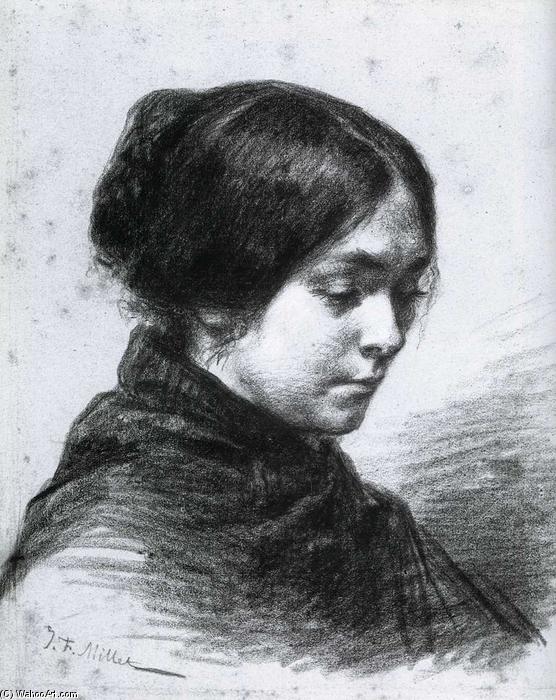
Jean-François Millet's "Catherine Lemaire," painted in 1848, transcends mere representation; it embodies the Romantic spirit’s fascination with inner contemplation and its unwavering belief in the inherent dignity of rural existence. This striking monochrome portrait captures a young woman seated in profile against a subtly textured Norman landscape—a scene that speaks volumes about Millet's artistic vision and his profound connection to the everyday lives of ordinary people. The photograph itself, meticulously scanned for reproduction, reveals an image brimming with textural detail and expressive lines, offering viewers a glimpse into the artist’s masterful technique.
Technical Brilliance: Mastering Charcoal and Texture
Millet’s skill lies primarily in his command of charcoal—likely graphite on paper—a medium perfectly suited to conveying both form and emotion. The artist employs hatching and cross-hatching with remarkable precision, layering lines to sculpt shadows and build depth. These delicate strokes aren't merely decorative; they are fundamental to capturing the palpable materiality of the woman’s hair and garment, mirroring the rugged beauty of the surrounding countryside. Notice how Millet renders the texture of her shawl—a subtle ripple effect achieved through careful line placement—creating a visual dialogue between subject and environment. The diffused lighting contributes to this textural richness, enhancing the impression of realism without resorting to dramatic contrasts.
Romantic Symbolism: Introspection and Resilience
Beyond its technical prowess, “Catherine Lemaire” resonates with symbolic significance rooted in Millet’s Romantic sensibilities. The woman's downward gaze—a gesture laden with unspoken emotion—suggests a preoccupation with inner thoughts and feelings, mirroring the broader Romantic preoccupation with psychological depth. Her posture exudes quiet dignity, reflecting Millet’s humanist conviction that even the simplest lives hold profound beauty and moral worth. The muted color palette reinforces this mood of melancholy contemplation, inviting viewers to ponder themes of solitude, resilience, and the enduring spirit of humanity.
Historical Context: Realism Amidst Romantic Idealism
Painted during a period marked by significant social upheaval—the Industrial Revolution reshaping European society—Millet’s work stands apart from the prevailing Romantic idealism. While acknowledging the sublime grandeur of nature, Millet focused on portraying the realities faced by rural laborers—a deliberate choice intended to elevate their status and challenge societal prejudices. This commitment to realism aligns with the burgeoning Realist movement, which sought to depict life as it truly is, unburdened by romantic embellishments. The photograph’s inclusion in collections like MFA demonstrates the enduring appeal of Millet's artistic vision.
Emotional Resonance: A Window into Human Experience
Ultimately, “Catherine Lemaire” succeeds in conveying a powerful emotional resonance—a quiet contemplation that speaks to our shared human experience. It is not merely a portrait; it’s an invitation to consider the dignity and complexity inherent in ordinary life. The photograph captures Millet's ability to distill emotion into visual form, creating an artwork that lingers in the memory long after viewing. Its timeless beauty continues to inspire collectors and interior designers alike who appreciate the profound impact of art rooted in observation and empathy.