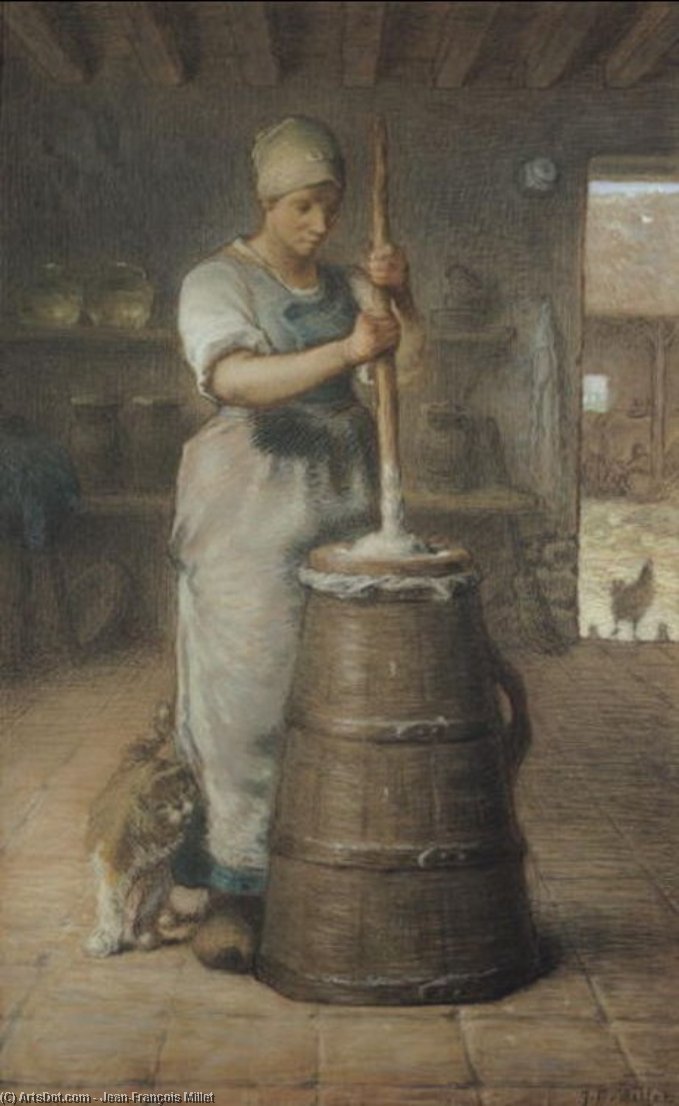
A Snapshot of Rural Dignity: Jean-François Millet’s ‘Churning Butter’
Jean-François Millet's “Woman Churning Butter,” completed in 1855–56, stands as a cornerstone of Realism—a movement that fiercely rejected Romantic idealism and sought to depict the everyday lives of ordinary people with unflinching honesty. Executed by Millet alongside Auguste Delâtre, this etching captures a scene from rural Normandy, France, transporting viewers back to a time when agriculture dictated the rhythm of existence for countless families.
The Scene: Domestic Labor Rendered With Precision
The painting depicts a woman diligently churning butter in her kitchen. Millet’s meticulous attention to detail—evident in the rendering of the wooden barrel, the milk splashing gently onto the surface, and the woman's focused gaze—is characteristic of the Barbizon School’s commitment to capturing naturalistic landscapes and figures. The inclusion of a cat observing the activity adds a subtle element of domestic tranquility, hinting at the quiet beauty found within rural life.
Technique & Style: A Masterclass in Etching
Millet skillfully employed etching on thin laid paper—a technique favored by Delâtre—to achieve remarkable tonal gradation and textural nuance. The artist’s masterful manipulation of lines creates a palpable sense of depth, mirroring the physicality of the task at hand. Observe how Millet captures the subtle sheen of perspiration on the woman's brow and the rough texture of her apron; these details elevate the image beyond mere representation, conveying an emotional resonance that speaks to the dignity of labor.
Historical Context: Challenging Romantic Ideals
“Woman Churning Butter” emerged during a period of significant social upheaval in France. The Romantic movement had championed heroic narratives and idealized visions of beauty—a stark contrast to Millet’s portrayal of peasant life. By focusing on the mundane realities of rural existence, Millet challenged prevailing artistic conventions and asserted the importance of portraying humanity with compassion and respect. As evidenced by its inclusion in the Cleveland Museum of Art collection (1917), this artwork continues to inspire admiration for its uncompromising realism.
Symbolism & Emotional Impact: Quiet Strength
Beyond its technical brilliance, “Woman Churning Butter” carries profound symbolic weight. Millet’s depiction celebrates the perseverance and resilience of rural laborers—women who tirelessly contribute to sustaining their families and communities. The clock hanging on the wall serves as a reminder of time passing, yet simultaneously underscores the steadfast dedication required for daily tasks. Ultimately, the painting evokes a feeling of quiet dignity—a testament to Millet's ability to transform ordinary moments into enduring expressions of human experience.