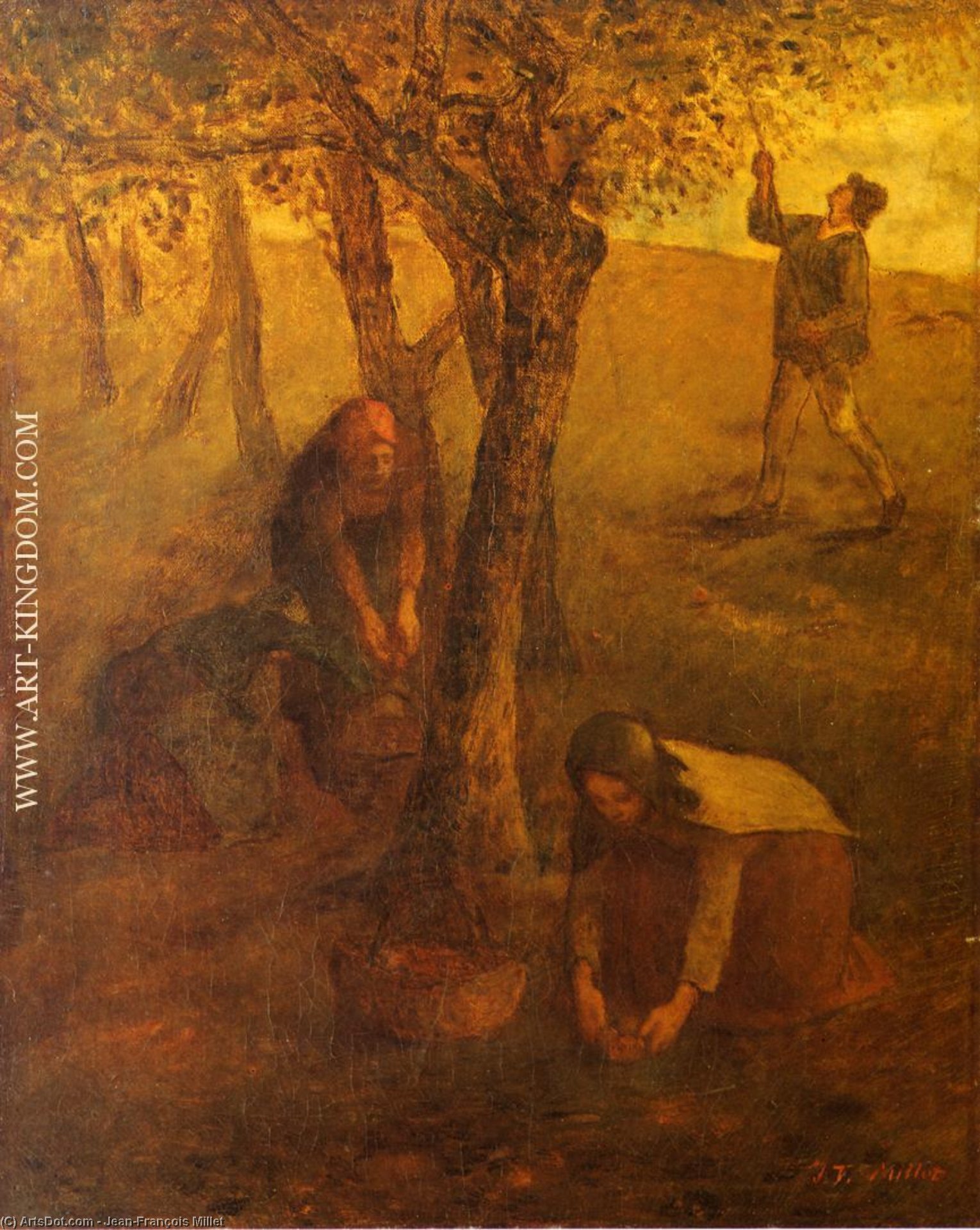
A Moment Frozen in Time: Jean-François Millet’s “Gathering Apples”
Jean-François Millet's "Gathering Apples" isn’t merely a depiction of rural labor; it’s a profound meditation on the dignity of work, the harmony between humanity and nature, and the quiet beauty found within everyday life. Painted around 1857, this oil on canvas—measuring a modest 29 x 37 cm—offers an intimate glimpse into the lives of peasant farmers in the French countryside, a subject that would become central to Millet’s artistic legacy and profoundly influenced the Realist movement. The painting captures a fleeting moment – perhaps during the autumn harvest – as three figures diligently gather apples from a laden orchard tree. The scene unfolds with remarkable simplicity, yet within its quietude lies a wealth of observation and emotional resonance.
The Language of Rural Life: Composition and Technique
Millet’s genius lay in his ability to render the commonplace extraordinary. He eschewed grand narratives or heroic figures, instead focusing on the honest faces and weathered hands of those who tilled the land. The composition is remarkably balanced, drawing the eye towards the central group of workers. Notice how Millet employs a pyramidal structure, grounding the scene with the base formed by the fallen apples and the tree’s roots, while subtly directing our gaze upwards to the figures engaged in their task. The brushstrokes are deliberately rough and textured, mirroring the physicality of the work being depicted. This technique—characteristic of the Barbizon school, which Millet helped establish—emphasizes the materiality of the paint itself, lending a tactile quality to the scene. The muted palette – dominated by earthy browns, greens, and ochres – further reinforces the painting’s connection to the land.
Symbolism in the Simplicity: Humanity and Nature
“Gathering Apples” is rich with symbolic meaning, subtly woven into its seemingly straightforward depiction. The act of harvesting itself represents a fundamental human activity—a connection to sustenance, community, and the rhythms of the seasons. The basket, overflowing with fruit, symbolizes abundance and shared labor. Each figure’s posture – one reaching for an apple, another bending to pick – speaks volumes about their roles within this communal effort. Millet doesn't romanticize rural life; he presents it with a quiet realism that acknowledges both its hardships and its inherent dignity. The orchard tree itself can be interpreted as a symbol of fertility and the cyclical nature of life—a reminder of the bounty provided by the earth.
A Window into 19th-Century France: Context and Legacy
Jean-François Millet’s work emerged during a period of significant social and political upheaval in France. The Industrial Revolution was transforming the landscape, drawing people from rural areas to burgeoning cities, and creating new forms of labor. Millet's focus on the lives of peasant farmers offered a poignant counterpoint to the idealized depictions of bourgeois society prevalent at the time. His paintings served as a powerful reminder of the enduring values of hard work, community, and connection to the land—values that resonated deeply with a public increasingly concerned about the social consequences of rapid change. “Gathering Apples” stands as a testament to Millet’s commitment to portraying the lives of ordinary people with honesty and empathy, securing his place as one of the most important artists of the Realist movement.
For those seeking a high-quality reproduction of this evocative masterpiece, ArtsDot.com offers meticulously crafted hand-painted reproductions that capture the essence of Millet’s vision. Explore our collection today and bring the serenity and dignity of “Gathering Apples” into your home or office.