A Moment Frozen in Time: Jean-François Millet’s “Portrait de Jeanne Doré”
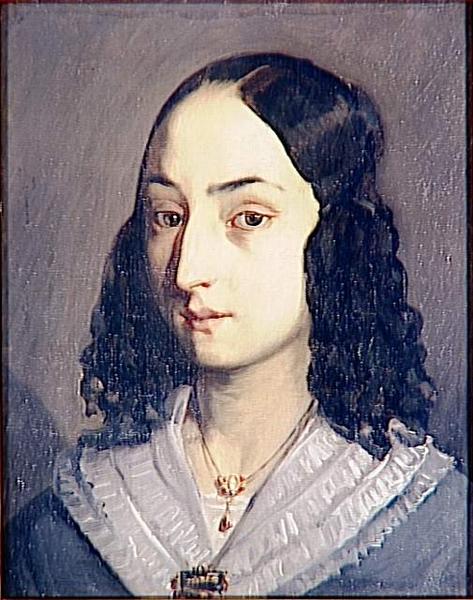
Jean-François Millet's "Portrait de Jeanne Doré" is more than just a painting; it’s a poignant window into 19th-century rural France, a testament to the dignity of labor and the quiet beauty found in everyday life. Completed around 1840-41, this captivating work, rendered in stark black and white, immediately draws the viewer into the direct gaze of Jeanne Doré, a young woman embodying both resilience and vulnerability. Millet’s masterful technique—characterized by loose brushstrokes and an almost photographic realism—captures not just her physical likeness but also a profound sense of her inner life.
The painting's power lies in its simplicity and the deliberate ambiguity surrounding Jeanne’s story. She is depicted wearing a modest white dress, a garment that speaks to her humble origins, yet she possesses an undeniable grace. A delicate necklace hints at a connection to family or perhaps a cherished memory. Her direct stare—a hallmark of Millet's portraits—demands engagement, inviting the viewer to contemplate her thoughts and experiences. The blurred background, rendered with atmospheric perspective, subtly emphasizes Jeanne’s presence, creating a sense of intimacy and drawing attention solely to her face – a face etched with a quiet strength.
The Barbizon School and Millet's Realist Vision
To fully appreciate “Portrait de Jeanne Doré,” it’s crucial to understand the artistic context in which it was created. Millet was a pivotal figure in the Barbizon school, a movement that rejected the academic traditions of the Parisian Salon in favor of painting *en plein air* (outdoors) and depicting scenes from rural life with unflinching honesty. Unlike many artists who idealized peasant subjects, Millet sought to portray them as he saw them—with all their hardships, dignity, and inherent humanity.
Born in Gruchy, Normandy, in 1814, Millet’s upbringing deeply informed his artistic vision. His family were farmers, and he spent his childhood immersed in the rhythms of agricultural life. This intimate connection to the land—the planting, harvesting, and daily struggles of rural laborers—became the bedrock of his art. He wasn't interested in romanticizing peasant life; instead, he aimed to capture its authentic reality, celebrating their resilience and portraying them with respect and empathy.
Symbolism and Emotional Resonance
While seemingly straightforward, “Portrait de Jeanne Doré” is rich in subtle symbolism. The white dress, often associated with purity and innocence, contrasts subtly with the weariness suggested by her gaze. The necklace could represent a connection to family or perhaps a reminder of happier times. More profoundly, the painting speaks to the universal experience of womanhood—the quiet strength, resilience, and inherent dignity found within ordinary lives.
Millet’s use of black and white further enhances the emotional impact of the portrait. The monochrome palette evokes a sense of timelessness, suggesting that Jeanne's story transcends specific historical circumstances. It invites viewers to contemplate her existence not as a particular individual but as a representative figure of rural France—a symbol of enduring spirit in the face of hardship.
A Reproduction for Your Space
ArtsDot offers meticulously crafted hand-painted reproductions of “Portrait de Jeanne Doré,” allowing you to bring this iconic artwork into your home or office. Our skilled artists replicate Millet’s distinctive style and technique with exceptional precision, ensuring that the reproduction captures the painting's original atmosphere and emotional depth. Whether you are an art enthusiast, a collector seeking to expand your collection, or simply someone drawn to the beauty of rural life, this reproduction provides a stunning tribute to Jean-François Millet’s enduring legacy.
Consider how this evocative portrait will complement your interior design—its stark simplicity and contemplative mood offering a powerful counterpoint to more vibrant or chaotic spaces. A ArtsDot reproduction of “Portrait de Jeanne Doré” is not merely a decoration; it's an investment in art, history, and the timeless beauty of human experience.