A Glimpse into the Heart of Rural France
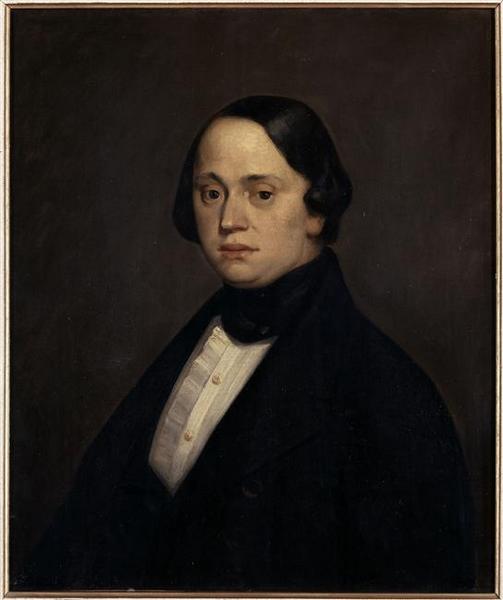
Jean-François Millet’s “Portrait de M. Doré” offers a profound and quietly powerful window into the world of mid-19th century rural France. More than just a likeness, it's a carefully constructed tableau that speaks volumes about social standing, respectability, and the contemplative nature of everyday life. Executed in the meticulous style characteristic of Millet’s Realist approach, this black and white portrait eschews vibrant color for a masterful manipulation of tonal values – shades of gray ranging from deepest charcoal to delicate ivory – creating an atmosphere both formal and deeply human.
The composition itself is subtly arresting. The subject, Mr. Doré, is positioned slightly off-center, lending the image a dynamic balance that draws the eye immediately to his face. His gaze, direct and unwavering, establishes a palpable connection with the viewer, inviting scrutiny and perhaps even a sense of shared understanding. Strong vertical lines define the structure of his suit jacket and tie, reinforcing the formality of the setting, while subtly curved lines around his eyes and mouth hint at an underlying seriousness or perhaps a quiet contemplation. The rectangular shapes of the collar and lapels add to the overall sense of order and restraint.
The Language of Form and Texture
Millet’s technical skill is evident in the rendering of texture – the smooth surface of Mr. Doré's skin, the crispness of his shirt fabric, and even the slight roughness of his hair. These details aren’t merely decorative; they ground the portrait in a tangible reality, anchoring it to the world Millet so faithfully depicted. The diffused lighting, originating from a light source above and slightly to the left, subtly highlights key features – the forehead and nose – adding depth and volume without resorting to dramatic contrasts. The relatively flat perspective, devoid of strong spatial cues, serves to focus attention entirely on the figure himself, emphasizing his presence within the frame.
Beyond its technical merits, “Portrait de M. Doré” is rich in symbolic meaning. The attire – the suit and tie – immediately communicates status and respectability, reflecting the social hierarchy of the time. The man’s posture and expression suggest a thoughtful demeanor, hinting at a life lived with dignity and perhaps even a degree of melancholy. Millet's work, deeply rooted in his own upbringing as a farmer’s son, imbues this portrait with an authenticity that resonates beyond mere representation; it captures the essence of a specific social stratum and its values.
A Legacy Rooted in the Soil
Jean-François Millet (1814-1875) was a pivotal figure in the Realist movement, choosing to depict the lives of rural laborers rather than the grand narratives favored by earlier artistic traditions. His work offers a poignant commentary on social inequality and the dignity of manual labor. Born in Gruchy, Normandy, Millet’s early life was inextricably linked to the rhythms of agriculture, an experience that profoundly shaped his artistic vision. As Millet's biography reveals, his family’s connection to the land instilled within him a deep respect for those who worked it – a sentiment powerfully conveyed in “Portrait de M. Doré.” The painting stands as a testament to Millet’s ability to transform everyday subjects into works of enduring beauty and social significance.
Consider commissioning a hand-painted reproduction of "Portrait de M. Doré" to bring this evocative work of art into your home or office. ArtsDot offers meticulously crafted reproductions that capture the essence of Millet’s original, allowing you to experience the depth and nuance of this remarkable portrait for generations to come.