A Portrait of Rural Dignity: Jean-François Millet's "The Large Shepherdess"
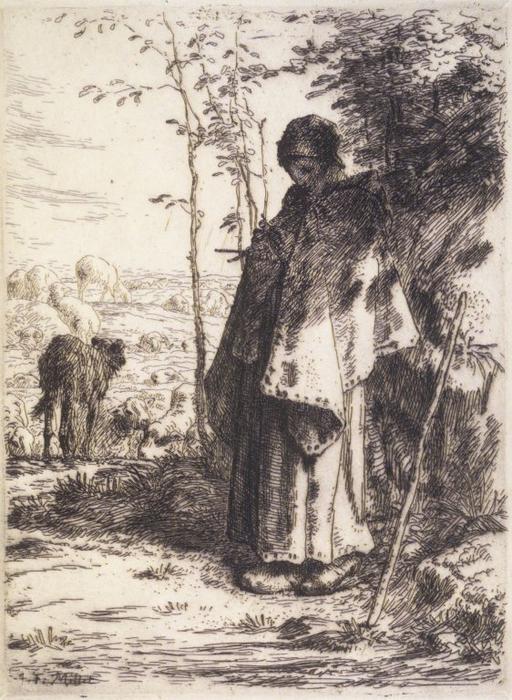
Jean-François Millet’s “The Large Shepherdess,” etched in 1862, is more than just a depiction of a woman tending her flock; it’s a profound meditation on the dignity and resilience of rural life – a cornerstone of the Realist movement that shook the foundations of academic art. This intimate print, measuring 32 x 23 cm, offers a window into the world of early 19th-century France, specifically the Norman countryside where Millet spent his formative years. The scene unfolds with quiet intensity: a woman, rendered with remarkable detail and a palpable sense of weariness, stands before a solitary tree, her gaze fixed on the viewer – an act of direct engagement that was revolutionary for its time.
- Subject Matter: The central figure embodies the archetype of the shepherdess, a common subject in Millet’s work. However, unlike idealized depictions, this woman is presented with unvarnished realism, reflecting the harsh realities of agricultural labor.
- Composition: The arrangement – the shepherdess framed by the tree and supported by two unseen figures – creates a sense of contained space and quiet contemplation. The scattered sheep contribute to the overall feeling of pastoral tranquility, though their presence also underscores the woman’s arduous task.
The Realist Vision: Millet and the Dawn of Modern Art
Millet's artistic trajectory was inextricably linked to his upbringing. Born in 1814 in Gruchy, a small Norman village, he witnessed firsthand the lives of peasant farmers – their struggles, their resilience, and their profound connection to the land. This direct observation fueled his commitment to Realism, an artistic movement that sought to depict everyday life without romantic embellishment or idealized beauty. Unlike the dominant Salon style, which favored historical or mythological subjects, Millet chose to focus on the lives of ordinary people, elevating them to the status of heroic figures.
The etching’s black and white technique amplifies this realism. The stark contrasts between light and shadow emphasize the textures of the woman's clothing, the rough bark of the tree, and the woolly coats of the sheep. This deliberate use of monochrome further intensifies the emotional impact of the image, stripping away any superficial distractions and focusing attention on the core themes of labor, hardship, and dignity.
Symbolism and Emotional Resonance
Beyond its straightforward depiction, “The Large Shepherdess” is laden with symbolic meaning. The woman’s direct gaze invites a connection between the viewer and the subject, fostering empathy and understanding. Her posture suggests both strength and vulnerability – she is a provider, yet also exposed to the elements and the demands of her labor. The tree, a traditional symbol of life and resilience, provides a grounding element in the scene.
The inclusion of two unseen figures in the background adds another layer of complexity. They represent the community that supports the shepherdess, highlighting the importance of social bonds in rural society. The overall atmosphere evokes a sense of peace and solitude, yet also hints at the challenges inherent in a life devoted to agriculture.
A Hand-Painted Reproduction: Capturing Millet's Legacy
ArtsDot offers meticulously hand-painted reproductions of “The Large Shepherdess,” ensuring that you possess an authentic representation of this seminal work. Our skilled artisans employ traditional techniques, faithfully recreating Millet’s nuanced style and emotional depth. Each reproduction is a testament to the artist’s vision, bringing this iconic image into your home or office with unparalleled fidelity. This print isn't merely a copy; it’s a living echo of Millet’s artistic legacy – a reminder of the enduring power of Realism and the dignity of rural life.