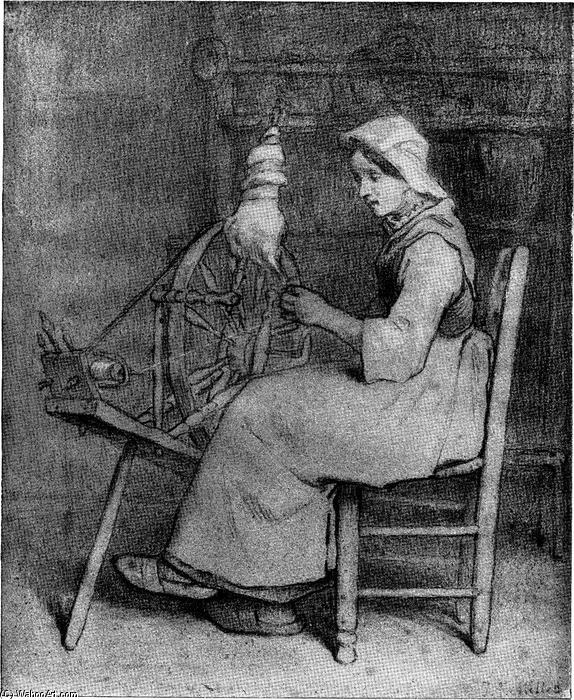
The spinner

Explore Jean-François Millet’s "The Spinner," a detailed pencil drawing of rural life. Admire its realism, hatching technique & timeless depiction of traditional craft.


Jean-François Millet (1814 - 1875)

Jean-François Millet (1814-1875): French Realist painter of the Barbizon School, celebrated for poignant depictions of peasant life like 'The Gleaners' & 'The Angelus'. Explore his legacy.

A Moment of Quiet Industry: Jean-François Millet’s “The Spinner”

  • Subject & Narrative: This captivating pencil drawing by Jean-François Millet presents a woman wholly absorbed in the age-old craft of spinning wool. It's not merely a depiction *of* work, but an intimate portrait *of* a worker – her posture, the focused set of her jaw, and the careful positioning of her hands all speak to a life defined by diligent labor. The scene is simple: a woman, her wheel, a chair, and hints of a domestic interior. Yet within this simplicity lies a profound dignity.
  • Style & Technique: Millet’s style firmly resides within the Realist movement, rejecting idealized depictions in favor of honest portrayals of everyday life, particularly rural existence. “The Spinner” is executed with remarkable precision using graphite pencil on paper. The artist masterfully employs linear shading – hatching and cross-hatching – to build form and texture. Notice how the wool appears soft and voluminous, while the wood of the spinning wheel possesses a solid, tactile quality. The lines are deliberate, creating a sense of groundedness and stability.
  • Historical Context & The Barbizon School: Jean-François Millet (1814-1875) was a central figure in the Barbizon School, a group of French landscape painters who moved to the forest of Barbizon near Paris. They sought to depict nature and rural life directly from observation, rejecting academic conventions. Millet’s focus on peasant life wasn't simply aesthetic; it reflected a growing social consciousness and an interest in representing the lives of those often overlooked by traditional art.
  • Symbolism & Themes: The act of spinning itself carries symbolic weight. It represents not only sustenance and practicality but also continuity – the passing down of skills and traditions through generations. The woman’s focused labor can be interpreted as a metaphor for the cyclical nature of life, the connection to the land, and the enduring strength of the human spirit. The interior setting suggests domesticity and the central role women played in maintaining rural households.
  • Emotional Impact & Aesthetic Appeal: “The Spinner” evokes a sense of quiet contemplation and respect for manual labor. It’s a nostalgic image, perhaps, but one that avoids sentimentality. The monochromatic palette enhances the drawing's intimacy and focuses attention on form and texture. This piece would be an exquisite addition to any collection, lending a touch of rustic elegance and historical depth to interiors – particularly those with a focus on natural materials or a desire for understated sophistication.
  • Interestingly, Vincent van Gogh created his own version of “The Spinner” after seeing Millet’s work, demonstrating the enduring influence of this iconic image. This speaks to the power and universality of Millet's vision.