Jean-François Millet (1814-1875): French Realist painter of the Barbizon School, celebrated for poignant depictions of peasant life like 'The Gleaners' & 'The Angelus'. Explore his legacy.
A Moment Frozen in Time: Exploring Jean-François Millet’s “The Whisper”
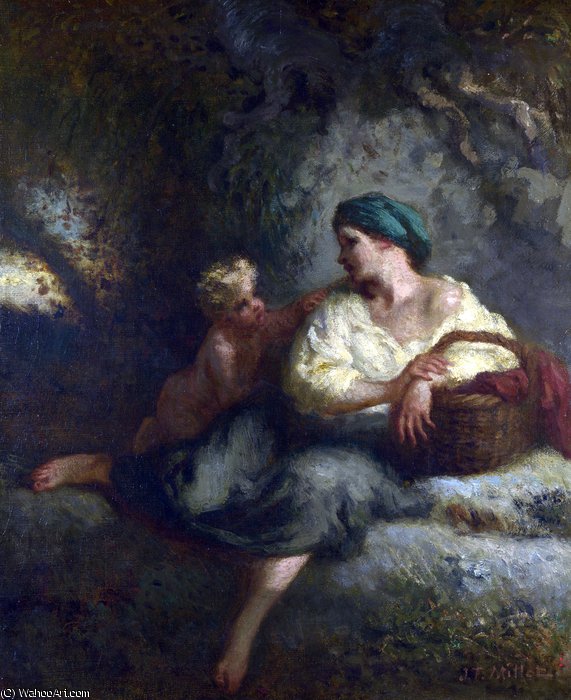
Jean-François Millet's "The Whisper" isn’t merely a depiction of rural life; it’s an embodiment of its quiet dignity and profound humanity. Painted circa 1857, this oil on canvas captures a tender tableau – a woman seated upon weathered rocks with her infant child nestled securely in her arms – a scene that speaks volumes about the simple joys and enduring bonds of family amidst the hardships of agricultural existence. Millet’s work firmly establishes him as a cornerstone of the Barbizon school, an artistic movement dedicated to portraying landscapes and rural subjects with uncompromising realism and capturing the essence of everyday life.
The Artist's Vision: Millet and the Barbizon School
Born in Gruchy, Normandy, in 1814, Jean-François Millet’s formative years were spent immersed in the rhythms of farming – a connection that profoundly influenced his artistic sensibilities. Unlike many artists of his era pursuing grand narratives or idealized beauty, Millet sought to depict the lives of ordinary people with unflinching honesty. The Barbizon school championed this approach, rejecting academic conventions and prioritizing direct observation of nature as inspiration for their paintings. Artists like Millet believed that truth resided in capturing the tangible realities of rural existence, rather than imposing preconceived notions onto the visual world. This conviction is palpable throughout his oeuvre, including “The Whisper,” where Millet eschews dramatic poses or opulent settings for a scene brimming with understated emotion.
Technical Mastery: Impressionistic Touches Within Realism
Despite its commitment to realism—evident in the meticulous rendering of textures and forms—“The Whisper” possesses subtle stylistic elements characteristic of Impressionism. Millet skillfully employs soft brushstrokes and warm hues, particularly ochre and amber, to create a luminous atmosphere that envelops the figures. These delicate strokes convey a sense of warmth and intimacy, mirroring the quiet serenity of the depicted moment. The artist’s technique isn't about achieving photographic accuracy; it’s about conveying feeling—the palpable connection between mother and child—through nuanced color palettes and expressive brushwork. Notice how Millet captures the diffused light filtering through the branches of a tree in the background, subtly enhancing the painting’s overall mood.
Symbolism Beneath Surface Calm
Beyond its visual beauty lies a rich tapestry of symbolism. The woman's posture – seated calmly yet protectively—represents maternal devotion and unwavering care. The basket beside her symbolizes sustenance and practicality, reflecting the daily struggles faced by peasant families. Even the rocks themselves serve as a grounding element, anchoring the figures within their environment and emphasizing the resilience of human spirit in confronting adversity. Millet’s deliberate choices contribute to a deeper understanding of the painting's message: a celebration of quiet strength and enduring love amidst the commonplace realities of rural life.
Emotional Resonance: A Window into Human Connection
“The Whisper” transcends mere representation; it evokes profound emotional resonance. The painting captures a fleeting moment of tenderness—a whispered reassurance between mother and child—that speaks to universal themes of vulnerability, compassion, and familial bonds. It’s a scene that invites contemplation on the beauty found in simplicity and the importance of human connection. Owning a high-quality reproduction allows viewers to experience this enduring artistic legacy, transporting them back to a time when art sought not grandeur but genuine empathy for the human condition. Explore more reproductions at https://ArtsDot.com/.