Jean Frédéric Bazille’s Intimate Reflection: *Self Portrait at Saint-Sauveur* (1867)
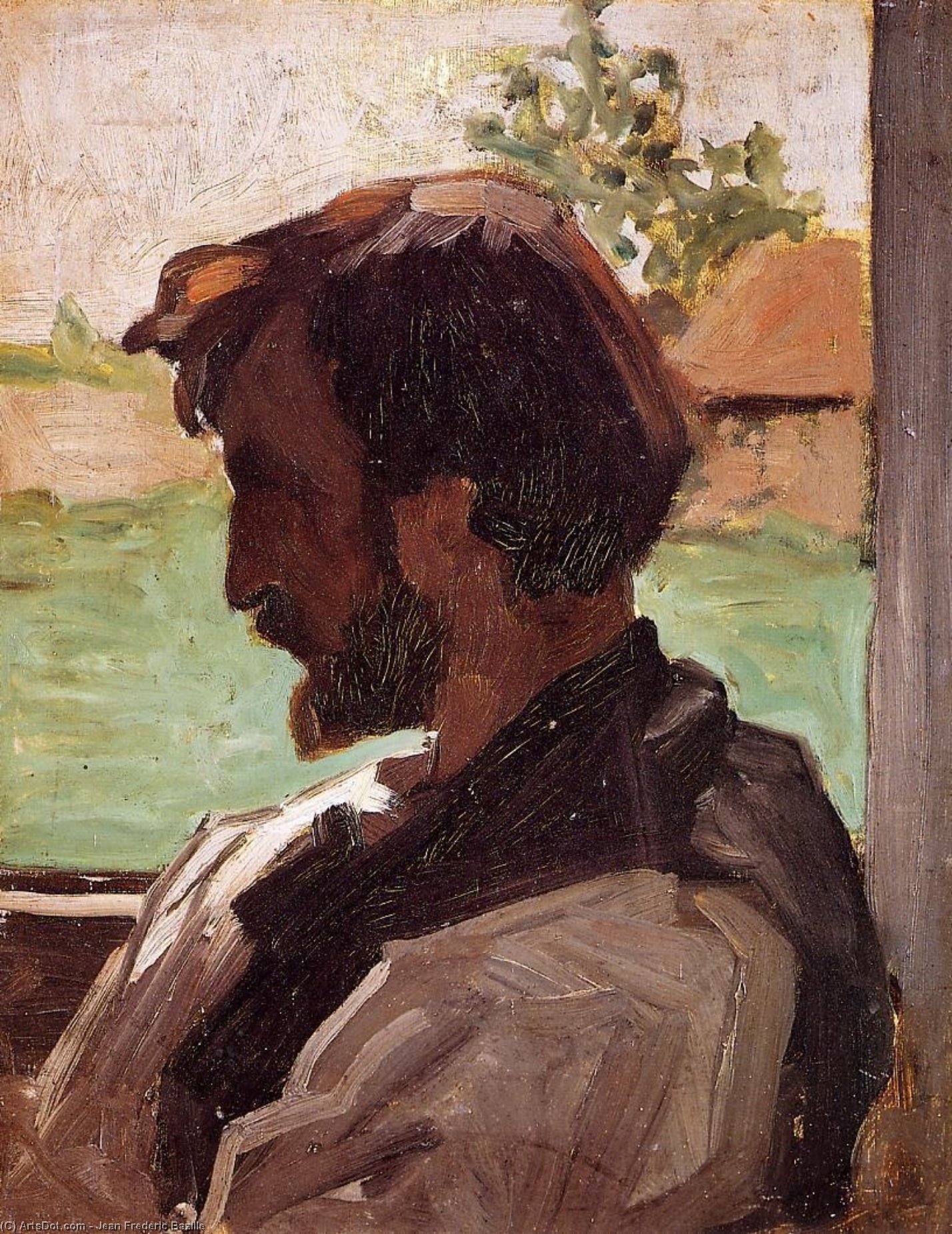
The canvas holds a quiet intensity, a moment captured with the delicate precision characteristic of Jean Frédéric Bazille's early work. This self-portrait, painted in 1867, offers a rare glimpse into the mind and sensibility of an artist on the cusp of greatness – a young man wrestling with his dual passions for medicine and art, seeking solace and observation within the familiar confines of his studio at Saint-Sauveur. The scene is deceptively simple: Bazille sits pensively before a window, his posture suggesting both contemplation and a subtle awareness of the world beyond. His slight turn of the head, as if absorbed in an unseen detail outside, invites us to share in his focused gaze.
Bazille’s technique reveals a burgeoning Impressionist sensibility. The brushstrokes are loose yet deliberate, capturing not just the likeness but also the fleeting effects of light and atmosphere. Note the subtle modulation of color – the warm ochres and browns of the bench contrasting with the cooler tones of the windowpane and the man's clothing. This careful attention to light, a hallmark of the Impressionist movement, demonstrates Bazille’s early experimentation with capturing transient moments rather than fixed representations.
A Portrait of Ambivalence
The inclusion of two secondary figures – a woman in the upper left corner and a man in the lower right – adds layers of complexity to the portrait. These aren't mere decorative elements; they represent the tensions within Bazille himself, the constant negotiation between his medical studies and his artistic pursuits. The woman, often interpreted as his sister, Julie, embodies domesticity and perhaps a longing for stability, while the man represents the intellectual world he was simultaneously drawn to. Their presence underscores the artist’s own internal conflict – a struggle to reconcile duty with desire, reason with passion.
The setting itself, the window at Saint-Sauveur, is significant. This location served as Bazille's studio and a crucial space for his artistic development. The natural light flooding through the window was a primary source of inspiration, fueling his exploration of color and form. It’s within this very space that he began to develop his unique style, laying the groundwork for his later masterpieces.
Symbolism and Emotional Resonance
*Self Portrait at Saint-Sauveur* is more than just a likeness; it's an emotional document. Bazille’s expression – a mixture of thoughtfulness and perhaps melancholy – speaks to the anxieties and uncertainties inherent in a young artist navigating a rapidly changing artistic landscape. The act of looking out the window, of observing the world with such intensity, suggests a desire for understanding, a yearning to translate his experiences onto canvas.
Painted in 1867, this work predates Bazille’s tragically early death in 1870, marking a pivotal moment in the Impressionist movement. It offers a poignant glimpse into the life of a brilliant artist on the verge of realizing his full potential – a testament to the power of observation and the enduring beauty of a single, carefully rendered self-portrait.
Perfect for Your Collection
- Authentic Reproduction: This hand-painted reproduction captures every nuance and detail of Bazille’s original masterpiece.
- Artistic Technique: Executed by skilled artisans, this reproduction faithfully recreates the loose brushwork and vibrant color palette characteristic of Impressionism.
- Versatile Decor: Ideal for a variety of interior design styles – from contemporary to traditional – *Self Portrait at Saint-Sauveur* will add an element of sophistication and artistic intrigue to any space.