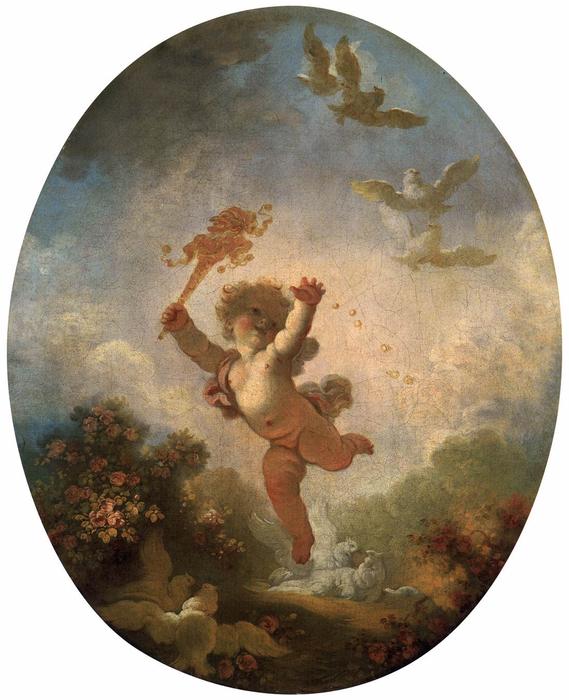
Possibly Jean François Leroy de Sennéville [1715-1784], Paris; possibly (his sale, Chariot and Paillet at Hôtel de Bulion, Paris, 5-11 April 1780, no. 56); possibly purchased by Verrier.
A Symphony of Rococo Whimsy
In the heart of the 1770s, amidst the gilded opulence of the French Ancien Régime, Jean-Honoré Fragonard captured a moment that transcends mere painting to become a sensory experience. Love as Folly is not simply a depiction of a pastoral encounter; it is a breathtaking masterclass in the Rococo aesthetic, where the boundaries between reality and dream dissolve into a haze of pastel light and exuberant motion. As one gazes upon this canvas, they are immediately transported to an idyllic, sun-drenched garden, a sanctuary of lush foliage and vibrant blossoms that seems to pulse with the very rhythm of life itself. The scene centers on a young woman caught in a moment of weightless grace, swinging playfully from a tree branch, while her lover leans in with a tender, breathless intent to kiss her lips. It is a composition that breathes with the spirit of frivolity, pleasure, and the fleeting nature of beauty.
Fragonard’s technical prowess is nothing short of magical, employing a signature style that favors loose, fluid brushstrokes over rigid lines. Through the sophisticated use of glazing techniques, he achieves a luminous, ethereal quality, making the light appear to shimmer across the skin of his subjects and through the translucent petals of the surrounding flora. The palette is a delicate dance of soft pinks, mint greens, and creamy whites, creating an atmosphere that feels both airy and deeply intimate. This mastery of light and movement allows the viewer to feel the gentle sway of the swing and the warmth of the afternoon sun, making the artwork an ideal centerpiece for any space seeking to evoke a sense of romantic elegance and sophisticated charm.
The Language of Hidden Desires
Beyond its immediate visual splendor, Love as Folly serves as a complex tapestry of symbolic meaning, inviting the discerning collector to look deeper into its verdant depths. Every element within the frame is a carefully placed metaphor for the complexities of human emotion and social convention. Scattered throughout the composition are doves, those timeless emblems of fidelity and marital bliss, yet they exist alongside more mischievous elements that challenge the notion of pure devotion. A small, clever monkey can be seen surreptitiously stealing fruit from a basket—a brilliant personification of disruption and the unpredictable nature of impulse. The stolen fruit itself acts as a potent symbol of temptation and the pursuit of forbidden desires, suggesting that love, much like the swing's arc, is often driven by irrational, uncontrollable whims.
This tension between harmony and mischief provides a profound historical commentary on the aristocratic society of Louis XV’s reign. During this era, Parisian high society was obsessed with the pursuit of pleasure and the celebration of sensual indulgence. Fragonard subtly satirizes the rigid societal conventions of marriage and courtship, suggesting that true romantic pursuits are often far more chaotic and "folly-driven" than the structured world would permit. For the interior designer or art enthusiast, this painting offers more than just decoration; it provides a narrative depth that sparks conversation, blending the sweetness of a pastoral romance with a sophisticated, intellectual wit that remains as captivating today as it was in 1773.