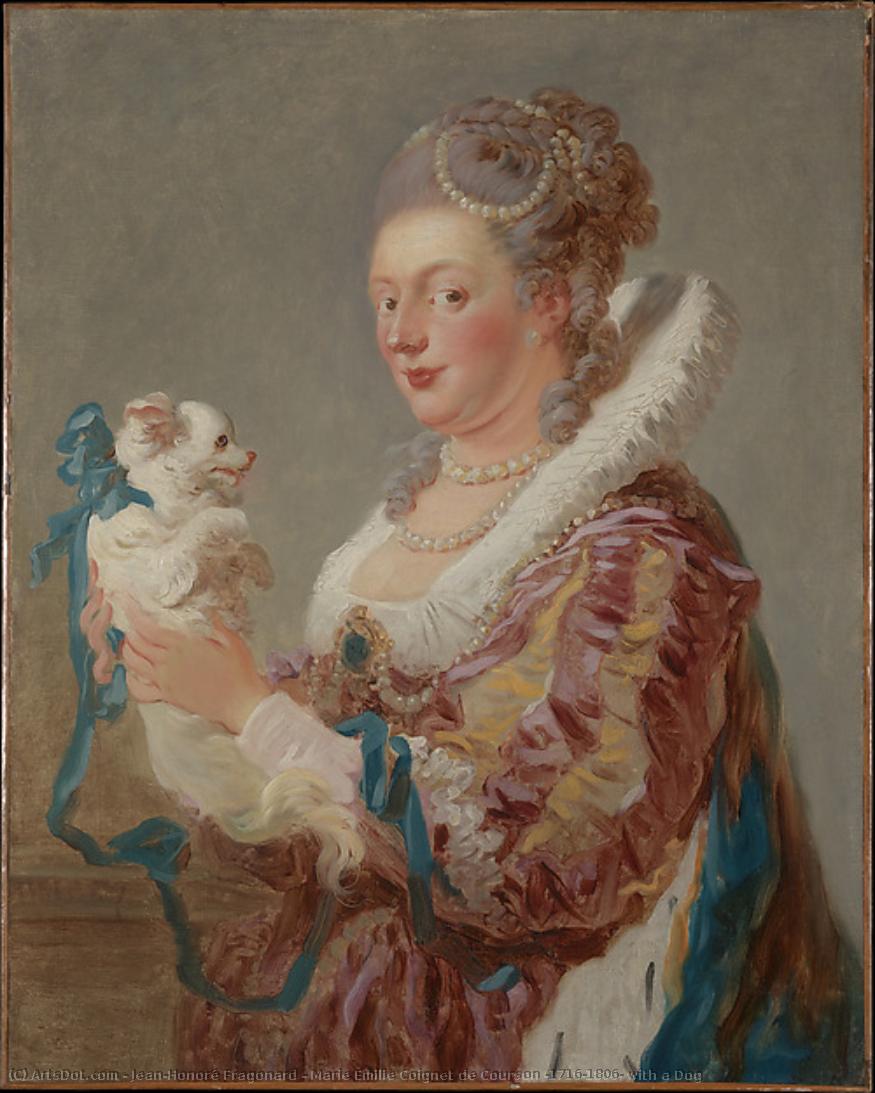
A Delicate Dance Between Artist and Subject: Fragonard’s Portrait of Marie Emilie Coignet de Courson
The canvas holds a captivating glimpse into the opulent world of Rococo France, specifically 1769, when Jean-Honoré Fragonard executed this portrait of Marie Emilie Coignet de Courson. More than just a depiction of a woman seated with her canine companion—a symbol of loyalty and companionship—this artwork transcends mere representation; it’s an artist's self-portrait rendered in exquisite oil paint on canvas, capturing the spirit of its era with breathtaking finesse.
- Subject Matter & Context: Fragonard’s fascination with portraying idealized beauty aligns perfectly with the Rococo aesthetic—a reaction against the formality and grandeur of Neoclassicism. The sitter herself embodies aristocratic grace, dressed in attire reminiscent of Queen Maria de’ Medici's court gowns from centuries prior, as evidenced by Rubens’ monumental paintings housed within the French royal collections. This deliberate reference underscores Fragonard’s awareness of artistic tradition and his desire to engage with its legacy.
- Style & Technique: The painting exemplifies Rococo artistry through its characteristic ornamentation and delicate brushwork. Fragonard employed a technique known as “wet-on-wet,” meticulously layering paint while it was still pliable, allowing for subtle incising lines into the large white ruff—a bold stylistic choice that elevates the artwork beyond conventional portraiture. This method contributes to the luminous quality of the canvas and imbues the scene with an ethereal glow.
- Color Palette & Composition: Dominating the color scheme are warm hues – rose pinks, reds, golds, and browns – skillfully juxtaposed against cooler blues in the background. The artist’s compositional choices prioritize a central figure, framed by shallow depth of field that draws attention to her face and upper body. Lines guide the viewer's eye across the canvas, delineating drapery folds and facial contours with precision.
- Symbolism & Emotional Impact: Beyond its visual splendor, the portrait carries symbolic weight. The dog serves as a poignant emblem of fidelity and companionship, reflecting the values cherished within aristocratic society at the time. However, perhaps more profoundly, Fragonard’s masterful execution speaks to an artist's ambition—a desire to capture not only outward appearance but also inner character. The resulting artwork evokes feelings of serenity, elegance, and understated sophistication.
- Material & Craftsmanship: Crafted with meticulous care using traditional oil paints on canvas, this reproduction faithfully recreates the original’s textural richness. Each brushstroke captures the sheen of silk, the softness of skin, and the fluffy texture of the dog's coat—a testament to Fragonard’s unparalleled skill and dedication to artistic excellence.
This stunning artwork is ideal for interior designers seeking to infuse their spaces with a touch of Rococo glamour or collectors desiring to own a piece of art history. Its luminous palette, refined composition, and masterful technique guarantee a captivating visual experience—a celebration of beauty and artistry that continues to inspire admiration centuries later.