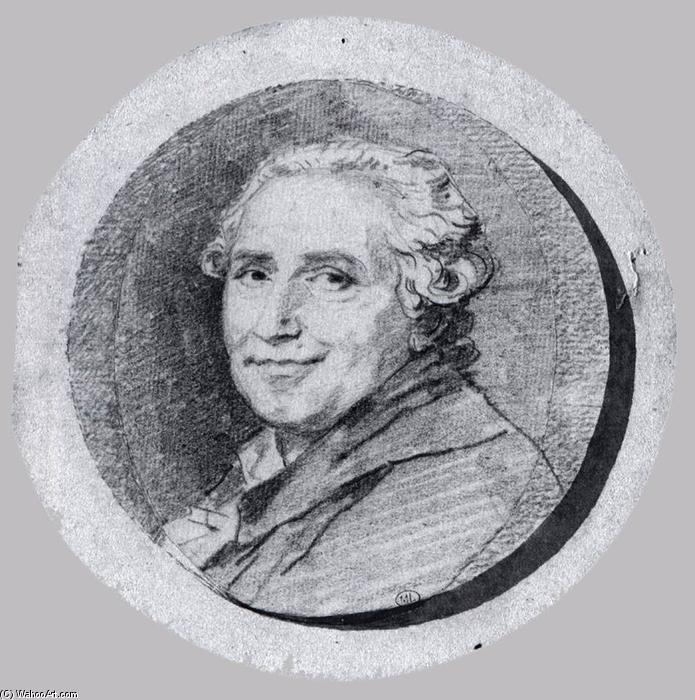
Fragonard’s early training under Chardin and later Boucher profoundly shaped his style, characterized by graceful forms, playful spirit, and a focus on capturing the essence of his subjects. This piece exemplifies his mastery of line and shading to create a lifelike and engaging portrait.
A Moment Captured in Gray: Jean-Honoré Fragonard’s Self-Portrait Facing Left
This exquisite chalk drawing, a poignant self-portrait by Jean-Honoré Fragonard created around 1780, offers a rare and intimate glimpse into the mind of one of France's most celebrated Rococo artists. More than just a likeness, it’s a carefully constructed tableau – a study in restrained elegance, subtle emotion, and the artist’s own considered gaze. The monochrome palette, achieved through the delicate application of chalk on paper, immediately establishes a mood of quiet contemplation, far removed from the vibrant color schemes that characterized much of his later work. The photograph itself, with its soft focus and aged quality, lends an additional layer of wistful beauty to the image, as if recalling a fleeting memory.
- The Artist’s Presence: Fragonard's pose is deliberately unassuming; he faces left, his expression a gentle smile that hints at both confidence and a touch of melancholy. His hands are clasped loosely before him, drawing the viewer’s attention directly to his face – a focal point meticulously rendered with precise lines and subtle shading.
- Technical Mastery: The artist's skill is evident in the masterful use of hatching and cross-hatching techniques. These methods create a remarkable sense of volume and texture, particularly noticeable in the curls of his hair and the folds of his clothing. It’s a testament to Fragonard’s dedication to capturing the nuances of form and light.
- A Study in Restraint: Noticeably absent are the flamboyant gestures and overt sensuality that would become hallmarks of his later, more famous paintings. Here, we see a different side of Fragonard – one of quiet introspection and artistic control.
Echoes of Boucher and the Classical Ideal
Fragonard’s early training under François Boucher profoundly shaped his artistic sensibilities. Boucher, a key figure in Louis XV's court, instilled in him a deep appreciation for graceful forms, balanced compositions, and a certain playful charm. This influence is palpable in this self-portrait; the pose itself echoes classical depictions of philosophers contemplating their work, while the overall sense of composure reflects Boucher’s emphasis on refined elegance. The decision to create a chalk drawing, rather than a more elaborate oil painting, also speaks to this period – chalk was favored for its immediacy and ability to capture likeness with remarkable speed.
- The Prix de Rome: Winning the prestigious Prix de Rome in 1752 provided Fragonard with invaluable experience in Italy. This journey wasn’t simply about copying ancient masters; it was a formative period where he developed his own artistic voice, absorbing the principles of classical art while simultaneously forging a distinctly French style.
- A Shift in Focus: While Boucher often depicted mythological scenes and allegorical subjects, Fragonard's work gradually shifted towards more intimate portraits and genre scenes – capturing everyday life with a subtle wit and an undeniable charm.
Symbolism of the Portrait and its Historical Context
The self-portrait itself is a significant gesture, offering a rare opportunity to connect directly with the artist’s personality. The attire Fragonard wears – a dark coat and waistcoat – suggests his status as an established professional within the Parisian art world. Created around 1780, this portrait sits at a pivotal moment in French history; the Rococo style was beginning to give way to the more austere Neoclassical movement, reflecting the growing influence of Enlightenment ideals. The muted tones and restrained emotion of this work can be interpreted as a subtle reflection of these shifting cultural values – a quiet acknowledgement of the changing times.
- The Rococo Era: Fragonard’s work is inextricably linked to the Rococo period, characterized by its emphasis on pleasure, beauty, and ornamentation. However, unlike some of his contemporaries, he never fully embraced the excesses of this style, retaining a sense of restraint and intellectual awareness.
- A Window into the Artist's Soul: Despite its formal qualities, the portrait possesses an undeniable intimacy – a glimpse into the artist’s inner world, inviting us to contemplate his thoughts and feelings.
Bringing Fragonard Home: Reproduction Options & Artistic Considerations
ArtsDot offers meticulously crafted hand-painted reproductions of Jean-Honoré Fragonard's “Self-Portrait Facing Left,” capturing the essence of this captivating artwork with unparalleled detail and authenticity. Our skilled artists utilize traditional techniques, carefully replicating the chalk’s texture and the photograph’s subtle nuances to create a stunningly lifelike representation. Whether you are an art collector, interior designer seeking to infuse your space with historical elegance, or simply an admirer of Fragonard's genius, our reproductions provide a beautiful and enduring way to experience this remarkable work of art. Consider the scale and framing options carefully to ensure that the reproduction complements your existing décor and enhances its visual impact.