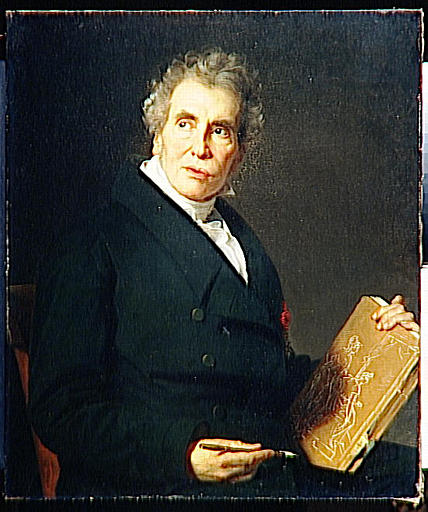
Admire Jérôme Martin Langlois's masterful depiction of Louis David—a Neoclassical portrait capturing the artist’s wisdom and contemplative gaze, illuminated by dramatic lighting and enriched with textural detail.
Jérôme-Martin Langlois (1779-1838): French Neoclassical painter, protégé of Jacques-Louis David. Explore his historical paintings & portraits!
Explore the Louvre Museum in Paris! Home to iconic masterpieces like the Mona Lisa & Venus de Milo, journey through art history from ancient Egypt to Renaissance icons. Plan your visit today!
A Portrait Steeped in Classical Ideals: Jérôme Martin Langlois’s Reverie on Louis David
The artwork, titled “Louis David,” presents a meticulously crafted portrait of the celebrated French artist himself, Jerome Martin Langlois's masterful rendition capturing the essence of Neoclassicism and imbued with subtle Romantic undertones. Executed with oil paints on canvas, this piece stands as a testament to Langlois’s dedication to mastering the stylistic conventions championed by Jacques-Louis David—David, who served as Langlois’s influential mentor—a relationship that profoundly shaped his artistic vision. The painting's formal composition and refined execution immediately convey an atmosphere of dignified contemplation, mirroring the intellectual fervor characteristic of its era.
Composition and Technique: Echoes of David’s Studio
Langlois skillfully employs a bust-length format, prioritizing Louis David’s face and upper torso—a deliberate choice reflecting the stylistic preferences prevalent in Neoclassical art. The artist positions his subject facing forward with a slight turn to his right, creating an element of dynamism within the otherwise restrained framework. Held open in David's right hand is a sketchbook brimming with sketches and drawings – a symbolic gesture highlighting intellectual pursuits and artistic talent—a direct nod to David’s own practice. Fine lines delineate facial features with remarkable precision, capturing the subtle nuances of age and experience, while broader strokes sculpt the volume of David’s clothing and jacket. The artist's meticulous layering of paint creates textures that convincingly mimic the surface qualities of fabric and paper, demonstrating a profound understanding of artistic technique.
Historical Context and Symbolic Resonance
Painted during the Napoleonic era (circa 1825), “Louis David” embodies the spirit of its time—a period marked by an unwavering commitment to classical ideals and a fervent desire to revive the grandeur of antiquity. The inclusion of the sketchbook serves as more than just a visual detail; it symbolizes the artist’s engagement with scholarly pursuits and his belief in the transformative power of observation. Furthermore, David's solemn gaze and posture convey wisdom gained through years of artistic endeavor—a reflection of the broader cultural preoccupation with virtue and moral contemplation that characterized Neoclassicism. The muted gray-blue background subtly isolates the figure, emphasizing its importance within the composition and enhancing its emotional impact.
Color Palette and Lighting: Drama Within Restraint
The artwork’s color palette is deliberately restrained, dominated by dark blues and grays punctuated by flashes of white, red, and flesh tones—a palette reminiscent of David's favored tonal harmonies. Dramatic directional lighting emanating from the upper left casts strong highlights on David’s face and clothing, creating a sense of depth and highlighting his features with meticulous care. This technique underscores the artist’s ability to convey emotion through visual cues—a hallmark of Romanticism that subtly blends into Langlois’s Neoclassical style.
Concluding Impression: A Legacy of Artistic Excellence
“Louis David” transcends mere representation; it aspires to capture a moment of profound intellectual and artistic contemplation. Jerome Martin Langlois's masterful execution, guided by the influence of Jacques-Louis David, secures this portrait as an enduring symbol of Neoclassical artistry—a timeless masterpiece that continues to inspire admiration for its elegance, precision, and evocative portrayal of human dignity.