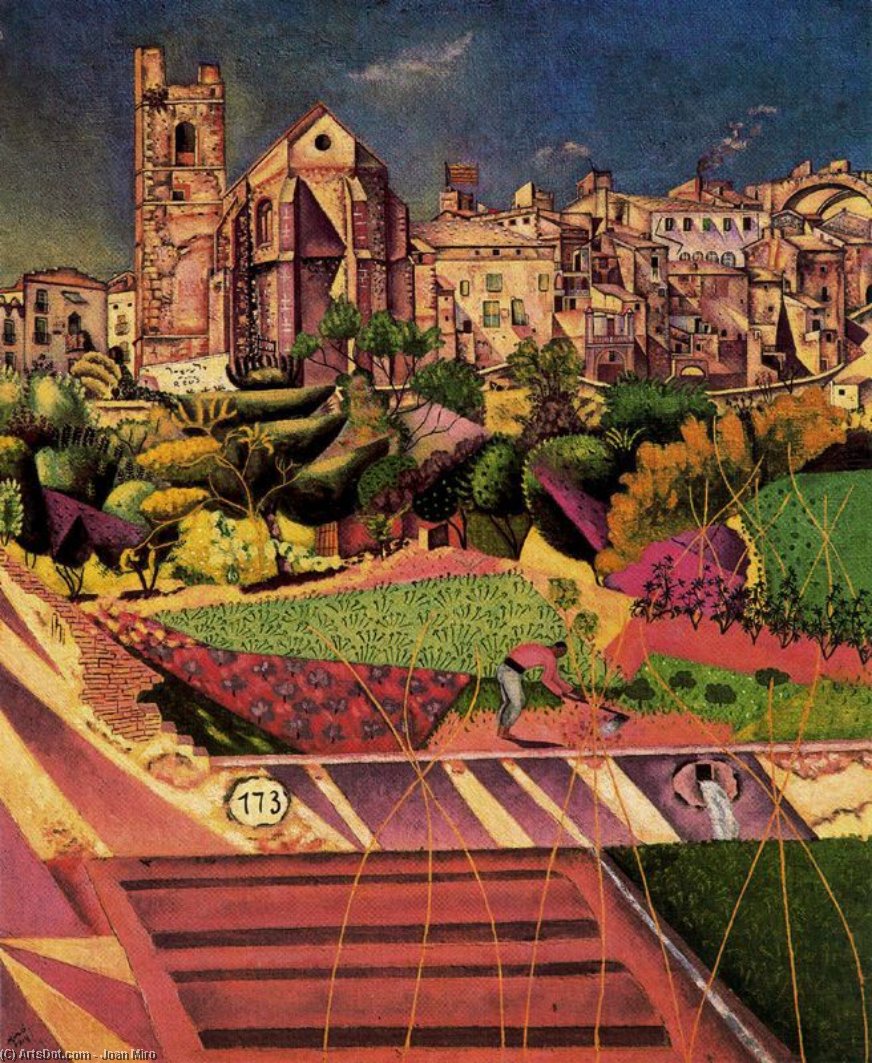
Montroig, la iglesia y el pueblo: A Glimpse into Miró's Catalan Roots
The painting Montroig, la iglesia y el pueblo (Montroig, the church and the village) is a captivating work created in 1919 by the renowned Spanish artist Joan Miró. This piece offers a fascinating window into his early artistic development, showcasing a keen observational eye and a deep connection to the natural world. The painting depicts the village of Montroig, located in rural Tarragona, Spain—a place that held immense personal significance for Miró, serving as a constant source of inspiration throughout his career.
The Significance: A Bridge Between Realism and Surrealism
Montroig, la iglesia y el pueblo is more than just a landscape; it's an early exploration of the themes that would later define Miró’s signature surrealist style. While rooted in observation—the church steeple piercing the sky, the clustered houses, the figures populating the scene—the painting possesses a dreamlike quality. The composition isn't strictly realistic; elements are simplified and stylized, hinting at an underlying symbolic language. The inclusion of seemingly ordinary details – people with an umbrella – injects vibrancy and narrative into the otherwise tranquil setting. This work demonstrates Miró’s burgeoning ability to capture the essence of his subject matter while subtly moving away from purely representational art.
Artistic Style and Technique: Early Foundations
Executed in oil on canvas (measuring 73 x 60 cm), Montroig, la iglesia y el pueblo exemplifies Miró’s early artistic style. The artist's hand is evident in the visible brushstrokes and layered application of paint. The painting is signed by Miró in the lower left corner, a testament to his growing confidence as an artist. This period marks a crucial stage in Miró’s development, laying the groundwork for his later contributions to Surrealism and Abstract Art. The use of color, while not yet fully abstracted, demonstrates a move beyond purely naturalistic representation; hues are chosen to evoke mood and atmosphere rather than simply mirroring reality.
Comparison with Other Works: Tracing Miró's Evolution
Comparing Montroig, la iglesia y el pueblo to later works like Pájaro en la noche (Bird in the Night) reveals a clear trajectory in Miró’s artistic evolution. While his subsequent pieces often embraced more abstract forms and surrealist imagery, this earlier work retains a stronger connection to observable reality. However, even within this early style, we see the seeds of his later innovations—the simplification of shapes, the expressive use of color, and the underlying sense of playful imagination that would become hallmarks of Miró’s artistic vision. Montroig, la iglesia y el pueblo stands as a significant example of his formative years, offering valuable insight into the development of one of the most influential artists of the 20th century.
Further Exploration