A Portrait of Dreams and Catalan Identity
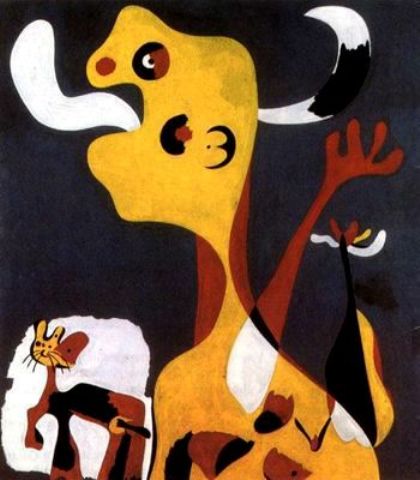
Joan Miró’s “Mujer y perro cara a la luna” (“Woman and Dog Facing the Moon”) transcends mere visual representation; it embodies the spirit of Surrealism and delves into the subconscious depths of Catalan culture. Painted in 1936, during a period marked by political upheaval and artistic experimentation—specifically coinciding with the Spanish Civil War—the artwork serves as a poignant reflection on anxieties surrounding conflict and an affirmation of resilience.
Born in Barcelona in 1893, Miró’s formative years were steeped in the vibrant atmosphere of Gaudí’s architectural legacy. This fascination for organic forms would permeate his artistic endeavors, shaping his distinctive style characterized by biomorphic shapes, simplified lines, and a palette dominated by earthy hues punctuated with bursts of color.
Stylistic Innovation: Abstract Expressionism Meets Catalan Folklore
Miró’s approach to painting defied conventional realism. He embraced abstraction as a vehicle for conveying emotion and exploring inner landscapes—a technique that aligns seamlessly with the burgeoning movement of Abstract Expressionism in America. However, unlike many of his contemporaries who sought purely formal explorations, Miró infused his work with elements rooted in Catalan folklore and mythology.
The composition itself is deliberately unsettling yet captivating. A woman’s figure—a recurring motif in Miró's oeuvre—is positioned alongside a dog’s head, which rests upon her shoulder. The dog’s open mouth suggests a gesture of repose or perhaps even yearning, creating an interplay between stillness and vulnerability.
Symbolism Under Moonlight
The moon dominates the canvas, serving as both a visual focal point and a symbolic representation of contemplation and transformation. Miró's use of color—primarily ochre and crimson—further amplifies the artwork’s emotional resonance. These hues evoke feelings of warmth, passion, and primal instinct.
Adding to the surrealist atmosphere are subtle details: two birds scattered across the background—one on the left and another near the top right corner—represent freedom and aspiration. A solitary cat nestled in the lower left quadrant embodies quiet observation and resilience. Collectively, these elements contribute to a tapestry of imagery that invites viewers to contemplate themes of solitude, vulnerability, and the enduring power of nature.
Technical Mastery: Pochoir Printing
“Mujer y perro cara a la luna” was executed using oil on canvas—a medium favored by Miró for its ability to capture nuanced tonal variations. However, what distinguishes this particular reproduction is its printing technique: pochoir. This method involves transferring ink onto paper through stencils, resulting in exceptionally precise and luminous prints that faithfully reproduce the artist’s original vision.
The Museo Nacional Centro de Arte Reina Sofía houses a stunning example of this artwork, offering visitors an opportunity to experience Miró's distinctive style firsthand. Its enduring appeal lies not only in its aesthetic beauty but also in its profound exploration of human emotion and the subconscious—a testament to Miró’s genius as one of the most influential artists of the 20th century.