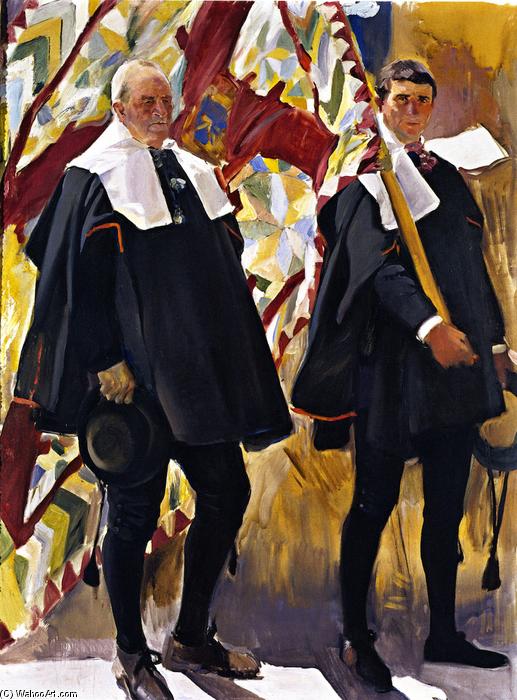
Joaquin Sorolla’s ‘Roncal Valley Types,’ a captivating black and white portrait from 1912, showcases the Spanish artist's mastery of light and human form. This intimate scene featuring two men in distinctive striped ties offers a glimpse into daily life during the early 20th century. Discover this stunning artwork and bring its timeless beauty into your space.
Roncal Valley Types: A Portrait of Spanish Identity
Joaquin Sorolla y Bastida’s “Roncal Valley Types,” painted in 1912, is more than just a depiction of two men; it's a carefully constructed evocation of the spirit of Spain at the turn of the century. This remarkable oil on canvas, measuring an impressive 508 x 381 cm, captures a moment of quiet contemplation within the rugged beauty of the Roncal Valley, offering a glimpse into the lives and traditions of its inhabitants. The painting’s stark black and white palette amplifies the drama and emphasizes the textures – the rough wool of their coats, the crisp lines of their ties, and the weathered faces etched with experience – creating an immediate sense of timelessness.
Sorolla's Masterful Technique: Light and Human Form
Sorolla’s genius lies in his ability to translate light into palpable emotion. He was a master of capturing the effects of sunlight, particularly evident in the way it illuminates the men’s faces and casts dramatic shadows across their forms. His brushwork is loose yet precise, conveying both the physicality of the subjects and the atmospheric quality of the valley. The use of chiaroscuro – the contrast between light and dark – dramatically emphasizes the textures of their clothing and adds a layer of depth to the composition. This technique, honed during his studies in Rome, reflects Sorolla’s deep understanding of classical principles combined with his uniquely Spanish sensibility.
Symbolism Within the Everyday
- Traditional Attire: The men's distinctive ties – one blue and white, the other red and white – are not merely decorative; they represent regional identity and social standing. Such details were characteristic of Sorolla’s approach, elevating ordinary subjects to the level of artistic significance.
- The Roncal Valley Setting: The backdrop of the Roncal Valley itself is symbolic of Spain's enduring connection to its rural roots. It represents a world untouched by rapid industrialization and offers a poignant reminder of a simpler way of life.
- Portraiture as Narrative: As a portrait painter, Sorolla was interested in capturing not just appearances but also the character and spirit of his subjects. These men are presented with dignity and respect, inviting viewers to contemplate their stories.
Historical Context and Artistic Legacy
"Roncal Valley Types" was created during a period of significant social and artistic change in Spain. Sorolla’s work reflects the growing interest in portraying everyday life with honesty and realism, moving away from purely historical or mythological subjects. His influence can be seen in the works of subsequent generations of Spanish artists. Sorolla's dedication to capturing the light and atmosphere of his native land established him as one of Spain’s most important painters of the early 20th century. To truly appreciate this work, a visit to the Museo Sorolla in Madrid is highly recommended, where you can see many more examples of his celebrated oeuvre, including “The Siesta” and “Types of La Mancha, The White Donkey.”