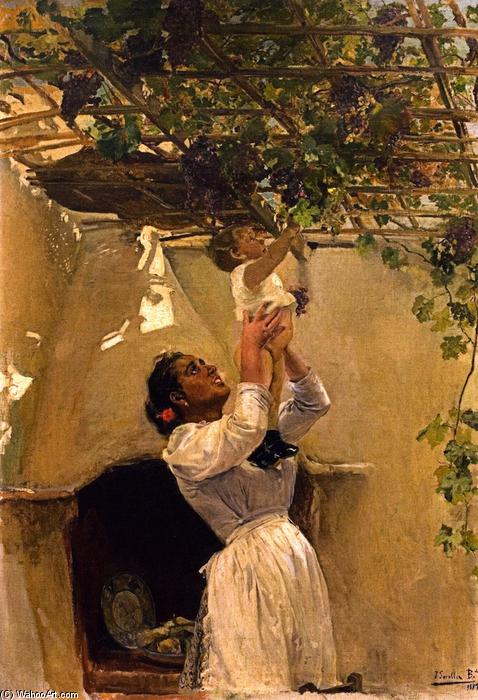
Experience the luminous beauty of Joaquín Sorolla’s ‘The Grapevine,’ a captivating 1897 oil painting depicting a serene mother and child under a grapevine. This Spanish masterpiece, measuring 94x64cm, showcases Sorolla's signature style and evokes warmth. Discover this stunning artwork.
A Moment of Serenity: Exploring Joaquín Sorolla’s ‘The Grapevine’
Joaquín Sorolla y Bastida's “The Grapevine,” painted in 1897, is more than just a charming depiction of a mother and child; it’s a masterful distillation of light, warmth, and the quiet beauty of everyday life – hallmarks of the artist’s distinctive style. Measuring 94 x 64 cm, this oil on canvas work immediately draws the viewer into a scene brimming with a palpable sense of peace, achieved through Sorolla's signature technique of capturing fleeting moments bathed in brilliant sunlight.
- Subject Matter: The painting centers around a tender tableau – a woman gently holding her infant child beneath the sheltering branches of a grapevine. This simple subject matter is elevated by Sorolla’s meticulous attention to detail and his ability to convey genuine emotion.
- Technique: Sorolla was renowned for his *alla prima* technique, meaning he painted directly onto the canvas without extensive underpainting. This resulted in vibrant colors, loose brushstrokes, and a remarkable sense of immediacy. The way light dances across the woman’s dress and the grapes is a testament to his mastery of capturing natural illumination.
- Composition: The composition itself is carefully balanced, with the figures occupying the foreground and a suggestion of an open-air setting in the background – perhaps a shaded courtyard or garden. A simple chair adds to the feeling of domestic tranquility.
The Painter’s Palette: Sorolla's Luminist Style
Sorolla was a key figure within the Spanish *luminismo*, an artistic movement that sought to capture the effects of light and atmosphere with unparalleled realism. Influenced by Impressionism, but firmly rooted in Spanish tradition, Sorolla employed a palette dominated by warm yellows, greens, and blues – colors he expertly manipulated to evoke a sense of warmth and optimism. The use of broken color, layering thin washes of paint, created a shimmering effect that seemed to bring the scene to life. This technique is particularly evident in the rendering of the sunlight filtering through the grapevine leaves, creating dappled patterns on the figures and the surrounding foliage.
Historical Context & Symbolism
Created during a period of significant social and artistic change in Spain, “The Grapevine” reflects Sorolla’s interest in portraying scenes of everyday life – a deliberate departure from the grand historical or mythological subjects favored by many of his contemporaries. The grapevine itself carries symbolic weight, representing fertility, abundance, and connection to nature. The image of a mother protecting her child is a timeless motif, resonating with universal themes of love, nurture, and family. Painted in 1897, the work reflects the burgeoning interest in realism and naturalism within Spanish art.
A Legacy of Light: Sorolla’s Enduring Appeal
Joaquín Sorolla y Bastida's “The Grapevine” stands as a testament to his extraordinary talent and his ability to capture the essence of human experience. His works, now held in prestigious collections like the Museo de la Real Academia de San Fernando in Madrid, continue to captivate audiences with their luminous beauty and emotional resonance. ArtsDot offers meticulously crafted hand-painted reproductions that allow you to bring this iconic masterpiece into your own space, experiencing firsthand the magic of Sorolla’s vision.