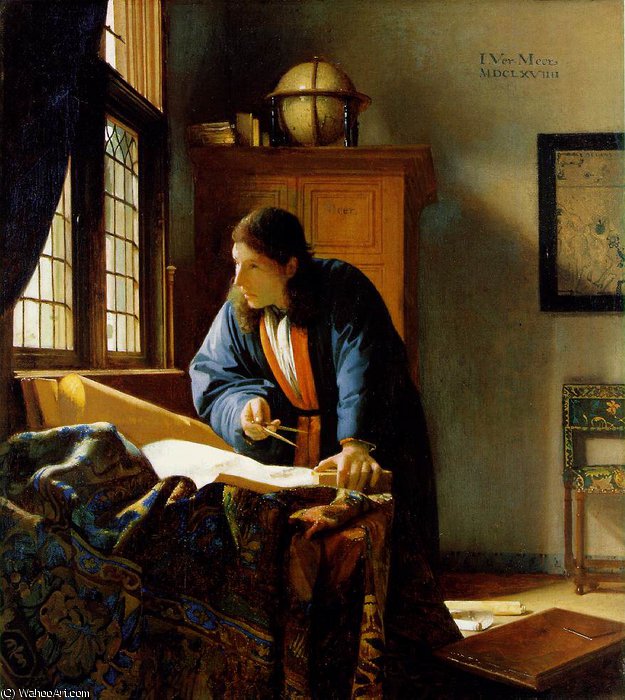
Geographer

Delft’s Johannes Vermeer captures serene contemplation in ‘The Geographer,’ a luminous 1669 oil painting depicting a scholar absorbed in a map and book—a quintessential emblem of Dutch Golden Age intellect. Bring this timeless masterpiece into your home with a beautifully crafted reproduction.


Johannes Vermeer (1632 - 1675)

Explore Johannes Vermeer (1632-1675), Dutch Master of light & intimate scenes. Discover 'Girl with a Pearl Earring' & his iconic Golden Age paintings, renowned for realism and tranquility.

A Portrait of Thoughtful Observation

  • Subject Matter: Johannes Vermeer’s “The Geographer,” painted in 1669, depicts a solitary man seated at a desk, engrossed in studying a large map adorning the wall. Alongside him rests a book, suggesting an intellectual preoccupation—a cornerstone of Vermeer's artistic vision.
  • Style: Characteristic of Vermeer’s oeuvre is his masterful use of chiaroscuro – dramatic contrasts between light and shadow – which imbues the scene with an ethereal quality. This technique elevates the mundane act of map reading into a moment of profound contemplation, mirroring the artist's own fascination with capturing fleeting impressions.

Technical Brilliance: Vermeer’s Mastery of Light

  • Technique: Vermeer employed meticulous layering of thin glazes—a hallmark of Delft painting—to achieve remarkable luminosity and depth. The subtle gradations of color create an illusionistic effect, convincingly simulating the textures of paper, fabric, and wood. This painstaking process underscores Vermeer’s dedication to realism while simultaneously conveying a sense of idealized beauty.
  • Materials: Primarily oil paint on canvas was utilized, demonstrating Vermeer's understanding of pigment mixing and surface preparation—skills honed through his father’s trade as an art dealer.

Historical Context: Delft During the Golden Age

  • Era: “The Geographer” emerged during the Dutch Golden Age (approximately 1648-1702), a period marked by unprecedented artistic flourishing and economic expansion. Vermeer’s work reflects the intellectual curiosity of his time—a fascination with science, geography, and humanist ideals—values championed by thinkers like René Descartes.
  • Social Significance: The painting speaks to the burgeoning bourgeois culture of Delft, where educated men pursued knowledge alongside practical pursuits. Vermeer’s depiction captures a scene from everyday life elevated through artistic skill, embodying the spirit of the era.

Symbolism and Emotional Resonance

  • Iconography: The map itself symbolizes exploration, discovery, and intellectual ambition—themes central to Vermeer’s worldview. The book represents learning and contemplation, reinforcing the image's core message of focused thought. Furthermore, the globe subtly hints at Vermeer’s awareness of the wider world beyond Delft.
  • Emotional Impact: “The Geographer” evokes a feeling of quiet solitude and intellectual engagement—a poignant reminder of the human desire for understanding and beauty. Its luminous palette and masterful composition invite viewers to immerse themselves in the scene’s contemplative atmosphere.