The Concert: A Window into Delft’s Golden Age
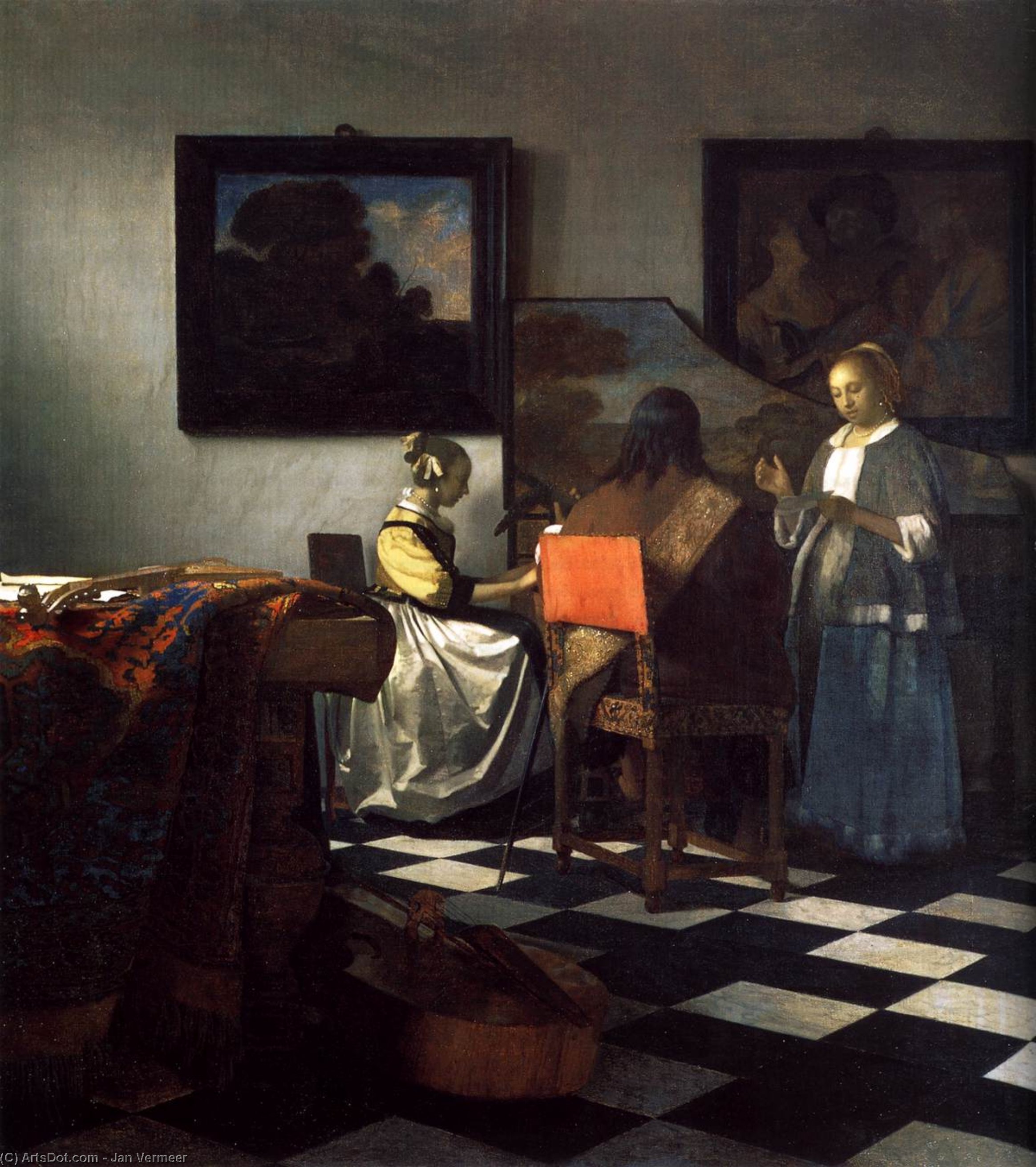
Johannes Vermeer's "The Concert," painted circa 1664-65, isn’t merely a depiction of musicians; it’s a meticulously crafted portal into the heart of 17th-century Dutch domestic life. Housed within the Isabella Stewart Gardner Museum in Boston – though tragically missing from its walls since 1990 – this painting transcends its subject matter to become a profound meditation on social harmony, artistic performance, and the quiet beauty of everyday moments. The scene unfolds within a modestly furnished room, bathed in a soft, diffused light that seems to emanate not just from an unseen window but also from the very fabric of the artwork itself. The muted palette—a symphony of browns, blues, and yellows—evokes a sense of intimacy and warmth, drawing the viewer into this private performance.
Vermeer’s mastery lies in his ability to capture not just appearances but the subtle nuances of human interaction. The figures – a woman playing the lute, a man with a violin, and another seated at a virginal (a keyboard instrument resembling a harpsichord) – are rendered with an astonishing level of detail. Note the delicate folds of the woman’s dress, the precise arrangement of her hands on the lute strings, or the focused expression on the violinist's face. These aren’t idealized portraits; they possess a palpable sense of realism, reflecting Vermeer’s meticulous observation of his surroundings and subjects.
A Room Within a Room: Setting and Symbolism
The room itself is crucial to understanding the painting’s significance. It's not a grand salon or a formal concert hall; it’s a comfortably furnished chamber, suggesting a private gathering among friends or family. The checkered floor, a recurring motif in Vermeer’s work, adds depth and perspective to the composition, grounding the scene in a tangible reality. The two paintings hanging on the wall – one depicting a landscape with trees and clouds, and another showing a figure that may be a self-portrait of Vermeer himself – are not mere decorative elements; they subtly enrich the narrative, hinting at the artist’s own engagement with art and his place within the cultural landscape of Delft.
The virginal, a keyboard instrument favored by women during this period, is particularly noteworthy. Its presence underscores the role of music in domestic life and suggests a scene of refined entertainment. The lute player's posture, slightly turned away from the viewer, invites us to become part of the performance, as if we are seated among the audience.
The Mystery of the Arcadian Landscape
Perhaps the most intriguing element of "The Concert" is the landscape depicted above the harpsichord. This isn’t a straightforward representation of nature; it's an idealized Arcadia—a pastoral paradise reminiscent of classical mythology and Renaissance art. Art historians have debated its meaning for decades, with some suggesting it represents the harmony between humanity and nature, while others interpret it as a symbol of death or decay, referencing the Dutch painter Jacob van Ruisdael’s penchant for depicting barren landscapes. Vermeer's choice to include this element adds a layer of complexity to the painting, inviting viewers to contemplate its multiple interpretations.
A Lost Masterpiece and Enduring Legacy
The theft of "The Concert" in 1990 was a devastating blow to the art world, but it also served to amplify Vermeer’s already growing fame. The painting's disappearance fueled international media coverage and sparked renewed interest in his work. Despite its absence from public view for over three decades, “The Concert” remains one of the most celebrated paintings of the Dutch Golden Age, a testament to Vermeer’s extraordinary talent and his ability to capture the essence of human experience with remarkable precision and emotional depth. Reproductions of this iconic artwork continue to inspire awe and admiration, offering a glimpse into a bygone era and reminding us of the enduring power of art to transport us to another time and place.