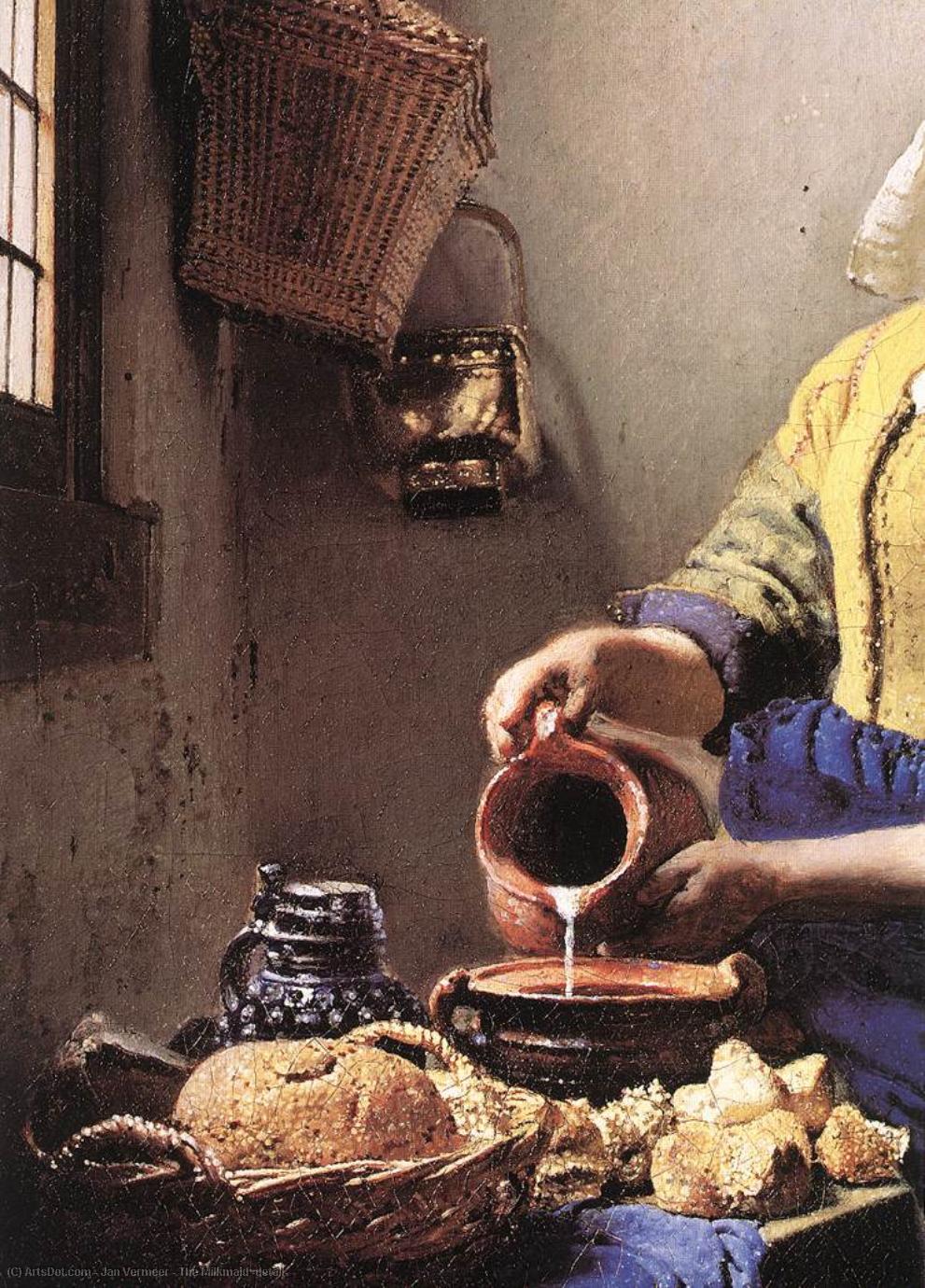
The painting emerged during the Dutch Golden Age (c. 1600–1700), a period marked by unprecedented artistic innovation and economic prosperity. Vermeer’s work aligns with broader trends in Northern European art of the era, characterized by meticulous observation of everyday life and an emphasis on illusionistic realism.
Explore Johannes Vermeer (1632-1675), Dutch Master of light & intimate scenes. Discover 'Girl with a Pearl Earring' & his iconic Golden Age paintings, renowned for realism and tranquility.
Rijksmuseum
(Amsterdam, Netherlands)
Explore Dutch art & history at the Rijksmuseum Amsterdam! Marvel at Rembrandt, Vermeer & Van Gogh masterpieces in an iconic landmark – a journey through 800 years of culture.
The Milkmaid (detail) – Vermeer’s Quiet Mastery
Johannes Vermeer, a name synonymous with the quiet intimacy of 17th-century Dutch life, remains an enigma despite centuries of scholarship. Born in Delft in October 1632, his existence unfolded against the backdrop of the Dutch Golden Age—a period of unprecedented prosperity, artistic innovation, and burgeoning civic pride. His father, Reijnier Janszoon, was a silk weaver and art dealer, a combination that subtly shaped young Johannes’s path. Exposure to both the tactile world of craftsmanship and the discerning eye of the art market instilled in him an understanding of materials, composition, and the delicate dance between creation and commerce. This early immersion wasn't merely observational; it provided a foundation upon which Vermeer would build his own unique artistic vision. He wasn’t born into privilege, but rather into a world where artistry was interwoven with everyday practicality, a sensibility that would profoundly influence his oeuvre.
A Snapshot of Domestic Tranquility
“The Milkmaid” (Dutch: De melkmeid or Het melkmeisje), sometimes called “The Kitchen Maid,” is an oil-on-canvas painting of a “milkmaid,” in fact, a domestic kitchen maid, by the Dutch artist Johannes Vermeer. It’s housed at the Rijksmuseum in Amsterdam, Netherlands, which regards it as “unquestionably one of the museum's finest attractions.” The exact year of completion is unknown, with estimates varying by source; the Rijksmuseum posits circa 1658. According to the Metropolitan Museum of Art in New York City, it was painted around 1657 or 1658. The “Essential Vermeer” website gives a broader range of 1658–1661.
The painting depicts a young woman pouring milk from a jug into a large earthenware bowl on a table—a scene remarkably simple yet imbued with profound artistic significance. Vermeer’s masterful use of light is a hallmark of his style, mirroring the luminous interiors that characterize many of his celebrated works. As seen in other paintings by Vermeer, such as those featured on ArtsDot.com, his technique relies heavily on layering thin glazes of pigment—a painstaking process that captures the subtle nuances of illumination and texture with breathtaking accuracy. The resulting image is bathed in a soft, diffused glow emanating from the window behind her, highlighting the contours of the woman’s body and emphasizing the textures of the bread crusts and the earthenware vessel.
Symbolism Within Simplicity
Beyond its technical brilliance, “The Milkmaid” resonates with symbolic depth. Vermeer's meticulous attention to detail—the loaf of bread, the basket, the window—creates a rich context for interpreting the scene’s emotional impact. The woman’s posture exudes calm concentration, conveying a sense of dedication to her task and hinting at an inner life beyond the confines of domestic routine. Scholars have debated whether Vermeer intended to portray a moment of contemplation or simply to depict the mundane realities of daily existence—a distinction that underscores the painting's enduring fascination for viewers across centuries. The Rijksmuseum, where “The Milkmaid” resides, attracts over 2 million visitors annually, showcasing its importance as a cornerstone of Dutch artistic heritage alongside masterpieces by Rembrandt and Frans Hals. As noted on ArtsDot.com, the museum’s collection comprises over 1 million objects, including works by other renowned Dutch artists. For more information on Johannes Vermeer and his works, visit Wikipedia.
A Legacy Enduring Through Time
“The Milkmaid” is a timeless masterpiece that continues to captivate art lovers around the world. Its beauty, simplicity, and sense of tranquility make it a must-see for anyone interested in Dutch art and culture. As a testament to Vermeer’s skill and artistry, “The Milkmaid” remains an iconic work of art that inspires contemplation on themes of domestic life, faith, and human connection—a reflection of the values prevalent during the Dutch Golden Age. Its enduring appeal speaks to the artist's ability to distill complex emotions into deceptively understated visual forms, cementing Vermeer’s place as one of history’s most influential painters.