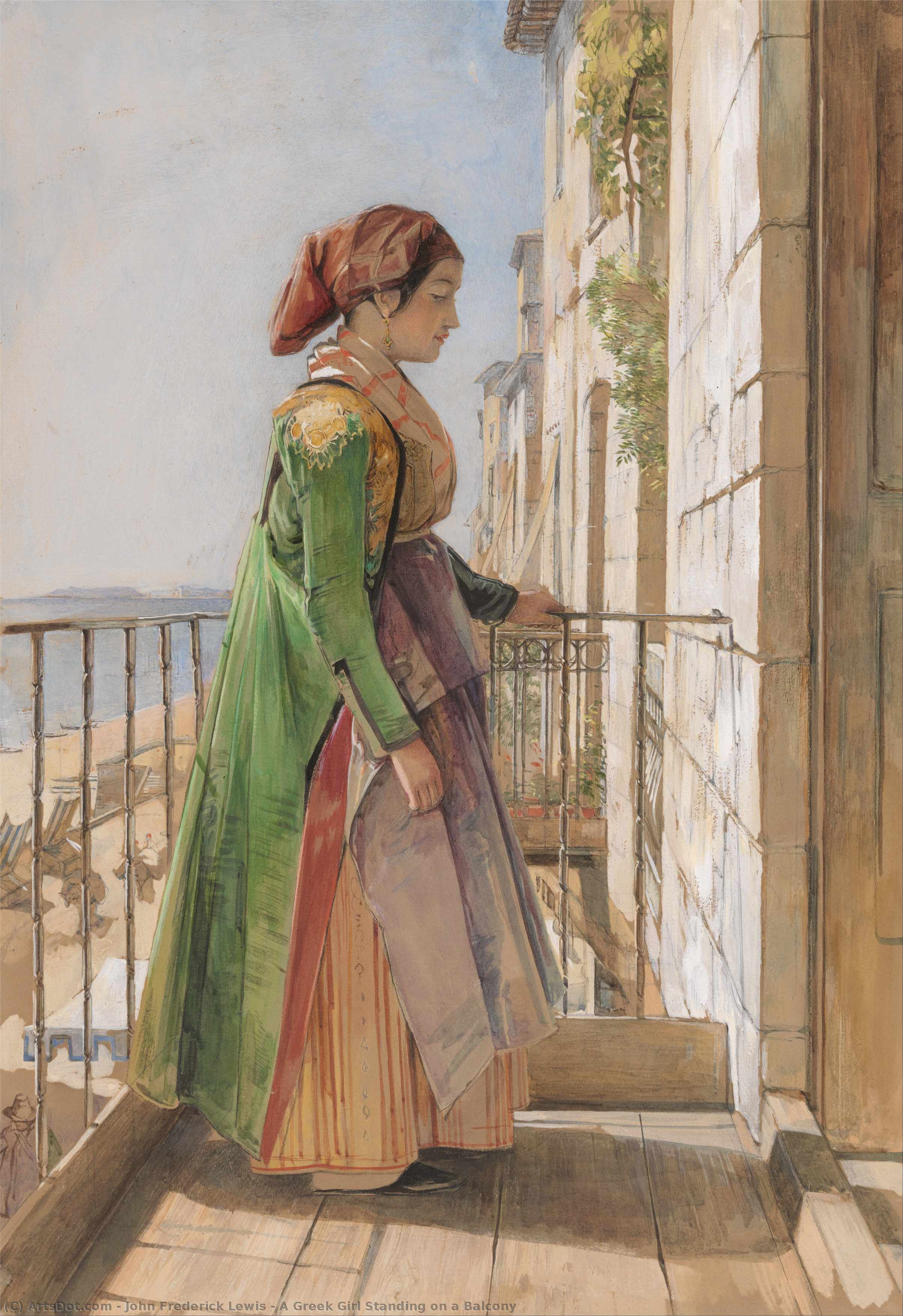
Experience the ethereal glow of John Frederick Lewis's 1840 watercolor, capturing delicate Orientalist beauty on a sun-drenched balcony overlooking the azure sea; discover this masterpiece today.
Discover John Frederick Lewis's captivating Orientalist paintings! Explore detailed scenes of Egypt, Spain & Morocco in watercolor & oil. A 19th-century master.
Explore British art's evolution at the Yale Center for British Art! From Hogarth to Turner, discover masterpieces in a Louis Kahn-designed space—a hub for scholarship and vibrant exhibitions.
A Greek Girl Standing on a Balcony – An Ode to Delicate Beauty and Orientalist Vision
The watercolor painting “A Greek Girl Standing on a Balcony,” created in 1840 by John Frederick Lewis, transcends mere depiction; it embodies the spirit of Orientalism—a movement that sought to capture exotic landscapes and cultures through European artistic sensibilities. More than just a visual record, this artwork speaks volumes about Victorian aesthetics and the fascination with idealized femininity within the broader context of the era.
The Artist’s Vision: John Frederick Lewis – Pioneer of Watercolor Technique
John Frederick Lewis (1804-1876), born in London, stands as one of Britain's foremost watercolorists. His formative years under Sir Thomas Lawrence instilled a profound understanding of composition and meticulous detail—skills he would expertly apply throughout his prolific career. Unlike the dramatic chiaroscuro favored by artists like Eugène Delacroix, Lewis championed a luminous palette achieved through layering gouache over watercolor, resulting in an ethereal glow that distinguishes his work from its contemporaries. This technique wasn't merely stylistic; it reflected a desire to convey subtlety and nuance—qualities paramount in capturing the essence of distant lands and subjects.
A Scene Steeped in Atmosphere: Athens and Beyond
The painting transports us to Athens, circa 1840, albeit viewed from afar. The balcony itself serves as a focal point, framing a woman dressed in elegant Grecian attire—a deliberate nod to classical ideals of beauty. Her posture exudes composure and grace, mirroring the Victorian fascination with idealized femininity. Behind her stretches an expanse of azure ocean, punctuated by distant buildings rendered in muted tones – creating a harmonious blend of color and texture that evokes tranquility and contemplation. The artist’s careful attention to light—particularly the dappled sunlight filtering through foliage—further enhances the scene's atmospheric quality.
Symbolism Within Detail: Costume Design and Artistic Expression
Lewis’s masterful costume design is noteworthy. The woman’s gown, adorned with intricate floral patterns, embodies Victorian fashion trends while simultaneously referencing Grecian drapery – a symbolic gesture reflecting the movement’s preoccupation with reviving classical forms. Furthermore, observe the meticulous stippling technique employed to depict her face—a hallmark of Lewis's style that conveys an astonishing level of realism and sensitivity. This painstaking detail underscores his commitment to capturing not just appearances but also emotional nuance. The painting isn't simply a representation; it’s an exploration of beauty, grace, and the artist’s ability to distill complex ideas into visual form.
Legacy and Influence: Watercolor’s Golden Age
“A Greek Girl Standing on a Balcony” exemplifies Lewis’s contribution to watercolor’s golden age—a period characterized by unprecedented artistic innovation and stylistic refinement. Critics lauded his work for its “mixed ease and severity of drawings, marvels of minute execution, extraordinary delicacy as well as beauty of color,” cementing his reputation as the undisputed champion of watercolor technique. This painting continues to inspire artists today, demonstrating the enduring power of observation, meticulous craftsmanship, and a profound appreciation for artistic expression. Its serene composition and luminous palette serve as a testament to Lewis’s visionary approach—a legacy that resonates powerfully within the annals of British art history.