A Moment of Shared Joy: Unpacking the Charm of “A Surprise Party”
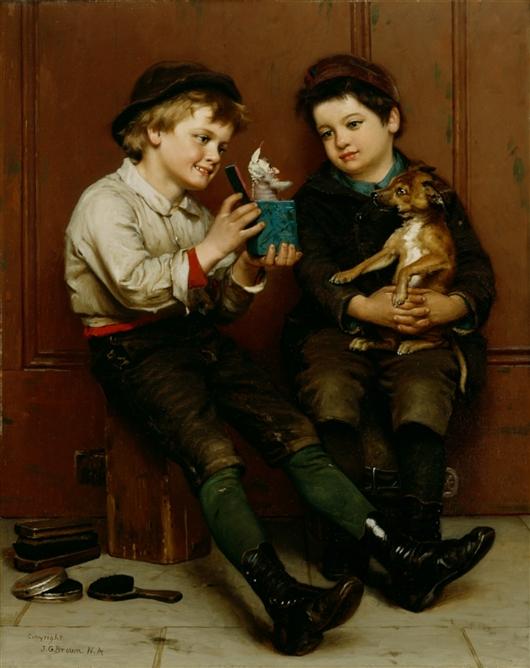
John George Brown’s “A Surprise Party,” painted in 1888, isn't merely a snapshot of childhood; it’s a tender distillation of American sentiment during a period of rapid transformation. The scene unfolds within a modestly furnished parlor – a space both familiar and imbued with a quiet warmth – where two young boys, clearly the center of attention, are engaged in playful interaction alongside their canine companions. The painting immediately draws the eye with its carefully rendered details: the worn but comfortable furniture, the clock on the wall hinting at the passage of time, and the book resting open on a nearby table, suggesting an interlude between moments of joyful play. Brown’s masterful use of light – diffused and gentle – creates an atmosphere of intimacy and contentment, inviting the viewer into this private, cherished moment.
Technically, Brown employs a realistic style, characteristic of his genre paintings. He meticulously captures the textures of fabric, wood, and fur, demonstrating a keen eye for observation honed through years of working as a glass cutter. The brushstrokes are generally smooth and controlled, contributing to the painting’s overall sense of quiet composure. However, it's not simply realism that defines Brown’s work; he imbues his scenes with a subtle emotional resonance, evident in the boys’ expressions of delight and the dogs’ attentive gazes. The color palette is muted yet harmonious – browns, creams, and greens dominate – reflecting the domestic setting and reinforcing the painting’s feeling of comfort and familiarity.
The Victorian Context: Childhood and Sentiment in American Art
To fully appreciate “A Surprise Party,” it's crucial to understand the social and artistic climate of late 19th-century America. The period witnessed a burgeoning middle class eager to embrace domesticity and celebrate family life. Artists like Brown responded to this shift by depicting scenes of everyday American life, particularly those centered on childhood. This fascination with children wasn’t simply sentimental; it reflected a growing awareness of their vulnerability and the importance of nurturing their development. Brown's work aligns with this trend, offering a glimpse into a world where simple pleasures – companionship, play, and shared moments – were valued above all else.
Furthermore, Brown’s career trajectory is itself a compelling narrative. An immigrant from England who found success in the American art market, he skillfully navigated the demands of his patrons while retaining a deep affection for the subjects he painted. His ability to capture the essence of American childhood – its innocence, its resilience, and its inherent charm – cemented his place as one of the era’s most beloved genre painters. The painting speaks volumes about Brown's own journey and his understanding of the values that defined the burgeoning American identity.
Symbolism and Emotional Resonance
Beyond its technical merits, “A Surprise Party” is rich in symbolic meaning. The presence of the dogs suggests loyalty, companionship, and a shared joy. The clock on the wall serves as a subtle reminder of time passing, emphasizing the fleeting nature of childhood moments. Even the book, open but unread, hints at an interruption to the boys’ play – a pause for reflection or perhaps simply a desire to momentarily escape into another world. The painting isn't about grand gestures or dramatic events; it’s about the quiet beauty of ordinary moments shared between loved ones.
Ultimately, “A Surprise Party” evokes a powerful sense of nostalgia and warmth. It captures a fleeting moment of pure joy – a testament to the simple pleasures of childhood and the enduring value of human connection. It's a painting that invites us to slow down, appreciate the beauty in everyday life, and cherish the moments we share with those closest to us.