Discover John George Brown (1831-1913), a British-American painter celebrated for his charming genre scenes of American childhood & Victorian life. Explore reproductions and learn about his legacy!
Explore the Palacio Real de Madrid, Spain's regal palace! Discover Baroque & Neoclassical architecture, masterpieces by Velázquez & Goya, and centuries of Spanish history. A UNESCO World Heritage Site.
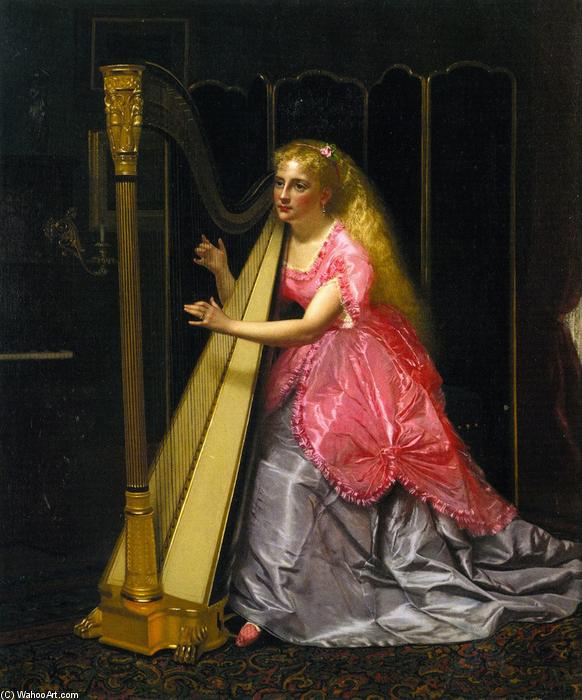
A Portrait of Melancholy and Music: John George Brown’s “The Harpist”
John George Brown's "The Harpist," painted in 1870, is more than just a portrait; it’s a carefully constructed tableau of Victorian sensibilities and burgeoning American artistic aspirations. This evocative work, depicting a woman lost in the delicate strains of two harps, immediately draws the viewer into a world of quiet contemplation and musical beauty. Brown, an English immigrant who established himself as a successful artist in America during this period, masterfully captures a mood – one of wistful reflection and perhaps even a touch of sadness – that resonates deeply with the era’s fascination with romanticism and the burgeoning interest in classical music.
- Subject Matter: The central figure, a woman adorned in pink attire and a delicate blonde hairstyle accented by a pink bow, embodies the idealized feminine form popular in Victorian portraiture. Her posture suggests absorption in her musical endeavor, inviting the viewer to share in her private moment.
- Composition: The arrangement of the harps, violin, and chairs creates a sense of intimacy and domestic tranquility. The placement of the two chairs subtly directs the eye and reinforces the idea of a solitary artistic pursuit.
Technique and Style – A Victorian Masterclass
Brown’s technique is characterized by meticulous detail and a refined understanding of light and shadow, hallmarks of his training in England and honed through years of observation within the American art market. He employs smooth brushwork and subtle gradations of tone to create a remarkably realistic depiction of the woman's features and clothing. The use of pink hues – both in the subject’s attire and the background – contributes significantly to the painting’s overall mood, evoking feelings of tenderness and serenity. The artist demonstrates a clear command of color theory, utilizing complementary colors (pink and green/brown) to create visual harmony and depth.
- Realism with Romantic Touches: While rooted in realism, the painting possesses a distinctly romantic quality, evident in the subject’s melancholic expression and the idealized setting.
- Brushwork: Brown's brushstrokes are controlled and deliberate, contributing to the overall sense of quiet contemplation.
Symbolism and Historical Context
"The Harpist" reflects several key trends of the 1870s. The harp itself was a potent symbol of both ancient Greece and burgeoning Romantic musical movements, representing beauty, harmony, and emotional expression. The inclusion of the violin further emphasizes this connection to music. Furthermore, Brown’s work aligns with the Victorian fascination with childhood innocence and the portrayal of women as muses or artistic inspiration – a common theme in 19th-century art. The date of 1870 places the painting squarely within a period of significant social and economic change in America, marked by industrialization and urbanization, yet Brown’s work offers a poignant counterpoint to this rapid transformation, focusing on a moment of quiet beauty and introspection.
Emotional Impact and Artistic Legacy
Ultimately, “The Harpist” transcends its technical merits to evoke a powerful emotional response. The painting's subdued palette, coupled with the subject’s contemplative pose, creates an atmosphere of profound stillness and melancholy. It is a work that invites viewers to pause, reflect, and perhaps even contemplate their own relationship with music and beauty. John George Brown’s legacy lies not only in his technical skill but also in his ability to capture fleeting moments of human emotion with sensitivity and grace – a quality that continues to resonate with audiences today. This hand-painted reproduction offers an exceptional opportunity to experience the full impact of this remarkable artwork.