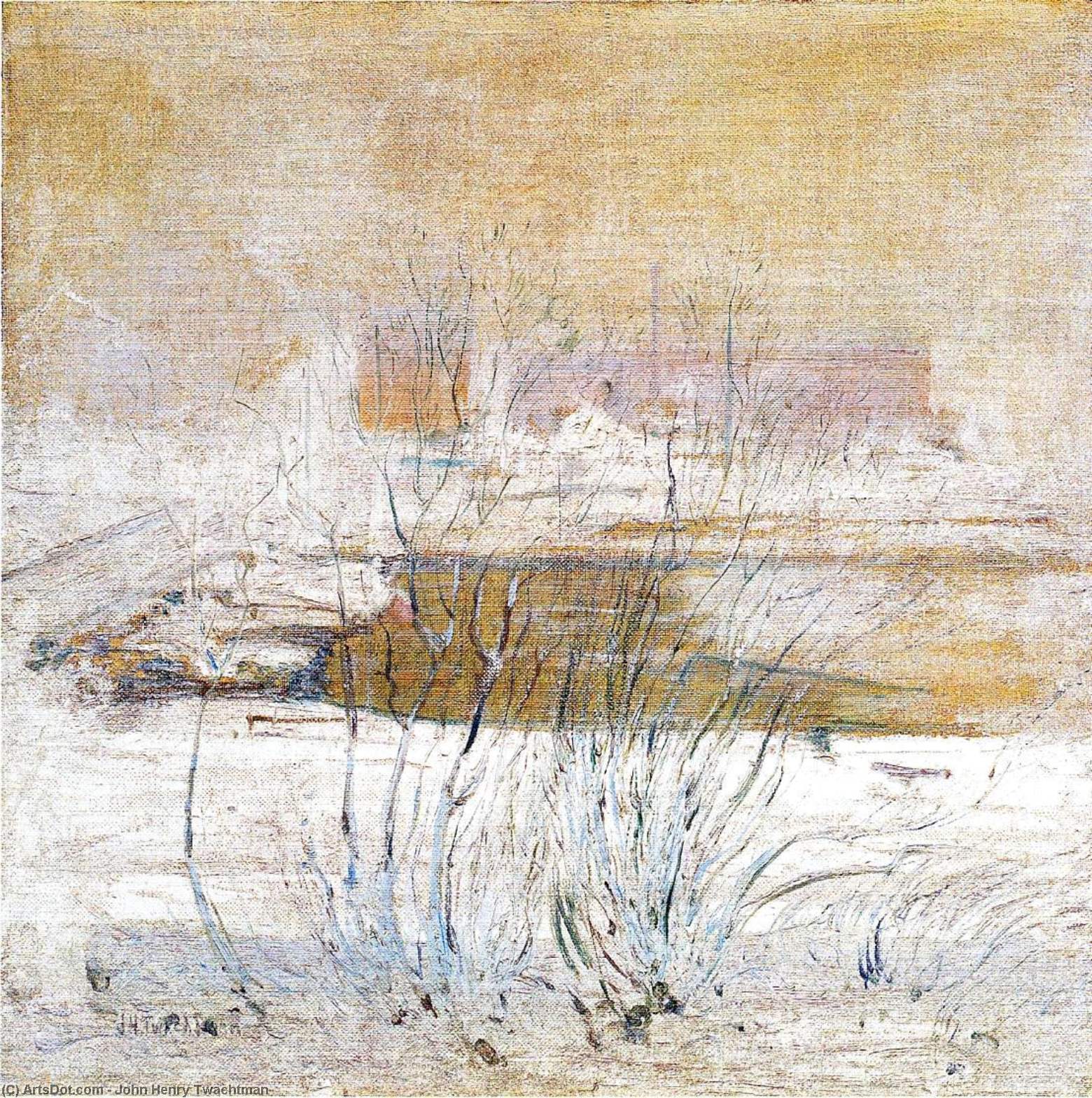
Twachtman skillfully employs Impressionist brushstrokes combined with Tonalist shading to create depth and atmosphere. The use of muted colors enhances the painting's contemplative quality.
The painting's aesthetic appeal and historical importance continue to resonate with collectors worldwide.
Created during the peak of American Impressionism, this painting reflects the movement’s fascination w
John Henry Twachtman (1853-1902): Explore the atmospheric landscapes of this pivotal American Impressionist & Tonalist painter. Discover works like 'Arques-la-Bataille' and his influence on early 20th-century art.
John Henry Twachtman's Bridge in Winter
John Henry Twachtman’s “Bridge in Winter” stands as a cornerstone of American Impressionism and Tonalism, capturing the serene beauty of a winter landscape with remarkable sensitivity to light and atmosphere. Created in 1901, this oil on canvas masterpiece measures 76 x 76 cm and embodies Twachtman's distinctive artistic vision—a harmonious blend of observation and tonal modulation that distinguishes him from many of his contemporaries.
### Composition and Visual Elements
The painting’s central focus is a bridge spanning across water, its snow-covered surface reflecting the muted hues of the sky. Sparse trees punctuate the horizon line, their branches etched against the pale winter light, creating a dramatic interplay of texture and color. Two figures—likely indistinct human forms—are positioned in the distance, subtly adding to the sense of scale and depth within the composition. Twachtman skillfully employs tonal variation – transitioning from darker shades at the base of the trees to lighter tones towards the sky – to convey the chill of winter and establish a palpable feeling of stillness. This technique aligns perfectly with the broader Tonalist movement, prioritizing mood and atmosphere over precise representation.
### Inspiration and Artistic Style
Twachtman’s artistic journey was profoundly influenced by his time spent in Europe, particularly at the Académie Julian in Paris, where he honed his observational skills and embraced innovative approaches to painting. His style is characterized by a meticulous attention to detail combined with an intuitive understanding of how light transforms surfaces—a hallmark of Impressionism. However, unlike many Impressionists who sought to capture fleeting moments of brilliance, Twachtman deliberately subdued the palette, favoring tonal harmonies that evoke contemplation and tranquility. The bridge itself serves as a visual metaphor for connection – perhaps representing the passage of time or the enduring presence of humanity amidst the natural world—a theme prevalent in Romantic art but skillfully revisited by Twachtman through his Impressionistic lens.
### Historical Context and Significance
“Bridge in Winter” emerged during a period of significant artistic experimentation in America, as artists wrestled with how to express emotion and experience within the framework of realism. The painting reflects the broader aesthetic concerns of its time—a desire for beauty rooted in observation and informed by philosophical contemplation. Its inclusion in exhibitions at institutions like Telfair Museum underscores its enduring importance as an exemplar of American landscape art and a testament to Twachtman’s contribution to the development of Impressionism. Collectors and interior designers alike appreciate “Bridge in Winter” for its understated elegance, masterful tonal control, and ability to transport viewers into a captivating winter scene—a timeless portrayal of nature's grandeur.
### Further Exploration
To delve deeper into John Henry Twachtman’s oeuvre, consider visiting https://ArtsDot.com/ to explore his other works, including “Winter Scene” and “Winter.” For scholarly insights into American Impressionism, consult Wikipedia: https://en.wikipedia.org/wiki/American_Impressionism. The painting's legacy continues to inspire artists and captivate audiences today.