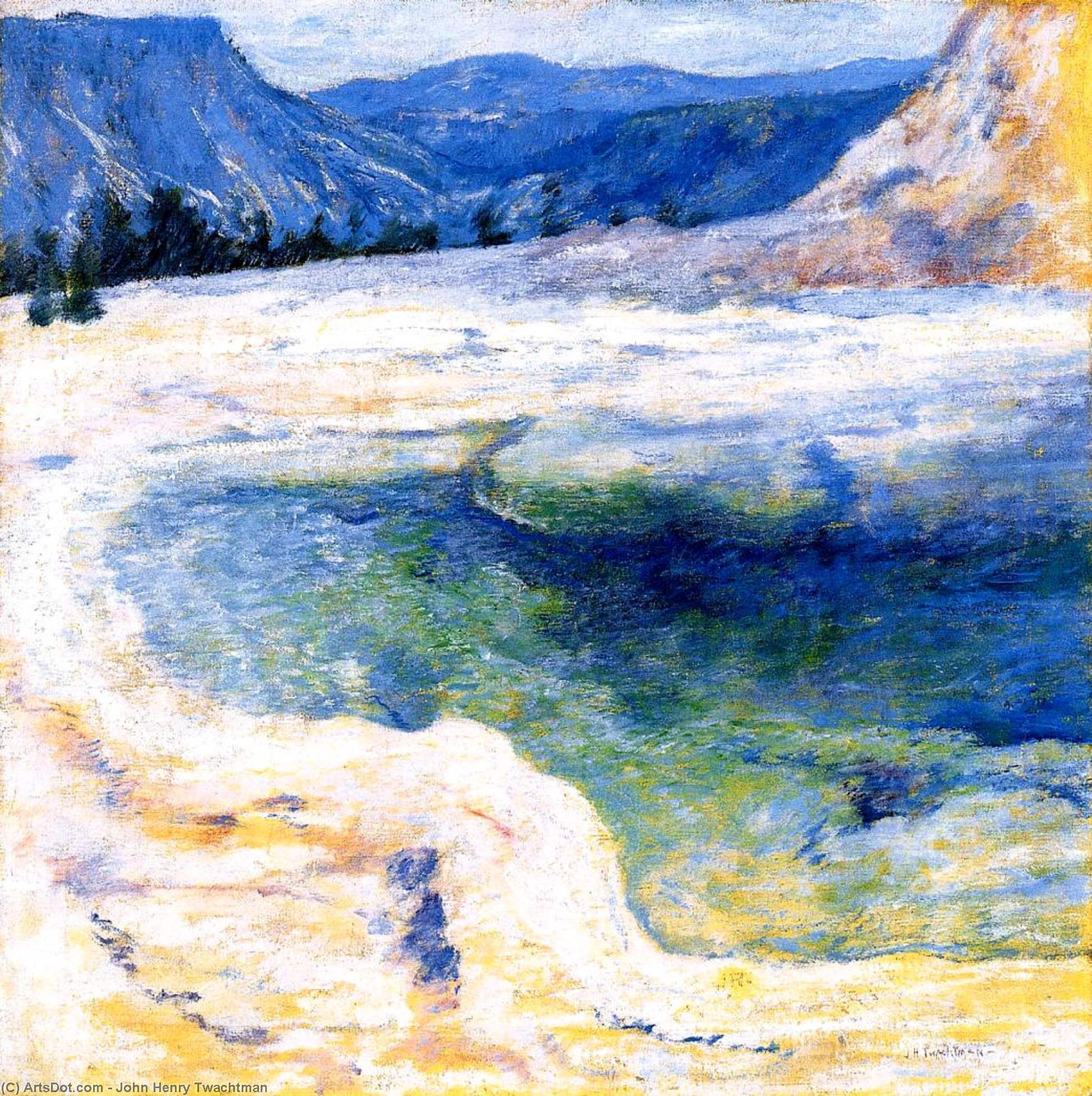
Discover John Henry Twachtman’s ‘Emerald Pool,’ a stunning Impressionist landscape capturing Yellowstone’s beauty. Explore this 1895 oil painting's serene details & artistic vision. #Impressionism #Art
John Henry Twachtman (1853-1902): Explore the atmospheric landscapes of this pivotal American Impressionist & Tonalist painter. Discover works like 'Arques-la-Bataille' and his influence on early 20th-century art.
A Glimpse of Serenity: Exploring Twachtman’s *Emerald Pool*
John Henry Twachtman's *Emerald Pool*, painted in 1895, is a captivating example of American Impressionism at its finest. Measuring 63 x 63 cm, this oil on canvas transports viewers to a tranquil landscape – likely inspired by Yellowstone National Park – where the boundary between reality and atmospheric suggestion beautifully blurs. The scene depicts a serene body of water, reflecting the snow-capped mountains in the distance, framed by delicate trees and brush. It’s not merely a depiction *of* nature, but an evocation *of* its feeling—a quietude that resonates deeply with the soul.
Impressionistic Technique & Tonalist Influences
Twachtman masterfully employs loose, visible brushstrokes and a vibrant yet harmonious color palette to capture the fleeting effects of light and atmosphere. This is quintessential Impressionism – prioritizing sensory experience over precise representation. However, *Emerald Pool* also reveals strong influences from Tonalism, an American artistic movement emphasizing mood and subtle harmonies. Notice how Twachtman utilizes muted tones and soft gradations to create a sense of depth and mystery. The painting isn’t about sharp details; it's about the overall impression – the shimmer on the water, the cool air emanating from the mountains, the peaceful stillness of the scene. This delicate balance between Impressionistic vibrancy and Tonalist subtlety is what makes Twachtman’s work so unique.
Historical Context & Artistic Legacy
Painted during a period of significant artistic change in America, *Emerald Pool* reflects a growing desire to forge an independent national identity in art. Twachtman, having studied extensively in both Europe and the United States, brought a sophisticated understanding of contemporary styles back home. He became a key figure in the Cos Cob Art Colony in Connecticut – one of the earliest Impressionist communities in America. His work helped pave the way for future generations of American landscape painters, influencing artists who sought to capture the beauty and spirit of the American wilderness. Other notable works by Twachtman, such as *Edge of the Emerald Pool, Yellowstone* and *The Rapids, Yellowstone*, further demonstrate his fascination with capturing the majesty of natural landscapes.
Symbolism & Emotional Resonance
Beyond its aesthetic beauty, *Emerald Pool* invites contemplation on themes of tranquility, reflection, and the sublime power of nature. The pool itself can be seen as a symbol of introspection – a mirror reflecting not only the surrounding landscape but also our own inner world. The distant mountains represent enduring strength and timelessness, while the delicate trees suggest vulnerability and resilience. Ultimately, the painting’s emotional impact is one of peaceful contemplation. It offers a respite from the chaos of modern life, inviting viewers to immerse themselves in the serenity of the natural world and reconnect with their own sense of inner peace. It's a piece that would lend itself beautifully to a variety of interior spaces – bringing a touch of calm sophistication to any room.