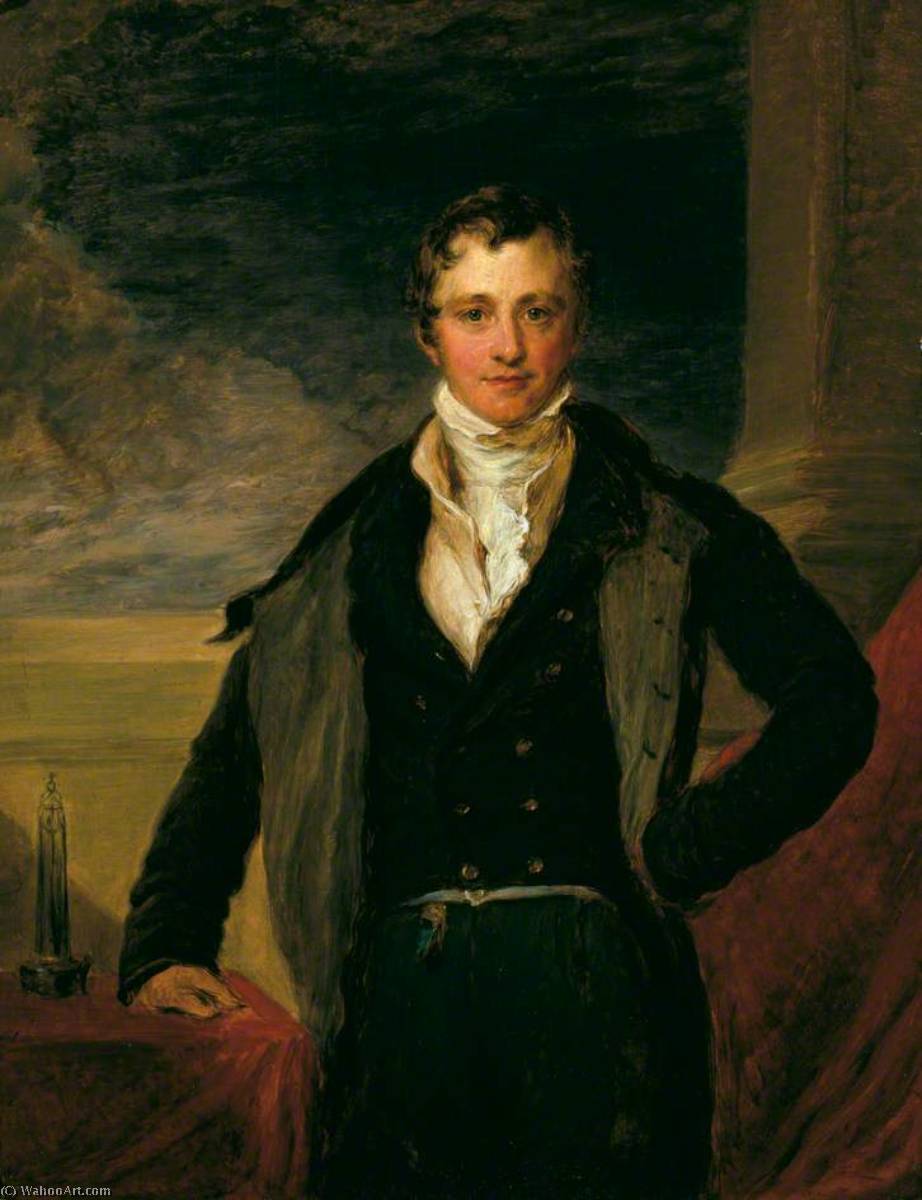
John Linnell’s masterful rendition of Sir Humphry Davy exemplifies Romantic British art. Influenced by luminaries like Leonardo da Vinci and Vincent van Gogh (ArtsDot.com), Linnell skillfully portrays Davy in a formal suit against a crimson curtain backdrop, mirroring the style of Sir Thomas Lawrence – a celebrated Regency portraitist known for capturing aristocratic elegance. This artwo
A Portrait of Scientific Distinction: John Linnell’s Reverie After Sir Thomas Lawrence
John Linnell's masterful depiction of Sir Humphry Davy stands as a testament to the Romantic spirit’s fascination with intellect and observation. Executed in 1837, this striking copy after Sir Thomas Lawrence transcends mere likeness; it embodies an atmosphere of thoughtful contemplation—a characteristic hallmark of Lawrence’s oeuvre and deeply rooted in the artistic currents of Regency England.
- Subject Matter: The portrait captures Davy, a pivotal figure in scientific advancement, poised with quiet confidence. His attire – a meticulously crafted suit and tie – speaks to his social standing and underscores the importance placed upon professionalism during this era.
- Style & Technique: Linnell skillfully employs Lawrence’s signature style, prioritizing tonal gradation and subtle modeling to imbue the figure with palpable presence. The artist's meticulous attention to detail is evident in the rendering of Davy’s facial features and clothing textures, mirroring Lawrence’s celebrated ability to convey psychological depth through visual representation.
- Historical Context: This artwork emerged during a period marked by burgeoning scientific inquiry and societal ambition. Davy’s groundbreaking experiments with electricity – isolating elements like potassium and sodium – propelled him to international acclaim and fueled the intellectual fervor of his time. Lawrence's portraits served as emblems of power and prestige, documenting the lives of influential statesmen and aristocrats.
Lawrence’s Legacy: Mastering Psychological Portraiture
Sir Thomas Lawrence was arguably the most celebrated portrait painter of his generation, renowned for his ability to capture not just physical appearance but also inner character. His canvases are imbued with a palpable sense of emotion and psychological nuance—a feat achieved through masterful use of chiaroscuro (the dramatic interplay of light and shadow), which Lawrence perfected as a technique.
- Chiaroscuro Technique: Lawrence’s distinctive approach involved carefully manipulating light to sculpt the form of his subjects, creating depth and dimensionality that conveyed mood and personality. This technique—a cornerstone of Baroque art—allowed him to illuminate key features while concealing others, fostering a captivating visual narrative.
- Symbolism & Atmosphere: The inclusion of a crimson curtain serves as an elegant backdrop, subtly enhancing the portrait’s grandeur and reinforcing its association with aristocratic refinement. It contributes to an overall atmosphere of dignified repose, mirroring Davy's contemplative gaze and reflecting Lawrence’s artistic vision.
Beyond Replication: Exploring Linnell’s Artistic Vision
While Linnell undertook this commission as a faithful copy after Lawrence, he nevertheless infused the artwork with his own distinctive aesthetic sensibilities. His stylistic choices demonstrate an understanding of Lawrence's influence and a commitment to conveying similar qualities of intellect and serenity—a reflection of the Romantic movement’s preoccupation with sublime beauty and profound contemplation.
- Romantic Influence: Linnell’s work aligns seamlessly with the Romantic aesthetic, prioritizing expressive color palettes and evocative landscapes. This stylistic inclination underscores the broader artistic landscape of the period, where artists sought to capture the grandeur of nature alongside explorations of human emotion.
- Emotional Impact: Ultimately, Linnell's portrait succeeds in conveying Davy’s intellectual prowess and inner composure—a testament to Lawrence’s enduring legacy as a painter who captured not merely likeness but also the essence of his subjects’ souls.