The Enigmatic Gaze: John Maler Collier’s William Kingdon Clifford
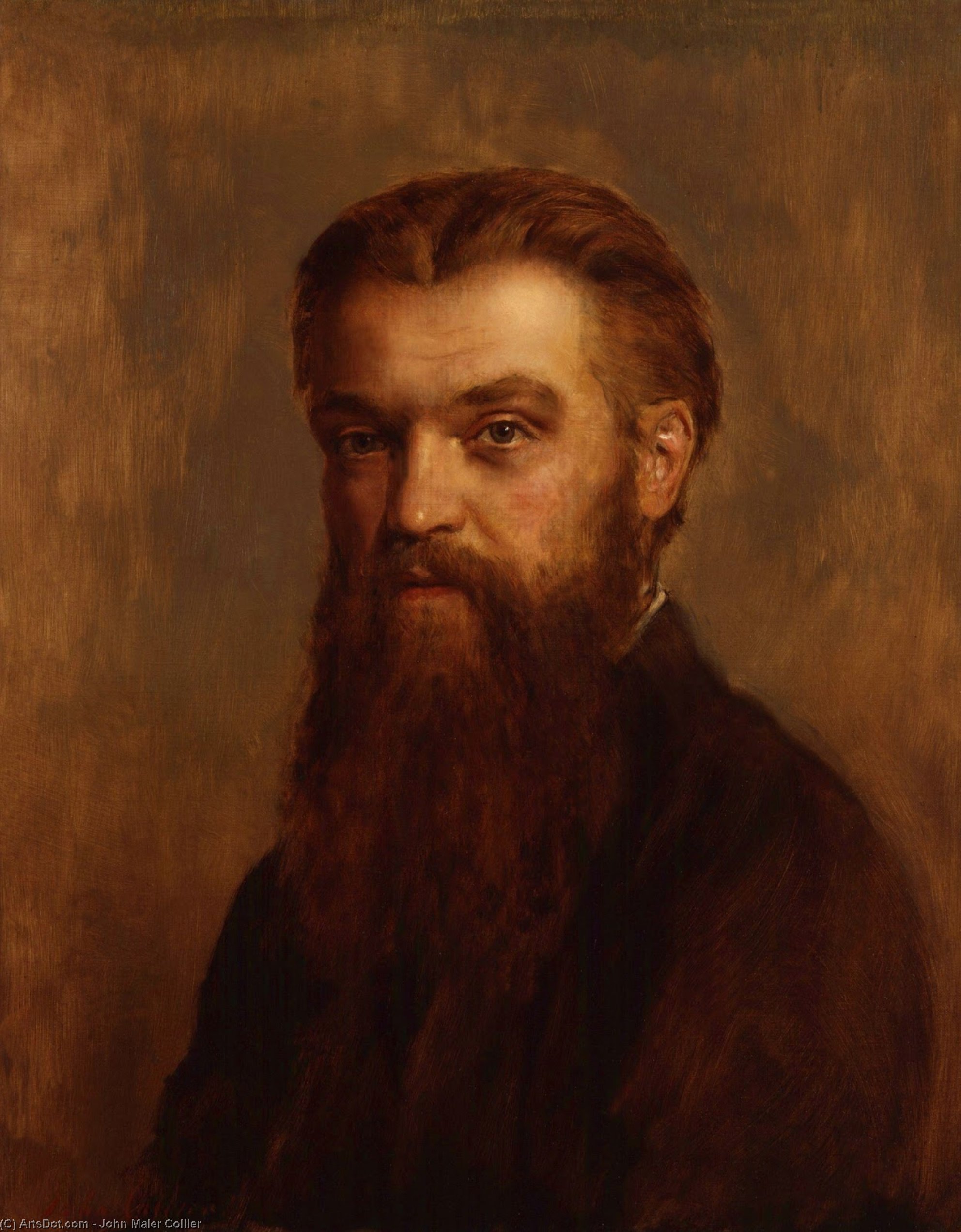
John Maler Collier's 1899 portrait of William Kingdon Clifford isn’t merely a likeness; it’s a carefully constructed embodiment of Victorian intellectualism, rendered with the meticulous detail and evocative storytelling characteristic of the Pre-Raphaelite movement. Collier, a master of capturing the essence of his subjects – as evidenced by his equally compelling portraits of Sir Michael Foster and Sir Ignatius Valentine Chirol – has here created an image that transcends simple representation, offering a glimpse into the mind of a mathematician and philosopher grappling with profound concepts.
The painting immediately draws the eye to Clifford’s face. His expression is one of quiet contemplation, his brow furrowed slightly as if lost in thought, yet his gaze holds a directness that invites engagement. The subtle lines etched around his eyes and mouth speak volumes about a life dedicated to rigorous study and intellectual pursuit. Collier's skill lies not just in capturing physical features but in conveying the inner world of his subject – a feat achieved through masterful use of light and shadow, and a remarkably sensitive understanding of human psychology.
- Color Palette: The muted tones—a symphony of browns, greys, and ochres—lend an air of gravitas and seriousness to the portrait. Collier eschews bright, vibrant colors in favor of a palette that reflects the subject’s intellectual pursuits, suggesting a focus on abstract thought rather than worldly concerns.
- Composition: The arrangement is deliberately restrained, emphasizing Clifford's figure within a simple, uncluttered background. This simplicity allows the viewer to concentrate fully on the subject and his expression.
- Technique: Collier’s brushwork is remarkably smooth and controlled, indicative of his meticulous approach to portraiture. He employs layering techniques to create depth and texture, particularly in Clifford's clothing and facial features.
The Pre-Raphaelite Influence & Victorian Portraiture
Collier’s work is firmly rooted in the Pre-Raphaelite aesthetic – a movement that sought to revive the artistic conventions of 15th-century Italian art, rejecting the perceived artificiality and materialism of academic painting. The Pre-Raphaelites valued truth, beauty, and moral purpose, often drawing inspiration from literature, mythology, and medieval legends. Collier’s portraits are characterized by their rich detail, vibrant colors (though subtly employed here), and a tendency to imbue his subjects with symbolic meaning.
This portrait also reflects the broader trends in Victorian-era portraiture. During this period, portrait painting became increasingly popular among the wealthy and influential, serving as both a means of commemorating individuals and displaying social status. Collier’s work exemplifies this trend, capturing the intellectual prestige associated with figures like Clifford, who were prominent in academic circles.
Symbolism & Intellectual Depth
Beyond its surface appearance, the portrait is laden with symbolic significance. Clifford's spectacles – a ubiquitous symbol of intellect and scholarly pursuit – immediately establish his profession and suggest a life dedicated to reason and observation. The carefully chosen attire—a dark suit and tie—underscores his status as a respected member of Victorian society. The subtle lighting highlights his face, drawing attention to the intensity of his gaze and hinting at the complex thoughts swirling within his mind.
Furthermore, Clifford’s subject matter – mathematics and philosophy – speaks to the intellectual ferment of the late 19th century, a period marked by rapid scientific advancements and philosophical debates. Collier's portrait captures this spirit of inquiry and intellectual exploration, offering a visual representation of a mind grappling with fundamental questions about the nature of reality.
Replicas & A Window into Victorian Thought
Reproductions of Collier’s “William Kingdon Clifford” offer art lovers a unique opportunity to connect with this remarkable portrait and gain insight into the intellectual landscape of the Victorian era. The painting serves as a powerful reminder of the enduring legacy of Pre-Raphaelite art and its ability to capture not only physical likenesses but also the essence of human character and intellect. High-quality reproductions, like those available on ArtsDot.com, allow us to appreciate Collier’s masterful technique and the profound symbolism embedded within this iconic portrait.