A Moment Frozen in Time: John Ottis Adams’s “Hanging Moss, St. Petersburg”
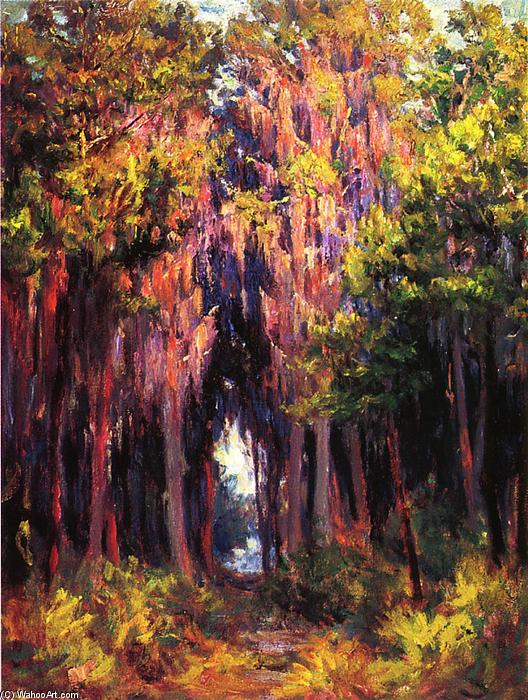
John Ottis Adams's "Hanging Moss, St. Petersburg," painted in 1914, isn’t merely a depiction of a forest; it’s an invitation to step into a realm of profound serenity and quiet contemplation. This oil on canvas masterpiece transcends the boundaries of landscape painting, offering a glimpse into the artist’s deeply personal vision of nature's restorative power. Adams, a key figure within the Hoosier Group – a collective of Midwestern artists dedicated to capturing the essence of American landscapes – eschewed grand narratives in favor of subtle observations and an intimate connection with his subject matter. “Hanging Moss” exemplifies this approach, prioritizing atmosphere and light over dramatic composition or overt detail.
The scene unfolds within a dense, ancient forest, likely situated near St. Petersburg, Florida—a location that subtly informs the painting’s mood. Towering trees, their branches laden with verdant moss, dominate the frame, creating a sense of both enclosure and openness. The artist masterfully employs a muted color palette – predominantly greens, browns, and ochres – to evoke the cool, damp atmosphere of a shaded woodland. Adams's brushstrokes are loose and expressive, suggesting movement and texture rather than precise representation. This technique contributes significantly to the painting’s overall feeling of tranquility, as if time itself has slowed within its borders.
The Influence of Luminism and the Hoosier Group
“Hanging Moss” is deeply rooted in the principles of Luminism, a style that emerged in the mid-19th century emphasizing the effects of light and atmosphere. Adams, along with his fellow Hoosiers, embraced this philosophy, rejecting the academic traditions of their time and focusing on capturing the fleeting qualities of natural light. The painting’s diffused light filtering through the canopy, casting dappled shadows on the forest floor, is a testament to this influence. It's reminiscent of the works of Frederic Church and Albert Bierstadt, though Adams imbues his landscape with a distinctly quieter, more introspective quality.
Furthermore, the painting reflects the Hoosier Group’s commitment to portraying the beauty of the American Midwest. The subject matter—a familiar forest scene—was elevated through Adams's sensitive observation and artistic skill. The group sought to establish a uniquely American style of landscape painting, distinct from European traditions, and “Hanging Moss” stands as a prime example of this ambition.
Symbolism and the Essence of Nature
The hanging moss itself is laden with symbolic weight. In nature, it represents resilience, longevity, and the interconnectedness of life. It clings to trees for centuries, silently witnessing the passage of time. Within the painting, this detail suggests a timeless quality—a sense that the forest exists outside the constraints of human concerns. The muted colors and soft light further reinforce this feeling of serenity and connection to something larger than oneself.
Adams’s choice to depict a relatively unremarkable scene – a moss-covered tree – is deliberate. He wasn't interested in grand vistas or heroic landscapes; instead, he sought to capture the quiet beauty of everyday life, inviting viewers to find solace and inspiration within its simplicity. The painting speaks to a fundamental human desire for connection with nature—a longing for peace and tranquility amidst the complexities of modern existence.
A Legacy of Quiet Beauty
“Hanging Moss, St. Petersburg” is now housed at the Indianapolis Museum of Art in Indiana, a testament to its enduring appeal. Reproductions of this captivating artwork offer a chance to bring a touch of Adams’s serene vision into any space. Whether displayed as a large-scale canvas or a smaller print, it serves as a constant reminder of nature's restorative power and the beauty that can be found in quiet contemplation. It is more than just a painting; it’s an invitation to slow down, breathe deeply, and appreciate the subtle wonders of the natural world.