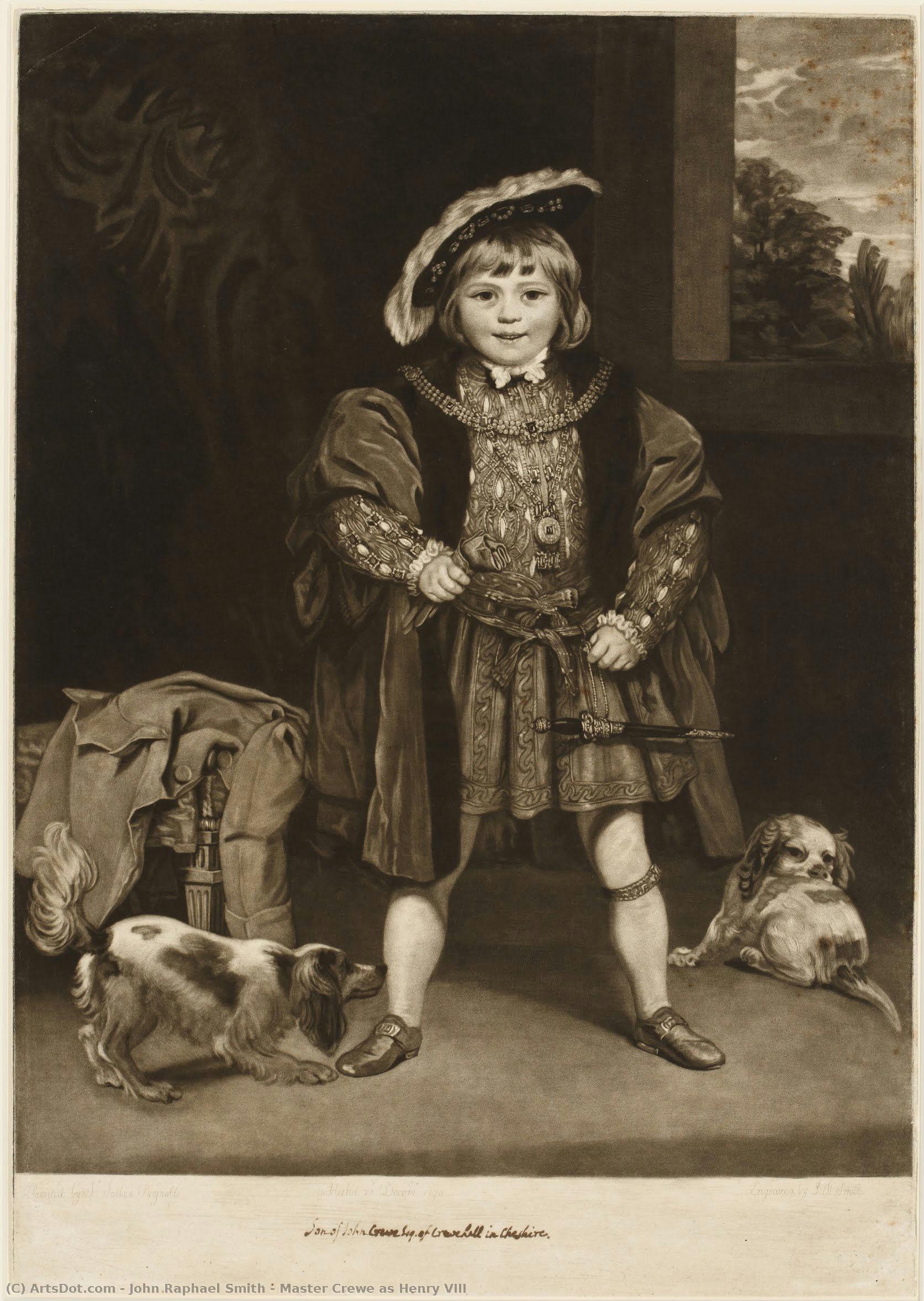
A Portrait Steeped in Tudor Majesty: John Raphael Smith’s Master Crewe as Henry VIII
This exquisite mezzotint by John Raphael Smith, published in 1776, transcends mere visual representation; it's a masterful distillation of artistic ambition and historical fascination. The print captures the youthful visage of John Crewe II, son of Baron Crewe, posed with striking dignity against a subtly rendered landscape backdrop—a deliberate echo of Hans Holbein the Younger’s iconic portrait of Henry VIII, cementing Smith’s commitment to elevating his subject beyond the commonplace. More than just an image, it's a carefully constructed dialogue between past and present, reflecting the prevailing aesthetic sensibilities of Georgian England.
- The Inspiration: Holbein’s Legacy
- Smith’s Technique: Precision and Texture
- Symbolism Within Composition
- A Window into Georgian Society
The Inspiration: Holbein’s Legacy
Smith's decision to emulate Holbein’s monumental portrait of Henry VIII speaks volumes about the artistic climate of the time. Holbein’s depiction of the Tudor monarch—powerful, regal, and imbued with symbolic significance—established a benchmark for portraiture, prioritizing grandeur and conveying psychological depth. Smith recognized this influence and skillfully adapted it to his subject, subtly mirroring Henry VIII's posture and gaze within Crewe’s youthful frame. This conscious homage underscores the importance of artistic tradition and demonstrates Smith’s erudition as an artist deeply attuned to the cultural currents shaping his era. The landscape serves not merely as a decorative element but as a grounding force, anchoring Crewe’s figure against a backdrop that embodies stability and authority—a deliberate contrast to the turbulent political landscape of the time.
Smith’s Technique: Precision and Texture
Smith's mastery lies in his meticulous application of mezzotint engraving technique. Unlike oil painting, which relies on pigment and brushstrokes, mezzotint employs a complex process involving acid etching onto metal plates—a method celebrated for its ability to achieve astonishing tonal range and textural detail. The artist’s skillful manipulation of burin tools creates intricate lines and hatching patterns that build up the image's form and volume with remarkable accuracy. Observe the subtle gradations of light and shadow, achieved through careful layering of tones – a testament to Smith’s technical prowess and his dedication to capturing the essence of his subject. The resulting print possesses an unparalleled luminosity and depth, qualities unattainable by other mediums.
Symbolism Within Composition
Beyond its formal beauty, “Master Crewe as Henry VIII” is laden with symbolic resonance. The boy's posture—legs apart, hands on hips—mirrors Henry VIII’s commanding stance, conveying confidence and self-assurance. Simultaneously, the inclusion of two spaniels symbolizes loyalty and companionship – virtues valued in Georgian society and subtly mirroring the familial bonds represented by Crewe’s lineage. Furthermore, the distant landscape serves as a visual metaphor for stability and permanence, juxtaposed against the fleeting nature of youth and beauty. These carefully considered elements elevate the portrait beyond mere likeness, transforming it into a statement about character and social standing.
A Window Into Georgian Society
Finally, this print offers a glimpse into the broader cultural context of Georgian England—a period characterized by aristocratic patronage, elaborate ornamentation, and an obsession with portraying idealized figures. The commission itself reflects the prevailing trend toward commissioning portraits that celebrated noble lineage and reinforced social hierarchies. Smith’s work exemplifies the artistic conventions of his time, demonstrating how art served as a vehicle for conveying prestige and reinforcing societal values. Its enduring appeal lies in its ability to transport viewers back to a bygone era—a testament to Smith's skill as an artist and his contribution to the visual culture of Georgian Britain.