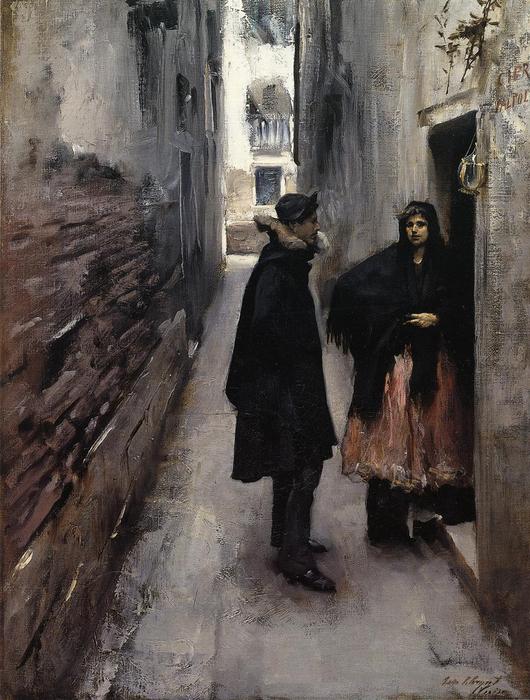
Experience John Singer Sargent’s evocative impressionistic masterpiece, "A Street in Venice," capturing a timeless moment of quiet conversation within a grayscale Venetian scene. This 1882 artwork showcases the artist's masterful use of light and texture, inviting you to own a piece of art history.
A Moment Frozen in Venetian Gray
John Singer Sargent’s “A Street in Venice,” painted in 1882, isn't merely a depiction of a canal-side scene; it’s a carefully constructed evocation of atmosphere and mood. This monochromatic masterpiece transports the viewer to the heart of Venice, capturing a fleeting intimacy within the bustling yet strangely quiet streets of the late nineteenth century. The painting’s power lies not in precise detail – Sargent deliberately eschews sharp focus, favoring instead an impressionistic approach that prioritizes the play of light and shadow, creating a palpable sense of place. The scene unfolds with two figures engaged in conversation on a narrow sidewalk, their presence adding a poignant layer to the already evocative setting.
- Composition & Perspective: The vertically oriented canvas immediately draws the eye upwards, mirroring the towering buildings that line the street. Sargent masterfully employs linear perspective, guiding the viewer’s gaze along the receding lines of the street towards a distant vanishing point – a technique that enhances the illusion of depth and creates a strong sense of spatial realism despite the limited color palette. The slightly off-center placement of the figures adds to the painting's dynamic quality, inviting contemplation.
- Technique & Materials: Sargent’s skill is evident in his layering of thin washes of oil paint, building up tone and texture with remarkable subtlety. Visible brushstrokes contribute significantly to the work’s tactile quality, particularly noticeable in the rendering of the rough stone facades and the folds of the figures' coats. This technique allows for a luminous effect, capturing the diffused light characteristic of Venetian mornings.
The Language of Gray: Color & Symbolism
The deliberate choice of a grayscale palette is central to “A Street in Venice’s” impact. Sargent abandons vibrant hues, opting instead for a spectrum of grays and browns that evoke a sense of nostalgia and timelessness. This monochromatic approach wasn't simply a stylistic preference; it was a conscious decision to emphasize form, texture, and the interplay of light and shadow. The subtle shifts in tone – from the darkest shadows clinging to the building corners to the lighter washes illuminating the figures’ faces – create a dramatic effect, intensifying the emotional resonance of the scene.
- Mood & Atmosphere: The subdued color palette contributes significantly to the painting's somber mood. It suggests a quiet contemplation, inviting viewers to reflect on the passage of time and the ephemeral nature of human experience.
- Symbolic Resonance: Some art historians interpret the monochromatic scheme as a symbolic representation of memory or perhaps even a longing for lost beauty – a common theme in Sargent’s work. The gray tones could also be seen as reflecting the muted, melancholic atmosphere often associated with Venice itself.
A Glimpse into Venetian Life & Artistic Context
Painted during a period of immense artistic innovation, “A Street in Venice” reflects the burgeoning influence of Impressionism while retaining Sargent’s distinctive style. Born in Florence to American expatriate parents, Sargent's upbringing was uniquely shaped by his family’s nomadic existence across Europe. This exposure to diverse cultures and artistic traditions profoundly influenced his work, fostering a cosmopolitan sensibility that is evident in his ability to capture the essence of different environments with remarkable sensitivity. Sargent’s focus on capturing fleeting moments – like this intimate scene in Venice – aligns perfectly with the Impressionist movement's emphasis on portraying the effects of light and atmosphere.
- Historical Context: The painting was created during the Gilded Age, a period of immense wealth and social change in Europe and America. Sargent’s portraits and scenes like this one offer a glimpse into the lives of the wealthy elite who flocked to Venice seeking beauty, inspiration, and escape.
- Artist's Vision: Sargent wasn't simply documenting a street scene; he was striving to capture a feeling – the quiet dignity, the subtle melancholy, and the inherent beauty of Venetian life.
Dimensions & Acquisition
This hand-painted reproduction faithfully captures the essence of Sargent’s original “A Street in Venice.” Measuring 45 x 54 cm (17.72 x 21.26 inches), this artwork is ideally suited for a variety of interior spaces, from formal living rooms to contemporary studios. It's a timeless piece that will undoubtedly become a focal point within your home or office.