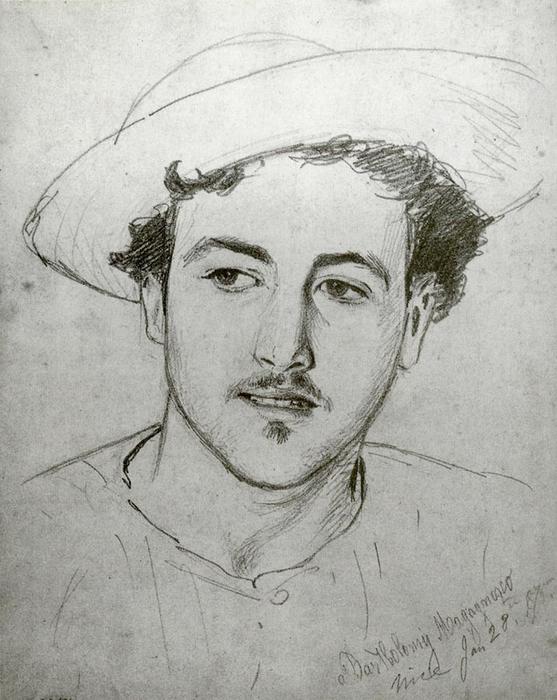
A Study in Graphite: Capturing Dignity Amidst Fleeting Light
The artwork presented here is John Singer Sargent’s “Bartholomy Magagnosco,” a deceptively simple pencil sketch that speaks volumes about the artist's meticulous observation and masterful command of tonal shading. Executed in 1875, this piece transcends mere likeness; it embodies the spirit of Impressionism filtered through Sargent’s distinctly refined aesthetic sensibilities. The drawing depicts a gentleman’s portrait—a figure rendered with remarkable accuracy against a muted monochrome palette—suggesting an artist's preliminary exploration rather than a polished final product.
- Subject Matter: The central focus is undeniably the subject’s face and upper torso, framed by a wide-brimmed hat that casts a subtle shadow across his forehead. This deliberate positioning emphasizes the importance of facial expression and contributes to the overall sense of contemplative stillness.
- Style & Technique: Sargent's approach aligns closely with Impressionism, prioritizing capturing fleeting moments of light and atmosphere over detailed representation. However, unlike many Impressionists who favored plein air painting, this sketch demonstrates a studio practice—a careful consideration of form and texture achieved through painstaking manual application of graphite pencil on paper.
- Composition & Perspective: Lines dominate the composition, skillfully delineating musculature and contours with hatching and cross-hatching techniques. While perspective is present – subtly hinting at depth – it’s understated, prioritizing tonal gradation over geometric precision.
Historical Context: The Gilded Age Portraiture Tradition
“Bartholomy Magagnosco” resides firmly within the context of late Victorian and Edwardian portraiture—a period characterized by opulent social gatherings and a fervent desire to commemorate individuals of distinction. Sargent’s work reflects this cultural preoccupation with documenting status and identity, aligning with the prevailing artistic conventions of his time. The meticulous rendering of detail speaks to the importance placed on capturing not just physical appearance but also conveying character and dignity – qualities highly valued within aristocratic society.
Symbolism & Emotional Resonance: Beyond Mere Likeness
Despite its apparent simplicity, “Bartholomy Magagnosco” possesses a subtle emotional depth. The artist’s deliberate use of shading—particularly the layering of hatching to build up tonal values—creates an illusion of volume and texture that invites contemplation. More than just a portrait, it's a testament to Sargent’s ability to distill complex psychological states into visual form. The quiet gaze of Magagnosco conveys composure and thoughtfulness, hinting at inner life beyond what is immediately visible.
Material & Craftsmanship: A Legacy of Pencil Drawing
The artwork itself—a graphite pencil sketch on paper—is a testament to Sargent’s dedication to traditional artistic methods. The rough, grainy surface reflects the tactile nature of his process and underscores the artist's commitment to capturing light and form with unwavering precision. Its enduring appeal lies in its understated elegance and its ability to evoke a profound sense of stillness – qualities that continue to resonate with viewers today.