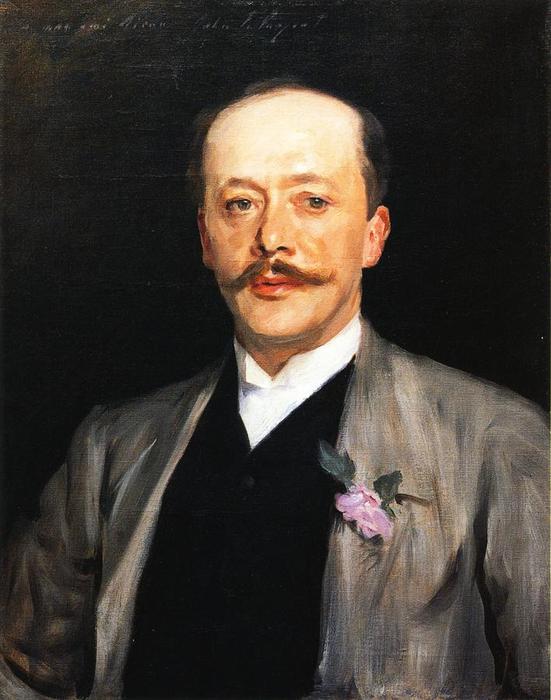
Charles Alexander Giron by John Singer Sargent is a captivating portrait embodying Realism's meticulous detail and luminous color palette. Capturing the confident gaze of Charles Alexander Giron amidst an elegant setting, this 1884 masterpiece showcases Sargent’s mastery of light and form.
Explore the art of John Singer Sargent! Discover iconic portraits like 'Madame X', Impressionistic landscapes & Gilded Age elegance from this American master.
Charles Alexander Giron: A Portrait of Confidence Reflected in Sargent’s Realist Vision
John Singer Sargent's depiction of Charles Alexander Giron stands as a quintessential achievement of Realism, capturing not merely likeness but also the very essence of aristocratic composure. Painted in 1884, this oil on canvas – measuring precisely 64 x 50 cm – resides within the Musée d’Orsay and continues to fascinate viewers with its masterful execution and subtle psychological depth. Sargent's reputation rested firmly upon his portraits of society’s elite, and Giron exemplifies his signature style: an unwavering commitment to capturing the subject’s physicality and demeanor with breathtaking accuracy.
The painting immediately draws attention to Giron himself – a gentleman dressed impeccably in a dark suit and tie, punctuated by a prominent mustache that speaks volumes about Victorian sensibilities. Sargent skillfully renders the textures of fabric, conveying the weight and drape of his attire with meticulous brushstrokes. The artist’s gaze is directed outwards, projecting an aura of self-assuredness and intellectual curiosity – qualities that resonate powerfully across time. This outward focus isn't merely observational; it suggests a man actively engaged in navigating the complexities of social interaction, embodying the ideal of masculine grace.
Beyond the portraiture itself lies Sargent’s masterful technique. He employs a layering approach, applying thin glazes over thicker underpaintings to achieve remarkable luminosity and tonal gradation. This method allows him to capture subtle nuances of light and shadow, creating an illusionistic space that envelops Giron within its frame. The artist's brushwork is characterized by fluidity and spontaneity, yet underpinned by rigorous anatomical precision – a testament to his unwavering dedication to mastering the human form. Notice particularly how Sargent captures the musculature beneath Giron’s skin, conveying not just physical presence but also an underlying sense of strength and vitality.
The inclusion of a potted plant in the background serves as more than mere decorative embellishment; it operates symbolically as a counterpoint to Giron's formal attire. Plants represent growth, renewal, and connection to nature – concepts that subtly underscore the broader humanist values championed by Sargent’s era. The verdant foliage provides visual respite from the rigidity of the suit, suggesting an inner harmony between intellect and emotion. Furthermore, it reinforces the painting’s setting within a bourgeois home—a space designed for contemplation and refinement.
Ultimately, Charles Alexander Giron transcends mere representation; it embodies the spirit of its time – a period defined by aristocratic ambition, artistic innovation, and a profound appreciation for beauty. Sargent's unwavering pursuit of realism ensures that Giron remains not just an image but an experience—one that invites viewers to contemplate notions of identity, confidence, and the enduring power of art to illuminate the human condition. Its place within the Musée d’Orsay guarantees its continued legacy as one of the most compelling portraits of the Belle Époque.