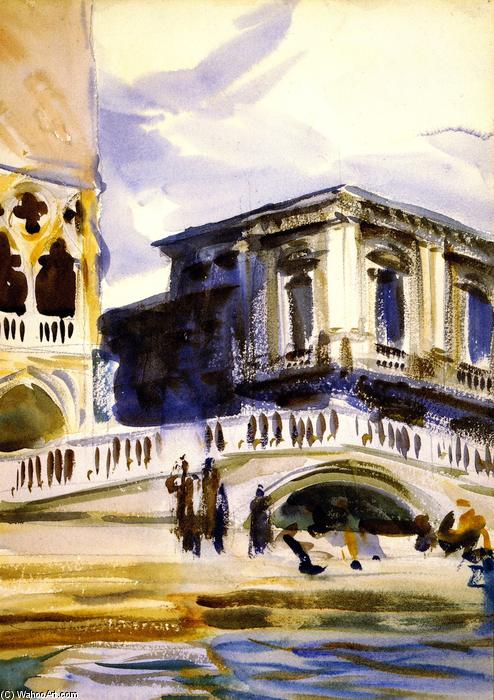
Doge's Palace and Prison

John Singer Sargent’s luminous watercolor captures the serene grandeur of Venice's Doge's Palace, showcasing intricate architectural details and tranquil Venetian life during the early 20th century – explore exquisite reproductions and bring timeless beauty into your home.


John Singer Sargent (1856 - 1925)

Explore the art of John Singer Sargent! Discover iconic portraits like 'Madame X', Impressionistic landscapes & Gilded Age elegance from this American master.

A Venetian Reverie Captured in Watercolor

  • Subject Matter: Sargent’s “Doge’s Palace and Prison” transports viewers back to Venice in 1903, capturing a quintessential image of the city's grandeur. The painting focuses on the iconic Doge’s Palace—the seat of Venetian power for centuries—alongside its adjoining prison complex. This juxtaposition speaks volumes about the history of Venice itself: a tale of opulent wealth intertwined with inescapable confinement.
  • Style and Technique: Executed in watercolor, Sargent's masterful technique exemplifies Impressionistic principles. Rather than striving for photographic realism, he prioritized capturing fleeting moments of light and atmosphere. Delicate washes of color blend seamlessly to create an ethereal quality, emphasizing the translucence of the medium and lending a sense of immediacy to the scene.
    • Color Palette: Sargent employs a muted palette dominated by blues and greens—reflecting the Venetian lagoon and the surrounding landscape—with subtle hints of ochre and terracotta adding warmth. These colors are skillfully layered to convey depth and luminosity, capturing the nuances of sunlight filtering through the palace windows.
    • Brushwork: The artist’s brushstrokes are loose and expressive, conveying movement and texture without resorting to meticulous detail. Sargent favored a technique known as “wet-on-wet,” allowing him to blend colors effortlessly and achieve an atmospheric effect that is characteristic of Impressionism.
  • Historical Context: Painted during Sargent’s European sojourn, the artwork reflects the artistic fervor of the Belle Époque. Venice was experiencing a revival as a cultural center after decades of decline, attracting artists and intellectuals from across Europe. The Doge's Palace itself served as a symbol of Venetian resilience and tradition—a reminder of its glorious past despite facing challenges in the modern era.
  • Symbolism: Beyond its depiction of architectural splendor, “Doge’s Palace and Prison” carries symbolic weight. The palace represents authority and prestige, while the prison underscores the darker side of Venetian history – a stark contrast that invites contemplation on themes of power, justice, and human experience.
  • Emotional Impact: Sargent's watercolor captures not merely what he sees but also how he feels about it—a profound appreciation for beauty amidst complexity. The tranquil atmosphere conveyed by the painting evokes a sense of serenity and nostalgia, transporting viewers to a bygone era and prompting reflection on the enduring legacy of Venetian art and culture.