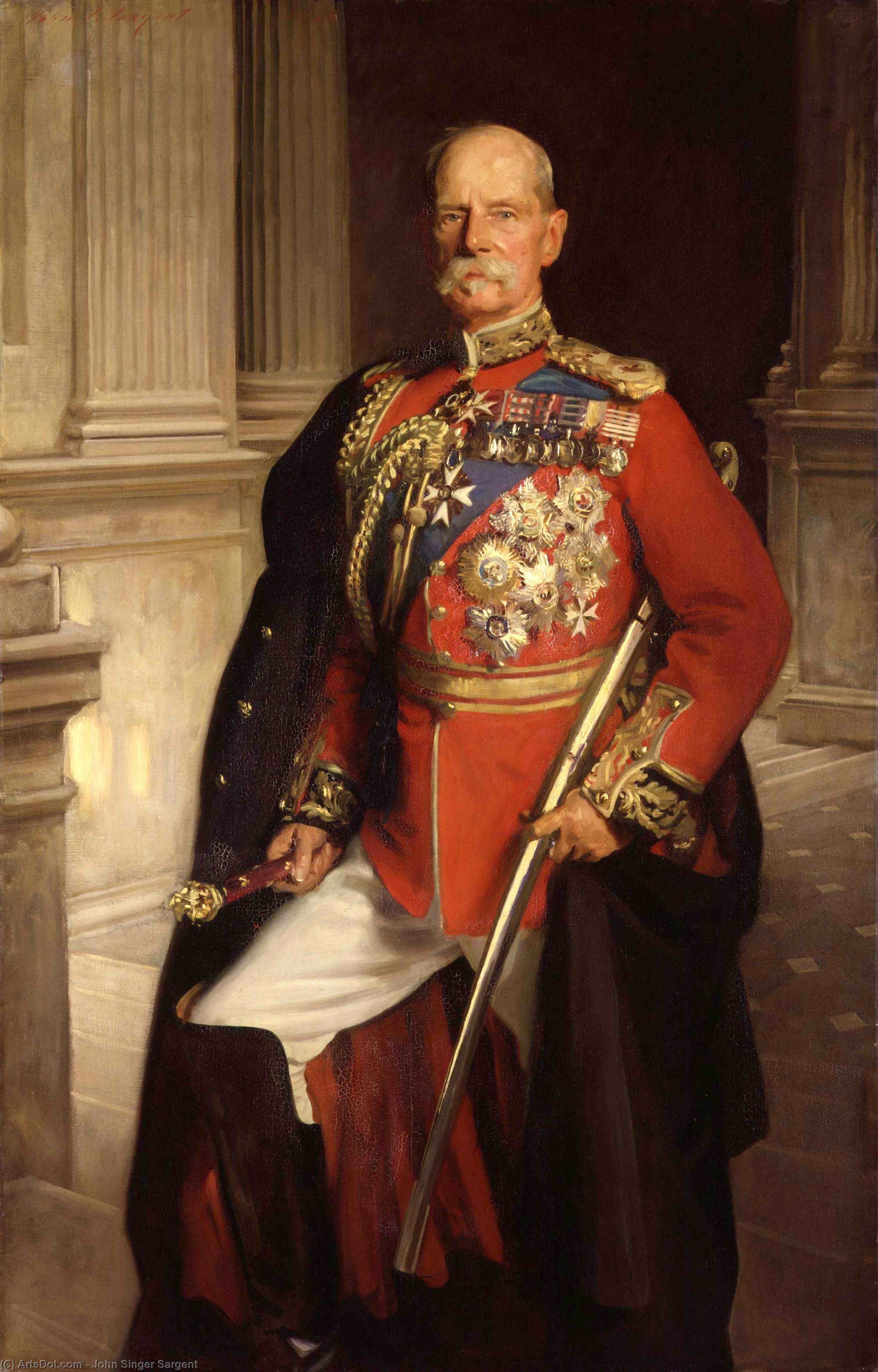
Captured in striking black and white photography by John Singer Sargent, this portrait depicts Frederick Sleigh Roberts, 1st Earl Roberts—a commanding military figure embodying the grandeur of the Edwardian era—standing confidently on stairs amidst a formal setting.
A Portrait of Command: The Dignity of an Era
In the quiet, commanding presence of John Singer Sargent’s 1906 portrait of Frederick Sleigh Roberts, 1st Earl Roberts, we encounter more than a mere likeness; we witness the very soul of Victorian authority. This striking work, captured through the lens of Sargent's masterful eye, presents a figure that transcends time. As Roberts stands poised upon a staircase, there is an unmistakable sense of movement held in check by profound composure. The composition invites the viewer to ascend with him, creating a psychological tension between the physical act of climbing and the static, monumental weight of his character. It is a piece that does not merely sit upon a wall but commands the space it inhabti, making it an unparalleled choice for collectors who seek art that breathes with historical gravity.
The technical brilliance of this work lies in its sophisticated use of chiaroscuro. Even within the monochromatic depth of the photograph, Sargent employs a dramatic interplay of light and shadow to sculpt the Earl’s form. The light catches the textures of his military regalia—the heavy fabric of his scarlet coat, now rendered in rich, tonal gradients, and the glint of gold trim that speaks of high distinction. This mastery of contrast lends a three-dimensional vitality to the subject, imbuing the figure with a sculptural permanence. For the interior designer, this interplay of light offers a sophisticated focal point, capable of adding depth and a sense of architectural structure to any curated room.
Symbolism and the Spirit of the Gilded Age
Every element within this portrait serves as a silent narrator of Roberts’ illustrious life. The attire is not merely clothing but a lexicon of power; the gold-trimmed coat and the prominent sword at his side are potent symbols of his role as a pivotal military strategist during the Sudan Campaign and the Boer War. Even the subtle inclusion of a cane acts as a metaphor for the wisdom and seasoned experience gathered through decades of service to the Crown. These symbolic layers transform the portrait from a biographical record into a profound meditation on duty, honor, and the enduring legacy of British aristocratic lineage.
To possess a reproduction of this masterpiece is to invite the elegance of the Gilded Age into the modern home. It evokes an era defined by social ambition and a reverence for tradition—values that resonate deeply in contemporary spaces seeking a touch of timelessness. Whether placed in a formal study, a grand hallway, or a sophisticated living area, this portrait serves as a window into a world of prestige. It offers not just decoration, but an emotional connection to the concept of leadership and the quiet strength of a life lived with purpose.